
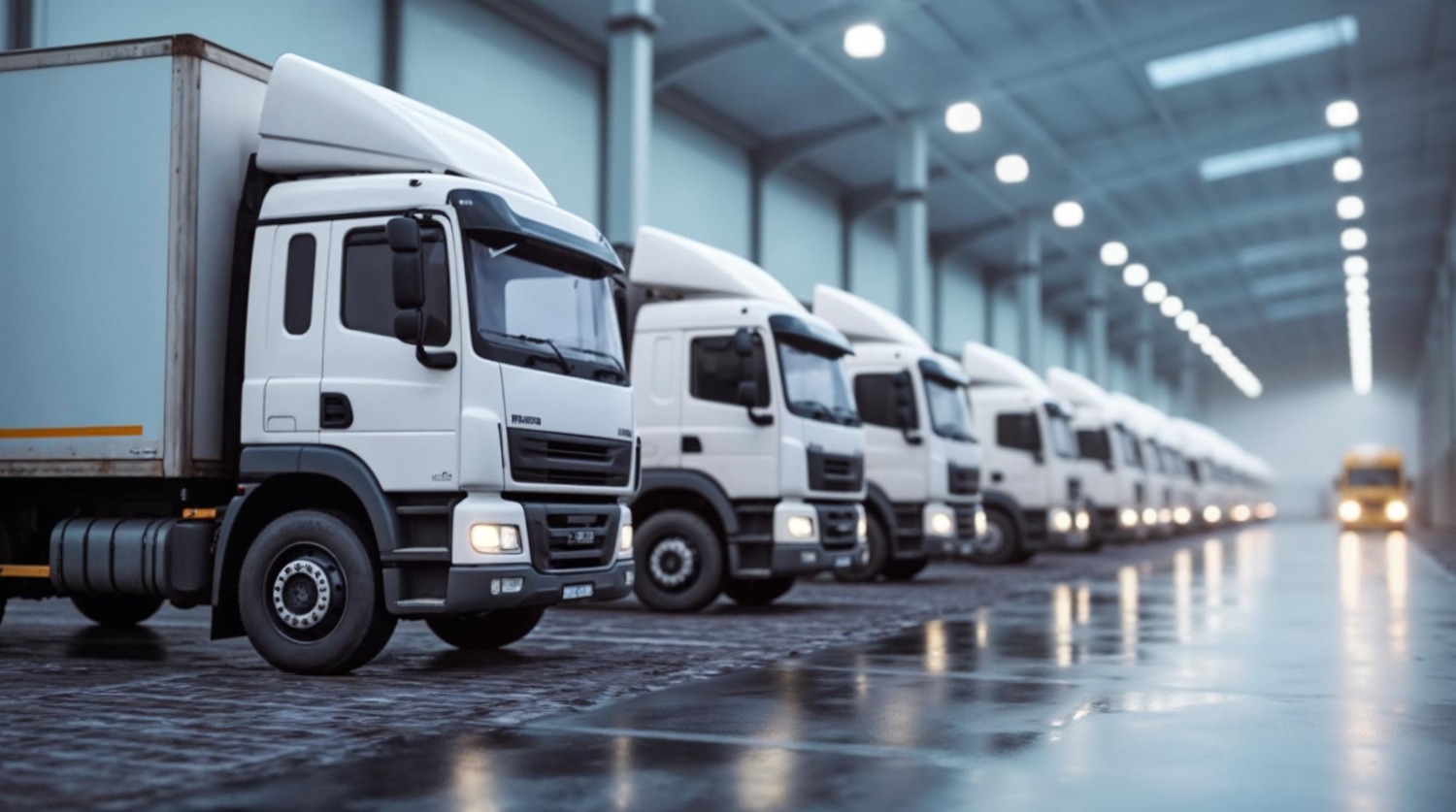
Road freight transport in Spain is experiencing countless contrasts in 2026. According to the forecasts of the International Road Transport Association (Astic), the sector will grow by 3% this year, driven by domestic demand, industrial activity, and consumption. An encouraging figure compared to the “very moderate” 0.9% of 2025, and one that positioned this year as a “hinge year” in which national traffic will gain prominence over international traffic. However, beneath this apparent boom lie structural cracks that threaten to turn optimism into a mirage.
Because the projected growth clashes head-on with an unforgiving demographic reality: the shortage of professional drivers. The sector carries a deficit that, according to the Spanish Confederation of Freight Transport (CETM), already exceeds 30,000 unfilled positions in Spain. And the problem, far from being resolved, is worsening. The average age of drivers exceeds 55 in more than half of cases, heralding a wave of massive retirements in the coming years.
As Filippo Welter, director of Eurowag Spain, warns, “the situation is very critical.” If not remedied, forecasts indicate that by 2028, up to 116,000 drivers could be missing in our country. A genuine act of self-sabotage for an activity that moves 96% of goods within the national territory.
Why don’t young people want to get behind the wheel of a truck? The reasons are multiple and complex. The profession has ceased to be attractive to new generations: endless hours, difficulties in balancing personal and family life, and a high training cost that can exceed €3,000. Added to this is that, despite competitive salaries, the proportion of young drivers in freight transport is residual, barely 6%, and female presence does not even reach 2%.
The Minister of Transport and the Secretary-General for Land Transport have promoted the Auto Plus Plan and aid such as the ‘Plan Reconduce’ for obtaining permits. But a line of half a million euros that barely benefits 160 people is, to say the least, insufficient to tackle a problem of this magnitude.
Added to this generational turnover crisis are other fronts that strain the sector’s profitability. Fuel, which represents more than a third of operating costs, has experienced a 30% increase in the European Union due to the conflict in the Middle East. Added to this are energy price volatility, increases in insurance, tolls, and maintenance, and the burdens derived from the climate policies of the Green New Deal and Fit-for-55.
The energy transition, although necessary, imposes additional costs that, for a fleet of 100 vehicles, could reach between €875,000 and €1.2 million annually with the introduction of ETS II. A scenario that, as Astic emphasises, occurs in a context of “high competition” and “increasingly tighter” profit margins.
2026 thus presents itself as a year of opportunities and urgencies. The 3% growth projected by Astic is a lifeline, but it must not hide the weaknesses of a sector that is strategic for the Spanish economy. Digitalisation, artificial intelligence for route optimisation, and business consolidation — with 62 merger and acquisition operations recorded in 2025 — are tools that can help improve efficiency. But without drivers, without a generational handover to keep the pulse of the road going, all this technological and financial scaffolding will rest on shifting sand. As the IRU warns, “the economy, social mobility, and Europe’s climate plan will grind to a halt without drivers.” The challenge is not just the sector’s; it is everyone’s.
Have any thoughts?
Share your reaction or leave a quick response — we’d love to hear what you think!
-
 0
0
-
 0
0
-
 0
0
-
 0
0
-
 0
0
