
In the last decade, the world has tightened its anti-smoking laws with unprecedented severity. Driven by the WHO Framework Convention on Tobacco Control, 79 countries have implemented 100% smoke‑free environments that already cover a third of the global population. What began as a ban in offices and bars has extended to terraces, beaches, parks, bus stops and outdoor spaces frequented by children. Cities like Milan have gone as far as banning cigarettes on streets and squares, while nations such as the Maldives apply generational bans that prevent those born from 2007 onwards from buying tobacco. The guideline is clear: there is no safe level of exposure to second-hand smoke, and protecting non-smokers has become an almost indisputable health principle.
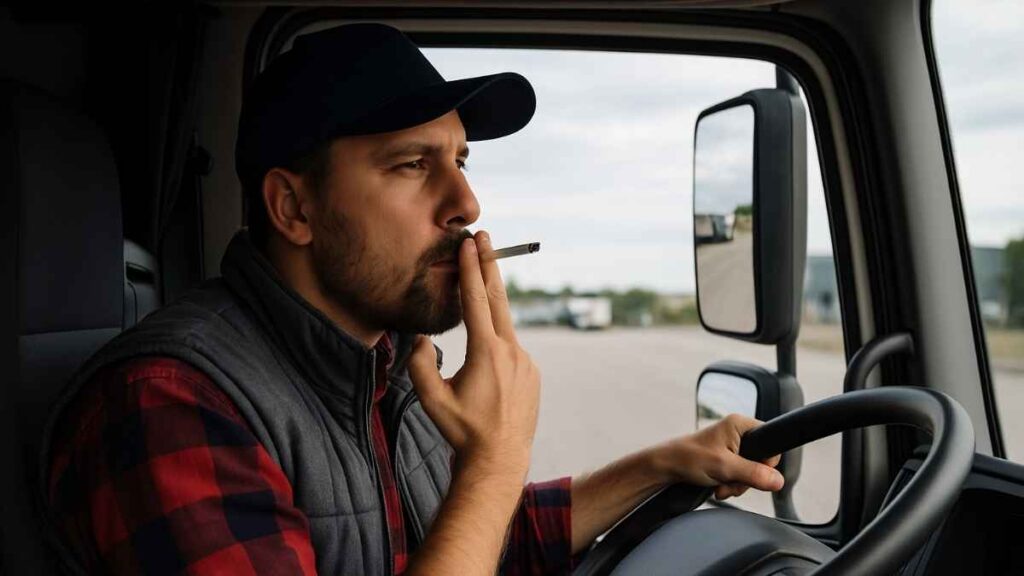
The truck, that disputed territory. But this restrictive wave has hit an unexpected obstacle: the truck cab. In Spain, the anti‑tobacco draft bill presented in 2025 equates commercial vehicles to workplaces and prohibits smoking inside them, including trucks and vans, even when the driver is travelling alone. The measure would affect more than 360,000 hauliers and has unleashed a storm in the sector. The transport associations — Fenadismer and CETM — describe the rule as “disproportionate, inadequate and discriminatory”, arguing that it creates unequal treatment between the professional travelling alone in his cab and the private individual who can smoke in his car with passengers. The government, for its part, maintains that allowing smoking in trucks would be incompatible with the occupational health protection principles applied in other sectors.
The loneliness of the road and the price of abstinence. To understand the scale of the conflict, one must look inside the cab: an average of over seven hours a day behind the wheel, up to four and a half consecutive hours of driving, and days spent in absolute solitude. In that space, the truck is not merely a tool: it is the office, the refuge and, for many, the only companion for days on end. Drivers turn to tobacco as a ritual to stay focused, relieve tension and break the silence of the road. Studies cited by the sector warn that nicotine withdrawal increases errors in complex tasks by 23% during the early hours, and that depriving a smoking driver of that outlet increases stress, irritability and anxiety, with the consequent risk to road safety. It is not a whim: it is the intersection of addiction, profession and a loneliness that few trades know.
The dilemma of the rule: public health versus professional reality. The debate pits two barely reconcilable logics against each other. From a public health standpoint, the ban is impeccable: it protects the worker from tobacco, eliminates smoke in the workplace and sends an unequivocal message about the harms of smoking. From the transport sector, the rule is an interference in a private space that does not affect third parties, and its practical application is almost absurd: if the driver cannot smoke in the cab or in service areas — where it is also prohibited — his only option is to stop on the hard shoulder, multiplying the risk of run‑overs and forest fires. The employers’ association warns that, far from being beneficial, the measure could prove counterproductive for the safety of all who share the road. Towards a more nuanced regulation. How can a rule be adapted to so many pros and cons? The solution probably does not lie in black or white. Some voices in the sector ask that the specific nature of professional transport be recognised and that smoking be allowed in the cab when the driver is travelling alone. Others propose technological alternatives — ventilation systems that extract the smoke to the outside — or the creation of specific smoking areas in rest stops. What seems clear is that a rule designed for offices and shared spaces cannot be mechanically transplanted into a 2‑square‑metre cab where a man spends 12 hours in solitude. Public health is a non‑negotiable goal, but effective regulation is one that understands the reality it applies to. The challenge, for legislators and hauliers, is to find a balance that leaves neither health protection nor the safety of those who, day and night, keep the economy rolling on wheels.
Have any thoughts?
Share your reaction or leave a quick response — we’d love to hear what you think!
-
 0
0
-
 0
0
-
 0
0
-
 0
0
-
 0
0
