
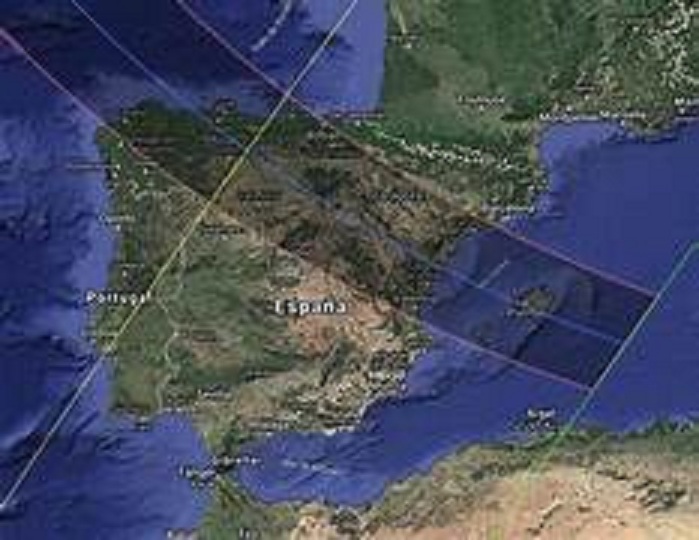
Spain is preparing for an event that has not occurred in more than a century. On August 12, 2026, the Moon will position itself between the Earth and the Sun, and for just over two minutes—138 seconds, to be exact—the Iberian Peninsula will be plunged into sudden darkness in the middle of a summer afternoon.
It will be the first total solar eclipse visible from Spanish territory since 1912, and forecasts indicate that it will generate between 400,000 and 1.5 million additional trips toward the path of totality. Spain’s General Directorate of Traffic (DGT) has already activated an unprecedented special operation, classifying the phenomenon as a High Traffic Impact Event (EVAAT). But what lies behind this celestial spectacle that has fascinated humanity since the dawn of time?
Solar eclipses occur when the Moon aligns exactly between the Sun and Earth, casting its shadow on our planet. They do not happen every new moon because our satellite’s orbit is tilted about five degrees relative to Earth’s orbital plane; most of the time, the Moon passes above or below the solar disk. But when all three align, the result is overwhelming: day turns into night, temperatures drop, and animals behave as if dusk has arrived. Somewhere on Earth, a total eclipse occurs approximately every year and a half. However, for an eclipse to occur exactly over the same location is extraordinarily rare: at a fixed point, a total eclipse repeats only every 300, 360, or even 400 years.
Partial eclipses, on the other hand, are more frequent and occur at least twice a year somewhere on the planet.
The eclipse on August 12 will cross Spain diagonally, from northwest to southeast, in the late afternoon. The path of totality—where the Moon will completely cover the solar disk—will pass through thirteen autonomous communities, from Galicia to the Balearic Islands, including Asturias, Cantabria, Castilla y León, Madrid, Aragón, Navarra, La Rioja, the Basque Country, the Valencian Community, and the Balearic Islands.
The peak moment is expected around 7:30 PM, although times will vary slightly depending on the location. From Madrid, for example, it will be visible in its entirety, as will much of the northern peninsula. Experts already warn that the worst enemy for observation will be low clouds, especially in the Cantabrian area and the Galician coast.
This phenomenon has aroused human curiosity since ancient times. Historical records document eclipses that marked entire civilizations: on May 28, 585 BC, an eclipse halted a battle between the Medes and the Lydians, interpreted as a divine omen. In imperial China, it was believed that a celestial dragon devoured the Sun, and court astronomers were obliged to predict eclipses on pain of death if they failed. The Maya, Babylonians, and Greeks developed sophisticated methods to anticipate these events, although it was not until the 20th century that science could precisely explain their mechanics. Today, far from ancestral fears, eclipses continue to generate the same awe and mobilize thousands of people—scientists, amateur astronomers, and curious onlookers—toward the path of totality, which becomes an improvised open-air observatory.
And amid all this wonder, Spain’s roads face their own particular trial by fire.
The DGT has been clear: yes, you can drive during the eclipse, but under very strict conditions. The first and most important rule: it is strictly forbidden to stop the vehicle on the hard shoulder or on the roadway to observe the phenomenon. Anyone who does so faces a fine of 200 euros, which can rise to 500 if officers consider the stop to pose an imminent danger to traffic. Nor may you record or photograph the eclipse while driving: this is a serious offense punishable by a 200-euro fine and the loss of six points from your driving license. And pay attention to glasses: driving with certified solar observation glasses is strictly prohibited, as their high filtering level drastically reduces vision of the road and constitutes negligent driving with significant penalties.
The DGT recommends turning on the dipped headlights in advance, lowering the sun visor to avoid glare—since the Sun will be very low on the horizon—maintaining a greater than usual safety distance, and adapting speed in case of sudden braking.
But perhaps the most important advice for the millions of people who will be traveling is this: do not start driving immediately after the eclipse ends. Authorities recommend delaying departure by one or two hours to avoid being caught in the massive traffic jams expected on the roads. The Traffic Division of the Civil Guard will reinforce surveillance on major routes, and traffic management centers will monitor circulation with the support of aerial resources.
Ultimately, August 12, 2026, will be a day to look at the sky… but without taking your eyes off the road. Nature is giving us a spectacle we will not see again for decades, and the responsibility of each driver will determine whether the day is remembered for its astronomical beauty or for its traffic jams and accidents. Planning ahead, choosing an observation point close to home whenever possible, respecting the rules, and above all, not getting carried away by the excitement of the moment are the keys to ensuring this eclipse goes down in history for all the right reasons. Because the Sun will shine again after two minutes, but the consequences of a reckless act can last a lifetime.
Have any thoughts?
Share your reaction or leave a quick response — we’d love to hear what you think!
-
 0
0
-
 0
0
-
 0
0
-
 0
0
-
 0
0
