
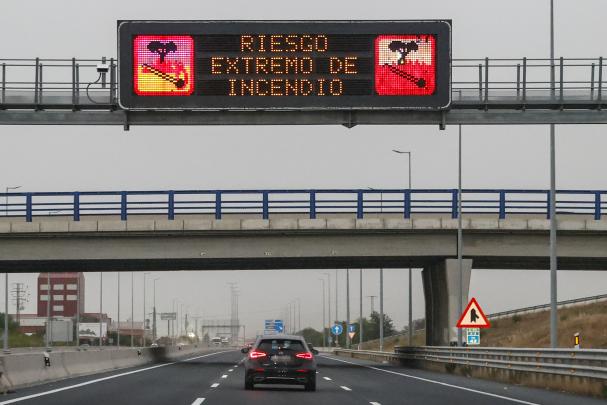
This July of 2026 is leaving a desolate mark on the Spanish geography. Wildfires have hit hard in provinces such as Almería, Madrid, Guadalajara, Ávila, Toledo and Castellón, forcing more than fifty road sections to be closed to traffic right in the middle of the summer holiday getaway. What seemed like just another summer has become one of the most challenging of the last decade, with over 61,000 hectares burned and 18 major forest fires recorded. For the driver planning a trip, the question is no longer whether there will be fire, but where and when it will appear. And the answer, as experts insist, leaves no room for improvisation: prevention and information are the first survival tools.
No summer trip should begin without prior consultation of the DGT’s interactive map, Infocar, which updates in real time the status of roads and closures due to fires. A colour code allows you to assess the situation at a glance: green for restricted circulation, yellow for irregular traffic, red for a complicated situation, and red with white for a closed road. Furthermore, AEMET launched in 2026 a new fire danger index with six levels and one-kilometre resolution, a tool that no driver should ignore before plotting their route. When preparing the vehicle, the connected V16 beacon has been since January 2026 the only legal emergency signalling device on interurban roads, and it is advisable to carry water, non-perishable food, a torch and a cotton cloth to moisten and protect yourself from smoke. Parking in areas clear of grass or scrubland is no minor recommendation: contact between the exhaust pipe and dry vegetation can be the origin of a tragedy.
When a driver encounters a fire on the road, the first and most important rule is to stay calm. The DGT clearly reiterates: call 112 without delay, indicating the exact location and the direction in which the fire is advancing. Do not assume they already know; in multi-fire situations, emergency services may be overwhelmed. The My112 app allows you to track your location more precisely. Next, close all windows and turn off the ventilation systems to prevent toxic gases from entering the cabin. If smoke reduces visibility, switch on dipped headlights and hazard lights to alert other drivers. If you must abandon the vehicle, cover all your skin, protect your airways with a damp cloth, and move away from the fire in a direction perpendicular to the flames, never uphill.
The DGT is unequivocal in its warnings: never try to cross an area affected by fire or smoke. Flames move quickly and can trap the vehicle before the driver can react; lack of oxygen can even stall the combustion engine. Nor should you take refuge in caves or wells, where you could run out of oxygen. And under no circumstances should you park in areas of dry grass or scrubland, especially if the engine is hot. Three per cent of forest fires in Spain originate from cigarette butts thrown from moving vehicles, a behaviour that is additionally punished with a fine of 200 euros and the loss of four driving licence points. Carelessness at the wheel not only endangers the forest: it endangers lives.
Spain has a network of 1,492 traffic cameras distributed across some 150 roads, which make it possible to know the state of the roads and the presence of smoke without having to travel. The DGT updated its wildfire action guideline in 2026, and the variable message signs (VMS) warn in real time about closures and hazards on the road. In addition, the V16 beacon, mandatory since January 2026, has become the standard hazard pre-warning device, replacing the traditional triangles. Civil Protection, for its part, insists that “if you are travelling and there are adverse weather events, seek information from official channels: radio, websites and social media”. In a summer like that of 2026, information is not a luxury: it is a safety issue.
Wildfire specialists agree on one diagnosis: “No matter how good prevention is, the risk of extreme fires continues to grow.” Climate change, prolonged drought and rural abandonment have created an explosive cocktail. The DGT insists that drivers must take an active role in their own protection: check the danger index before each journey, respect the regulations of each autonomous community and, above all, not make decisions on their own initiative that could put them at risk. As emergency services emphasise, in the event of a fire “it is preferable to turn around and find another route” rather than risk crossing a smoke curtain. This summer of 2026 has shown that fire does not understand holidays or rushing. The responsibility of each driver can make the difference between a scare and a tragedy.
Have any thoughts?
Share your reaction or leave a quick response — we’d love to hear what you think!
-
 0
0
-
 0
0
-
 0
0
-
 0
0
-
 0
0
