
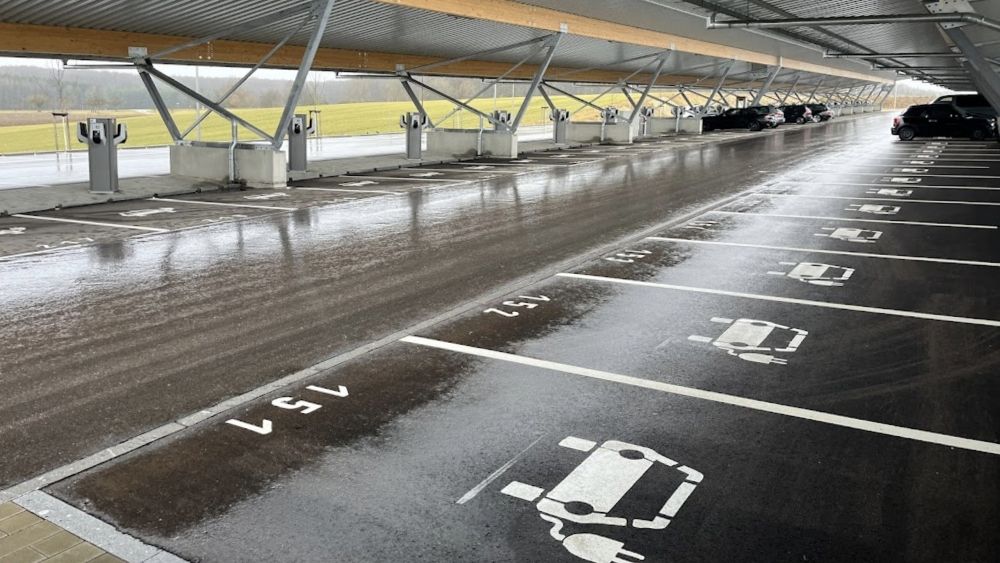
Road freight transport, the backbone of the European economy, faces its greatest challenge since the invention of the combustion engine. The electrification of the heavy-duty fleet of trucks and coaches is already an unavoidable goal for achieving climate neutrality, but the ambitious plan collides with a colossal obstacle: the power grid is not ready to handle the new demand. This was made clear at the recent meeting organized by the IRU in Brussels, where the diagnosis was blunt: without a robust, modern grid, the decarbonisation of commercial road transport will not be viable.
The problem is no small matter. While the European Union advances decisively in regulating CO₂ emissions for heavy-duty vehicles and sets increasingly stringent climate targets, the development of electrical infrastructure progresses at a very different pace. The electrification of the heavy fleet requires high-power charging points on strategic corridors and long-term energy planning that, for now, is notably absent. The IRU has made it clear: concrete, measurable targets for grid reinforcement, aligned with decarbonisation goals, are urgently needed.
The figures being handled by the various stakeholders in the sector are staggering. The European Automobile Manufacturers’ Association (ACEA) estimates that Europe needs to invest €280 billion in electric vehicle charging infrastructure. To put that into perspective, it means installing 14,000 public charging points per week until 2030, compared to the current rate of barely 2,000. For trucks alone, 279,000 charging points will be required, the vast majority at fleet depots, but also 36,000 high-power public points along motorways. And this is only the cost of the charging points themselves, without counting the reinforcement of the distribution and transmission grids themselves.
Spain is not immune to this reality. According to ANFAC’s Electromobility Barometer, the country closed 2025 with 53,072 publicly accessible charging points, 37% more than the previous year. However, this positive reading is tarnished by a worrying fact: one out of every four installed charging points is not operational, either due to breakdowns or the inability to connect to the power grid. Spain has accumulated 16,340 charging points out of service, 43% more than in 2024. The overall Spanish electromobility indicator stands at 22.9 points out of 100, still far from the European average (35.5). A clear symptom that installing infrastructure is not enough – it must be guaranteed to work.
Transport operators need certainty, not promises. The lack of guarantees regarding the availability of electrical capacity on major routes and logistics nodes is holding back investments in zero-emission vehicles and creating uncertainty about medium-term energy costs. That is why the IRU’s message is particularly relevant: transport and energy policies must be designed in a coordinated manner, not in silos. Emissions regulation, alternative fuels infrastructure rules, and power grid planning must advance in unison to avoid bottlenecks that could ultimately derail the transition.
The challenge is immense, but so is the opportunity. The energy transition of road transport is not an option; it is a necessity. And for it to be effective, decisions about the power grid must be made with the sector’s operational reality in mind: route patterns, rest times, and the location of logistics centres. The European Commission and the Member States have the final say and, above all, the responsibility to establish a stable and predictable regulatory framework that mobilises the necessary private investments. Road transport moves the vast majority of goods in Europe. If its electrification fails due to a lack of grid foresight, the cost will not only be economic, but also environmental and social. And that is a price the EU cannot afford to pay.
Have any thoughts?
Share your reaction or leave a quick response — we’d love to hear what you think!
-
 0
0
-
 0
0
-
 0
0
-
 0
0
-
 0
0
