
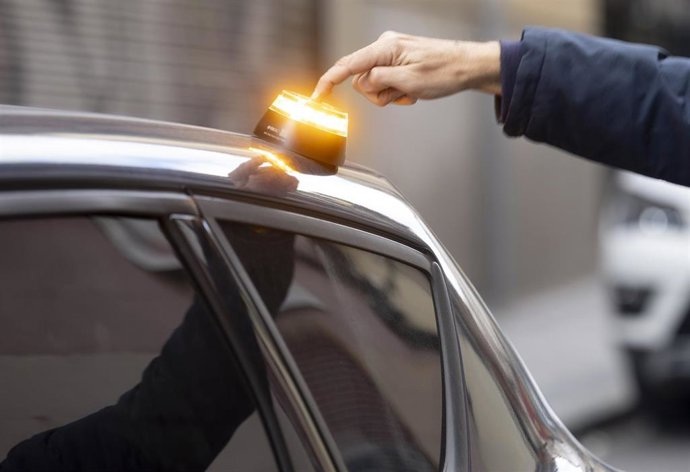
Let’s go back a few months in history to recall that image as familiar as it was risky: a truck or car driver getting out of their cab in the dead of night, under heavy rain or freezing cold, to walk dozens of metres along the hard shoulder and place the old reflective triangles. Every second outside the vehicle was a gamble with life, especially on unlit roads or in foggy conditions. That scene, which seemed eternal and inevitable, has begun to be left behind thanks to the arrival of the V-16 beacon, a small device that, placed on the roof from inside the cabin and connected to the DGT’s digital platform, protects the driver without exposing them and warns approaching vehicles in real time. But, although the technology is already here, the numbers reveal an uncomfortable truth: out of the 32 million vehicles required to carry it, barely 13 million have acquired the device, meaning that more than half of the vehicle fleet – around 19 million – still circulates without this tool that can make the difference between a scare and a tragedy.
The patience of the Directorate General of Traffic has run out. After a grace period that ended on 1 January 2026, this summer marks the end of tolerance and the start of specific control campaigns during the peak holiday travel season. The warning is clear and backed by the National Federation of Transport Associations of Spain (Fenadismer): failing to carry or activate the V-16 beacon in the event of a breakdown or accident will result in a €200 fine. But the financial penalty, however painful, is by no means the greatest risk. What should truly set off all the alarms is that insurance companies have already announced that they will have solid legal arguments to pass civil liability back onto the non-compliant driver, leaving them unprotected and forced to pay compensation and accident costs out of their own pocket if an impact occurs against their immobilised vehicle.
Fenadismer’s message is urgent and aimed especially at professional and self-employed transporters, who spend the most hours on the road and are most exposed to suffering the consequences of an omission. Because this is not just a bureaucratic obligation: the V-16 beacon is the only one that, thanks to its connection to the DGT platform, sends a digital signal to the navigation systems of nearby vehicles, alerting them to the presence of an obstacle on the hard shoulder. And this warning takes on a critical dimension from 1 October onwards, when the reform of the General Traffic Regulations will allow motorcycles to circulate on the right-hand hard shoulder in congested situations, turning that space, which until now was exclusively for emergencies, into an active traffic lane. Imagine a motorcyclist moving along the hard shoulder at 30 km/h and suddenly coming across an unmarked broken-down truck: the reaction time is zero, and the V-16 beacon then becomes the only digital lifeline capable of avoiding that collision.
However, the data are stubborn and reflect a reality that should shame both the sector and private users alike. While the DGT prepares to tighten controls this summer, the market only records 13 million beacons sold against a fleet of 32 million required vehicles. That means more than 15 million drivers – professionals and private individuals – are travelling without the mandatory protection, relying on luck or the old habit of using triangles, which are no longer valid and, moreover, forced drivers to get out of their vehicles on the road itself. The question is simple: is it really worth saving the few euros that this device costs, only to risk a €200 fine, having your insurance claim tens of thousands in compensation, and worst of all, endangering your life and that of others?
Fenadismer insists on a protocol that every driver should engrave in their memory: before setting off, check that the beacon is approved, charged and stored in an accessible place inside the cabin – never in the boot; in the event of any incident, activate it from inside, place it magnetically on the roof without getting out of the vehicle, and only then contact the insurer or breakdown service. This simple gesture, which takes less than thirty seconds, can save a life and legally shield the driver against any claim. Technology has already solved the problem that for decades forced lorry drivers to risk their lives in the dark; now all that remains is for the more than 15 million drivers who have not yet taken the step to realise that the V-16 beacon is not an expense, but the cheapest investment in road safety they can make.
The summer of 2026 will be the first major test for this regulation, and the DGT is not going to look the other way. The €200 fines will come, insurers will be on the lookout to transfer liability to offenders and, above all, the new scenario with motorcycles using the hard shoulder makes the absence of the beacon an unacceptable risk. Do not wait for an officer to stop you or, worse still, for an accident to teach you the hard way what we are telling you today. Get your approved V-16 beacon now, keep it charged and use it whenever necessary. Because protecting yourself and warning others is not just a legal obligation; it is the most intelligent act of responsibility a driver can have on the road. Do not let laziness or ignorance cost you money, legal trouble or, most precious of all, your own integrity. The beacon is here, the rule is clear and the time for excuses is over. Do it for yourselves, do it for your loved ones and do it for everyone who shares the asphalt.
Have any thoughts?
Share your reaction or leave a quick response — we’d love to hear what you think!
-
 0
0
-
 0
0
-
 0
0
-
 0
0
-
 0
0
