
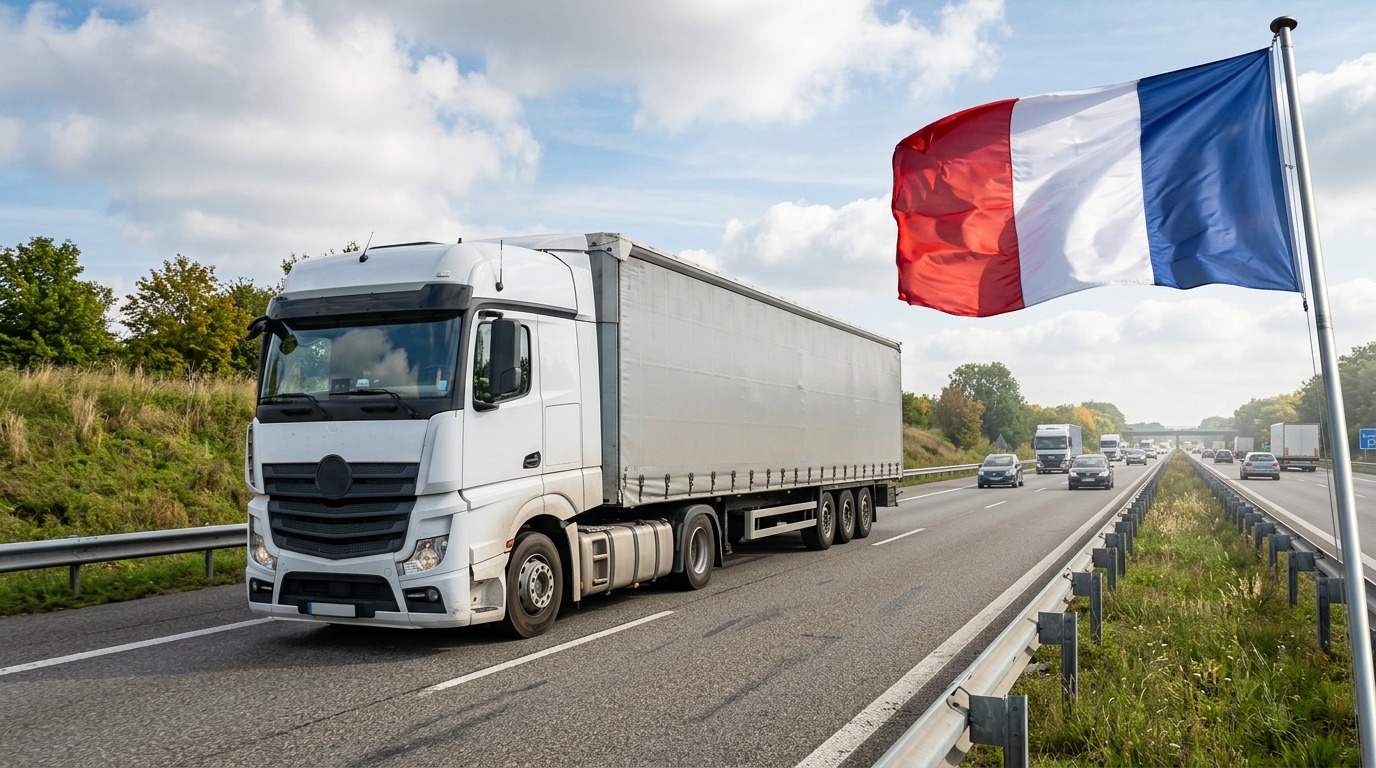
French road transport legislation has become a web of strict, constantly updated rules that make no distinction between domestic carriers and those from other European Union countries.
For French authorities, a heavy vehicle is one whose maximum authorised mass (MAM) exceeds 7.5 tonnes. However, the major difference between a national truck and a Community one lies in weight limits – a difficult border for international hauliers to cross. While French vehicles can reach 44 tonnes under very specific conditions (only for national intermodal transport and with low‑emission engines), trucks from the rest of Europe have their maximum weight capped at 40 tonnes when operating on French soil – a measure aimed at curbing unfair competition.
The requirements for driving go far beyond the weighbridge. The regulations impose a complex system of time restrictions and documentation that every haulier, regardless of origin, must follow to the letter. Heavy goods vehicles are banned from driving on weekends and on the eve of public holidays, from 10 p.m. on Saturday to 10 p.m. on Sunday, with special surveillance during holiday periods. Moreover, the so‑called EU “Mobility Package” adds another layer of control: foreign drivers carrying out transport in France must carry the A1 posting certificate, which proves social security coverage in their home country, as well as a copy of their employment contract and a certificate of minimum wage in French, under the supervision of the so‑called “Macron Law”.
Added to this is the obligation to display the Crit’Air environmental sticker to access the Low Emission Zones of major cities.
A common, and potentially very costly, mistake is to think that ignorance of the law excuses compliance. For the French authorities, responsibility is absolute: every driver entering the country must know and respect its highway code. Ignorance of the rules is not a valid excuse, and penalties are applied with equal rigour to nationals and foreigners – offenders may even be prosecuted once they return home through cross‑country information exchange systems.
The fine system is particularly dissuasive, especially for large trucks. In the event of speeding, financial penalties can reach €1,500 if the limit is exceeded by more than 50 km/h, on top of vehicle immobilisation. However, the greatest concern for a haulier should be overweight: the fine is €750 per excess tonne, which can turn a small oversight into a bill for thousands of euros. As of 2026, very serious speeding offences (more than 50 km/h over the limit) have ceased to be a simple administrative infringement and have become a criminal offence, punishable by up to 3 months in prison and a €3,750 fine.
To enforce these rules, France has deployed control technology that goes far beyond traditional police officers on the road. The crown jewel is the “smart radar” – a fixed device capable of distinguishing between a car and a truck, thereby applying the specific speed limit for each vehicle category and photographing the offender on the spot. In addition, new satellite toll systems (GNSS) are being implemented in strategic regions such as Alsace, which will charge trucks based on kilometres driven and their emission level – an automatic and relentless control.
In short, the French road is a scenario where technology and the law monitor every movement of heavy transport. For Spanish or any other EU hauliers, the key to avoiding penalties is prevention and information. It is essential to check the mandatory documents before crossing the border, from the A1 certificate to the Crit’Air sticker, to scrupulously respect weight and speed limits, and to plan routes taking into account the strict weekend driving bans. Only then can one successfully navigate the complex but fair framework of French road safety.
Have any thoughts?
Share your reaction or leave a quick response — we’d love to hear what you think!
-
 0
0
-
 0
0
-
 0
0
-
 0
0
-
 0
0
