
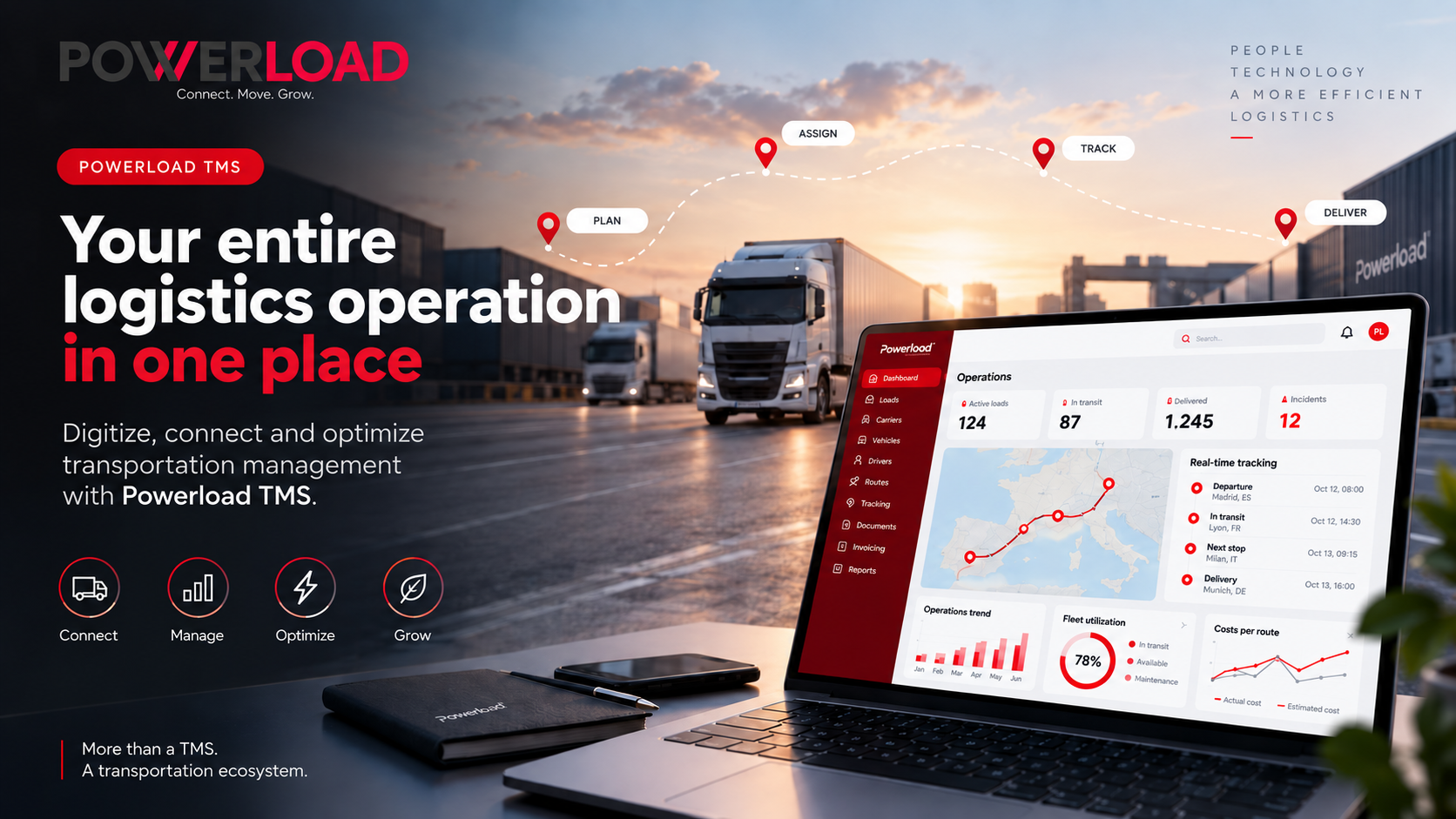
Powerload TMS: The Transportation Management Software That Centralizes Your Entire Logistics Operation
Transportation management involves much more than moving freight from one point to another.
Behind every operation are transportation orders, loads, vehicles, drivers, carriers, routes, documentation, costs, communications, tracking and incidents. When all this information is managed through separate tools, operations can become complex, time-consuming and difficult to control.
Powerload TMS is designed to address this challenge by digitizing and centralizing transportation and logistics management within a single platform.
From planning and assigning transportation operations to documentation, tracking and cost control, Powerload TMS provides a comprehensive view of logistics activity.
The goal of Powerload is to help companies transform traditional transportation management into a more connected, efficient, intelligent and profitable operation.
What Is Powerload TMS?
Powerload TMS is a Transportation Management System (TMS) designed to centralize transportation operations within a single digital environment.
Instead of working with information scattered across spreadsheets, emails, phone calls and different software applications, Powerload TMS allows companies to organize key operational processes from one platform.
The system is designed to support processes such as:
- Transportation order management.
- Load management.
- Vehicle and driver management.
- Route planning.
- Carrier assignment.
- Document management.
- Transportation tracking.
- Incident management.
- Cost control.
- Invoicing.
- Operational communications.
The goal is to create a more organized, visible and controlled transportation operation.
One Platform for Your Entire Transportation Operation
One of the main challenges facing modern logistics operations is fragmentation.
One tool for loads. Another for vehicles. Another for documents. Emails for communications. Spreadsheets for costs. Phone calls to find out where a shipment is.
Powerload TMS is designed to connect these processes.
Operational information can be centralized within the same environment, allowing different participants to work with a shared view of the operation.
Who Is Powerload TMS Designed For?
Powerload TMS is not limited to a single type of company. Its solution is part of an ecosystem designed to connect different participants in the transportation industry.
Shippers
Companies that need to manage transportation operations, publish loads, select carriers and control their shipments.
Carriers
Transportation companies and professionals that need to manage trips, vehicles, drivers, documentation, invoicing and operations.
Logistics Operators
Companies coordinating loads, customers, carriers and multiple transportation operations that need centralized management.
This approach allows Powerload TMS to become part of the entire logistics workflow rather than functioning as an isolated tool.
Load and Transportation Order Management
The load is the starting point for many logistics operations.
Powerload TMS allows companies to centralize information related to transportation orders and services, making them easier to manage.
Operational data can be organized within the system and connected to the different resources required to execute the transportation service.
Vehicle and Driver Management
Vehicle and driver availability is essential for effective transportation planning.
With Powerload TMS, information related to these resources can be integrated into transportation operations.
This makes it easier to connect vehicles, drivers, services, routes, loads and availability within the same operational environment.
Transportation Planning and Optimization
Effective transportation planning can make a significant difference in terms of time and costs.
Powerload incorporates analysis tools and intelligent matching capabilities designed to help connect loads with transportation capacity.
Its AI technology can analyze variables such as the required truck type, vehicle location, capacity, routes and carrier history.
This helps move transportation management away from purely manual searches and toward more data-driven decisions.
Artificial Intelligence Applied to Logistics
One of the differentiating elements of Powerload is the incorporation of artificial intelligence into different transportation-related processes.
Intelligent Price Calculation
Tools designed to help estimate transportation costs and pricing.
Intelligent Transportation Matching
Helps identify carriers or vehicles that may be suitable for a particular load.
Route Optimization
Tools designed to analyze and optimize transportation routes.
Environmental Impact Analysis
Analysis designed to provide insight into certain environmental aspects of transportation operations.
The purpose of these tools is to use available data to provide useful information and support specific operational decisions.
Transportation Document Management
Documentation is another major challenge in logistics management.
CMRs, proof of delivery documents, invoices and other records can easily become scattered across different systems.
Powerload TMS allows companies to centralize digital transportation documents, making them easier to organize and access.
This helps connect documentation with the corresponding transportation operation and improve operational traceability.
Real-Time Transportation Tracking
Once transportation has been assigned, visibility remains essential.
Powerload incorporates GPS tracking to provide information related to vehicle location, arrivals and waiting times during transportation.
This provides greater operational visibility and helps companies identify and manage potential incidents.
Cost Control and Profitability
Logistics efficiency is not simply about moving more freight. It is also about understanding how much each operation costs and how those costs affect profitability.
Powerload TMS incorporates tools designed to analyze costs related to routes and transportation operations.
This information provides companies with a broader view before making operational decisions.
Invoicing and Payment Management
A logistics operation does not end when the freight reaches its destination.
The next important step is invoicing and payment management.
The Powerload ecosystem incorporates invoicing and payment management tools, allowing financial processes to be connected with transportation operations.
A Complete View of Your Transportation Operation
The true value of a TMS becomes clear when different transportation processes can work together.
- Plan: organize transportation requirements and operations.
- Find: identify loads, vehicles and carriers.
- Assign: connect each operation with the appropriate resources.
- Execute: manage transportation and its different participants.
- Track: monitor transportation progress.
- Document: centralize transportation documentation.
- Invoice: manage administrative and financial processes.
- Analyze: use operational information to improve future transportation decisions.
Powerload TMS + Load Board
One of the important characteristics of the Powerload ecosystem is the connection between a TMS and a Load Board.
The platform combines transportation management with an intelligent Load Board, helping connect transportation needs with companies and professionals across the industry.
This creates a more complete workflow:
Instead of separating transportation sourcing from subsequent management, Powerload TMS is designed to connect both processes within the same ecosystem.
What Are the Benefits of Powerload TMS?
Centralization
Manage relevant transportation information from a single environment.
Visibility
Gain greater visibility into loads, vehicles and transportation operations.
Automation
Reduce repetitive manual and administrative tasks.
Intelligence
Use AI and algorithms to support decisions related to pricing, matching and routes.
Control
Monitor transportation operations, documentation and costs.
Connectivity
Connect shippers, carriers and logistics operators.
Scalability: a digital infrastructure designed to support transportation operations as they grow.
Why Use Powerload TMS?
The goal of a TMS should not simply be to replace an Excel spreadsheet with another software application.
It should help companies change the way transportation is managed.
Powerload TMS is designed to centralize processes that have traditionally been managed separately and provide a more complete view of the operation.
From sourcing and assignment to tracking, documentation and invoicing, Powerload is designed to turn transportation management into a more connected and traceable process.
The Future of Transportation Management
Digital transformation is changing the way companies manage logistics.
Artificial intelligence, automation, data analytics and real-time tracking are becoming increasingly important tools for transportation operations.
In this environment, a Transportation Management System must evolve from a simple management tool into an infrastructure capable of connecting the entire operation.
That is the approach behind Powerload TMS.
Powerload TMS: Your Entire Logistics Operation in One Place
Managing transportation means coordinating multiple elements at the same time.
Powerload TMS helps centralize that complexity within a digital platform designed to connect, manage and optimize transportation operations.
Loads. Carriers. Vehicles. Drivers. Routes. Documents. Tracking. Costs. Invoicing.
Everything connected.
Powerload TMS
Digitalize. Connect. Optimize.
Request a DemoFrequently Asked Questions About TMS
What does TMS mean?
TMS stands for Transportation Management System. It is software used to plan, manage, monitor and optimize transportation operations.
What is a TMS used for?
A TMS is used to centralize processes such as load management, carriers, vehicles, drivers, routes, documentation, tracking and transportation costs.
What is the difference between a TMS and a Load Board?
A Load Board is primarily designed to connect loads with available transportation capacity. A TMS manages a broader range of transportation operations. Combining both can connect load sourcing with transportation management.
Is a TMS useful for small transportation companies?
Yes. The value of a TMS does not depend solely on company size. It can also help small and medium-sized companies organize operations and reduce manual tasks.
Can a TMS help reduce transportation costs?
A TMS can help identify and manage different transportation cost components, improve planning and provide information to support more efficient decisions. Actual results depend on the operation and how the system is used.
Does Powerload TMS use artificial intelligence?
Powerload incorporates artificial intelligence and analytics tools designed for specific transportation functions, including cost estimation, matching, optimization and environmental impact analysis.
Have any thoughts?
Share your reaction or leave a quick response — we’d love to hear what you think!
-
 0
0
-
 0
0
-
 0
0
-
 0
0
-
 0
0
