
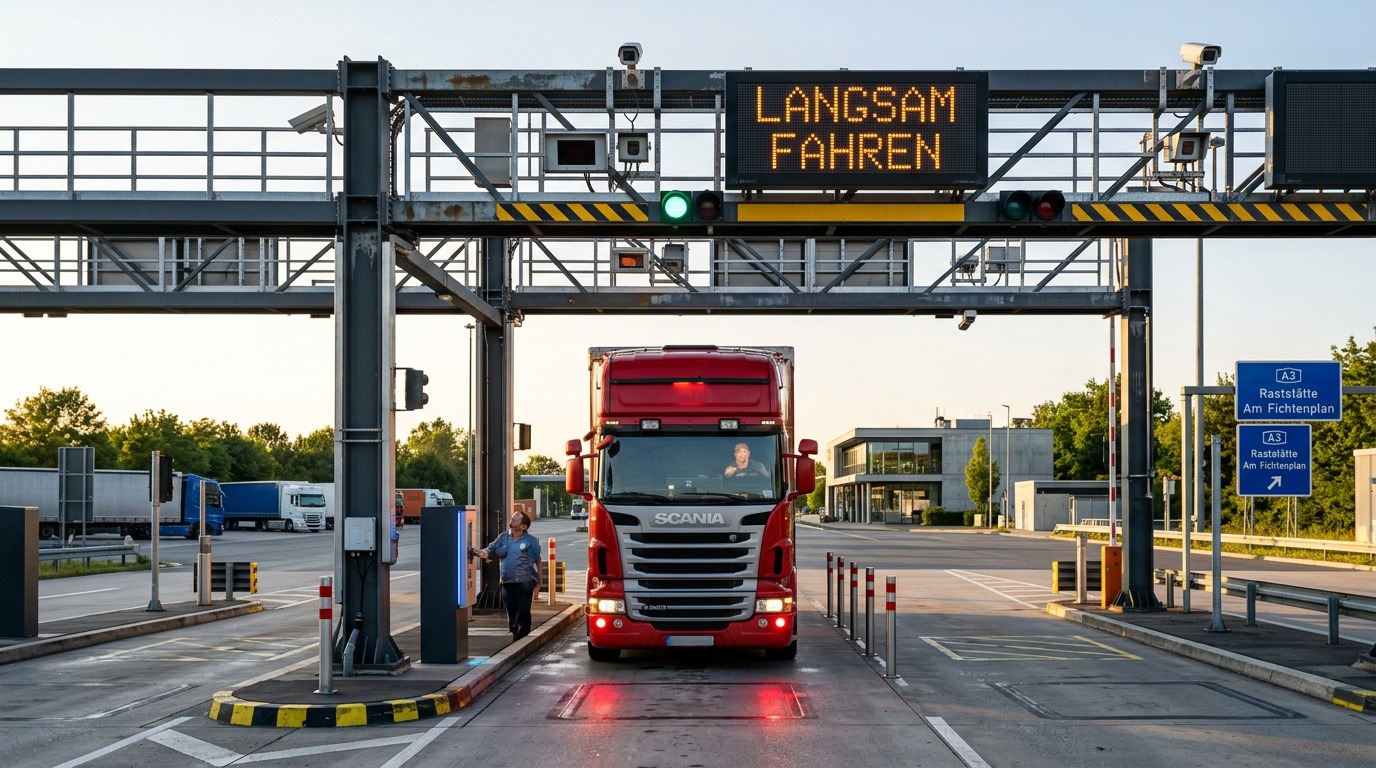
Since June 2024, the truck toll in Germany has undergone a significant change that directly affects Spanish transport operators working in the German country.
The system, managed by Toll Collect, now applies to all goods vehicles with a technically permissible maximum laden mass exceeding 3.5 tonnes – an expansion that includes vans and light trucks previously exempt.
Spanish drivers travelling on motorways (Autobahn) or federal highways (Bundesstraßen) must ensure they have registered their route in the system and have a payment device, as controls are strict and fines for non-payment can exceed €1,000.
Toll rates are not fixed and can be consulted in the official Toll Collect table.
The calculation of the toll in Germany depends on several key factors: CO₂ emission class, pollutant standard (Euro), vehicle weight, and number of axles. The most polluting trucks, such as Euro 0 and Euro I, pay rates of up to €0.51 per kilometre. In contrast, electric and zero‑emission vehicles are completely exempt until 30 June 2031. A five‑axle Euro 6 truck of 40 tonnes pays approximately €0.35 per kilometre. To avoid surprises, hauliers must correctly update their vehicle information in the Toll Collect system; otherwise, they will be assigned the highest emission class with the highest rates.
Which roads are subject to tolls? The answer is clear: all German motorways (over 51,000 kilometres) and all federal highways, even in urban areas.
Spanish drivers should bear in mind that motorways are free for passenger cars and light vehicles, but not for trucks. The Warnow and Herren tunnels also have additional tolls.
To pay, there are several options: the Toll Collect OBU device, which automatically records kilometres travelled via GPS; online route booking or at authorised terminals; and the new “TollNow” app for one‑off payments. It is essential to register the vehicle on the Toll Collect portal before starting the route.
Regarding road quality, Germany remains a world reference in road infrastructure. Its motorways, built with several layers of concrete and subject to periodic inspections, allow high‑speed traffic and are known for their durability. However, not everything is perfect: more than 10% of the approximately 3,800 bridges assessed were rated as unsatisfactory or inadequate. Moreover, according to a study by the German Ministry of Transport, the condition of motorways varies greatly by region. The best are found in Saarland, Thuringia and Schleswig‑Holstein, where at least 60% of the roads are in good condition, while North Rhine‑Westphalia, Mecklenburg‑Western Pomerania and Hesse have the worst maintenance records, with nearly half of their motorways in fair or poor condition.
Toll controls in Germany are exhaustive and can result in severe penalties. The Federal Office for Logistics and Mobility (BALM) and the Toll Collect agency carry out regular inspections, often in collaboration with the police and customs authorities. In a recent two‑day operation on the A1 motorway, 176 vehicles were inspected and 76 infringements were detected, of which 43 were related to violations of driving and rest times.
Fines for non‑payment of the toll can exceed €1,000, and penalties for driving on Sundays and public holidays (from 00:00 to 22:00) amount to €120 for the driver and €570 for the operator. In addition, hauliers must comply with summer Saturday driving restrictions (July and August) on specific sections of motorways and federal highways. To avoid fines, it is advisable to voluntarily declare any unpaid toll within two working days, which may exempt you from penalties.
Have any thoughts?
Share your reaction or leave a quick response — we’d love to hear what you think!
-
 0
0
-
 0
0
-
 0
0
-
 0
0
-
 0
0
