
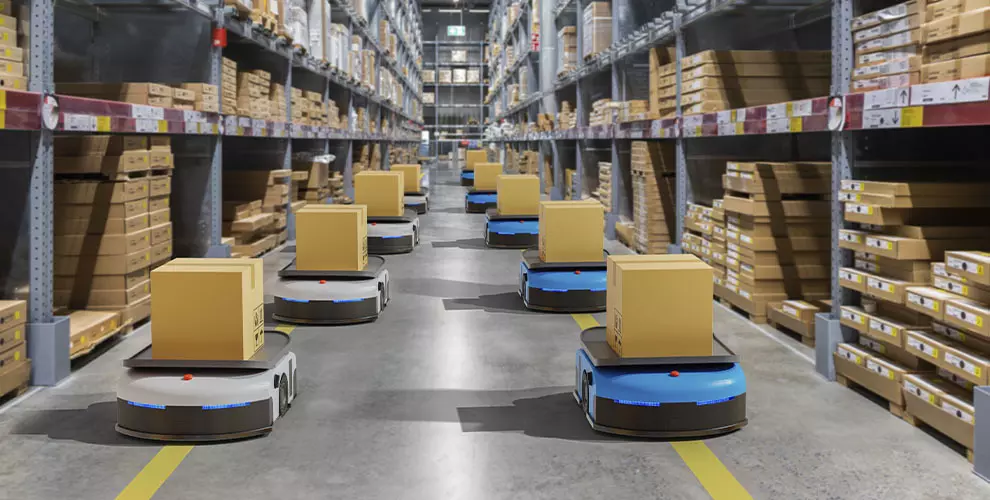
Logistics is no longer that world of dusty back rooms and manual forklifts; it has become a jungle of algorithms, sensors, and millimetric decisions. Although the 2026 trend headlines are dominated by artificial intelligence and autonomous robots, what is truly unsettling — and also most hopeful — is how these technologies are redefining human conditions at the heart of distribution centers. Because while robotic arms are being fine‑tuned with sensors and vision systems to work alongside operators, an uncomfortable question begins to echo through the aisles of large warehouses: who looks after the workers when machines become faster, but also more autonomous?
Available data offers a nuanced answer: intelligent automation can relieve the most physically exhausting tasks and improve safety, but it demands professional retraining that is still rarely discussed in sector reports.
Artificial intelligence is, without a doubt, the great silent transformer. Far from the myths of deserted factories, in 2026 AI acts as a “co‑pilot” within warehouse management: it prioritises tasks, assigns jobs, and monitors safety conditions in real time, according to industry analyses. This ability to foresee bottlenecks and optimise picking routes allows employees to concentrate on higher‑value tasks rather than tedious travel or manual checks. However, the realistic implementation of these systems requires more than just buying software — it needs an integrated plan that considers where automation makes sense and where human supervision remains indispensable.
Flexibility has become the new mantra of successful distribution centres. Linear, one‑way solutions designed for predictable demand have proved incapable of absorbing viral spikes from social media or the demands of ultra‑fast deliveries. In this context, modular automation — such as bag sorters or scalable systems — makes it possible to expand or reduce capacity without major construction work. Fleets of autonomous mobile robots (AMRs), replacing older wire‑guided vehicles, are able to dodge obstacles and workers in real time. The real challenge, experts point out, is not so much the technology itself, but the ability to integrate these modules into a coherent ecosystem that does not create disconnected islands of automation.
But the biggest headache for logistics managers in 2026 is not on the warehouse floor — it is in the network. The very hyper‑connectivity that allows data to flow between sensors, robots, and management systems turns warehouses into attractive targets for increasingly sophisticated cyberattacks. Indra Group warns that software supply chain attacks have become one of the main risk vectors. Cybersecurity thus ceases to be a separate department and becomes a strategic priority, with approaches such as “Security by Design” and zero‑trust architectures that protect projects from their initial design. At the same time, blockchain technology emerges as an additional layer of transparency, creating immutable records for every transaction and inventory movement — something especially critical in sectors such as pharmaceuticals or food.
It would not be fair to end this overview without mentioning the most fragile yet most valuable link: people. Augmented reality and virtual reality, far from being sci‑fi gadgets, are already used to train workers in simulated, risk‑free environments. And sustainability, which some once saw as a passing fad, is becoming a regulatory and market requirement: artificial intelligence helps optimise routes, reduce packaging, and measure the carbon footprint with previously unimaginable precision. In short, the warehouses of 2026 will be more connected, more transparent, and more demanding spaces. But their success will not depend solely on algorithms: it will continue to depend on companies’ ability to support their teams through this transformation, ensuring that technology does not displace but rather enhances what only humans can bring.
Have any thoughts?
Share your reaction or leave a quick response — we’d love to hear what you think!
-
 0
0
-
 0
0
-
 0
0
-
 0
0
-
 0
0
