
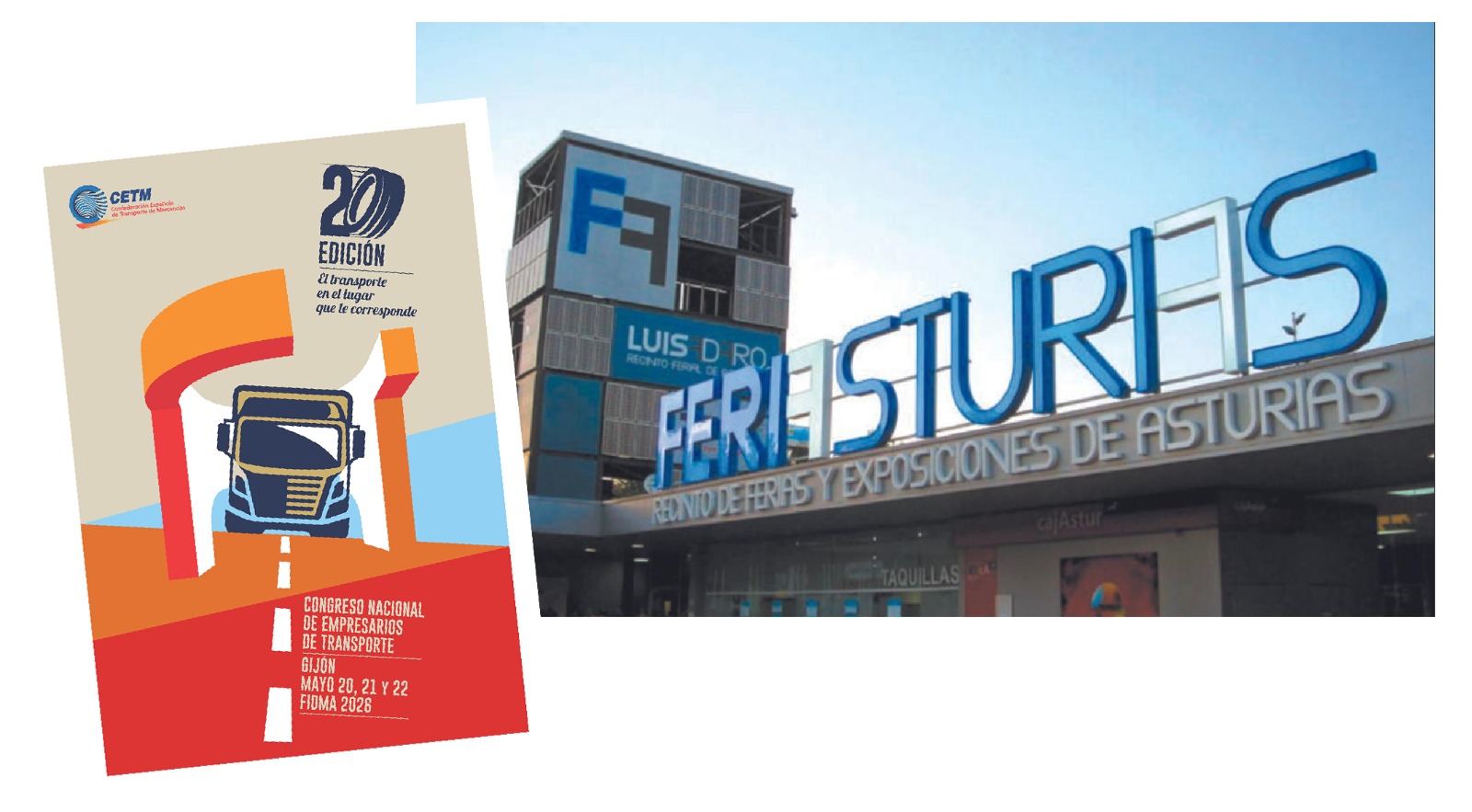
Road freight transport has claimed its place at the center of the economic and political board this May 20, as its major biennial event kicks off in Gijón.
The 20th National Congress of Transport Entrepreneurs, organized by the Spanish Confederation of Freight Transport (CETM) under the motto “Transport in its rightful place,” began this Wednesday at the Luis Adaro Exhibition Center with the clear aim of marking a turning point. As the specialized magazine Diario de Transporte had been anticipating for months, the event has become a faithful thermometer of the sector’s temperature, which, as reflected in one of its latest reports before the event, faces an uncertain context and demands to be heard. The high attendance of nearly a thousand professionals and the sense of urgency in the inaugural sessions confirm that this is not just another edition.
The meeting comes at a time of maximum tension for companies in the sector, facing the unstoppable rise in diesel prices, the main pressure factor on their economic viability.
In fact, Transporte Profesional, which has closely followed the preparatory weeks, warned that the event is being held in a particularly sensitive context, conditioned precisely by fuel price trends and a tangle of regulatory changes that threaten to suffocate small and medium-sized enterprises. From the very first moment, the tone of the speeches has been that of a sector demanding a shift from words to action, urging Public Administrations to provide stability and a regulatory framework that does not jeopardize its ability to move over 95% of the country’s goods.
Faced with this scenario, one of the most repeated messages in Wednesday’s sessions has been the urgent need for unity. As Diario de Transporte had anticipated in its call weeks ago, the CETM has made an explicit appeal for internal cohesion within the sector to present a united front to the Government and society.
The employers’ association representing hauliers wants, as has become evident at the opening event, to leave behind individual differences and build a robust voice capable of defending collective interests. This quest for unity is not an end in itself, but a tool to achieve what underlies each debate: recognition of transport as a strategic link in the economy and not as a mere subcontractor without specific weight.
The program, which runs until next Friday, addresses the main open fronts that condition the daily life of entrepreneurs.
The opening lecture by economist Marcos de Quinto focused on the need to make difficult decisions in an environment of economic contraction and changing leadership, while the afternoon sessions focused on analyzing the true pulse of the Spanish SME. The presence of top-level speakers, such as professor Francisco Pérez de los Cobos or the president of CEPYME, Ángela de Miguel, provides a first-rate platform for the demands of a group that, according to Transporte Profesional, is determined not to leave Gijón empty-handed.
One of the most anticipated moments will take place on Thursday with the round table entitled “The future of transport policy.” In this face-to-face meeting, which will serve to gauge the harmony between the employers’ association and the Ministry of Transport, the president of the National Road Transport Committee, Javier Arnedo, and the Secretary General for Land Transport, Rocío Báguena, will participate.
This forum expects an intense debate on regulatory planning and competitiveness, two aspects that particularly concern hauliers, who have already expressed their outright opposition to any attempt to introduce new tolls on highways, arguing that the sector already bears an exorbitant tax burden.
Beyond major macroeconomic issues, the congress is addressing the structural problems of the trade. The sessions are analyzing two very specific threats: the regulation of the professional driver’s working day, a complex legal issue directly affecting road safety and rest, and cybersecurity, where experts have been warning for months that the sector is not immune to cyberattacks.
Additionally, a panel of insurance experts addresses comprehensive risk management and cost control, trying to demonstrate that a well-chosen policy can become a competitive advantage and not just another expense on the bottom line.
The relevance of the event has transcended the purely professional sphere, with broad institutional representation that reinforces political commitment to the city of Gijón. The mayor, Carmen Moriyón, the president of the Principality of Asturias, Adrián Barbón, and the Minister of Transport himself, Óscar Puente, have confirmed their attendance or have been represented in these early stages. This presence, together with the massive turnout of vehicle manufacturers and service companies, consolidates the Congress as the country’s largest logistics fair, with an exhibition area of nearly 10,000 square meters that has already sold out.
In short, the Congress that began today in Gijón is not a mere periodic meeting of entrepreneurs, but a stage for direct confrontation between the real needs of an essential guild and public policies. The CETM employers’ association, supported by provincial associations such as ASETRA, wants this to be the forum where transport regains its rightful social and economic initiative, not only as a victim of price hikes or bureaucratic demands, but as an active agent in building a more competitive and sustainable future.
The coming days will tell whether this twentieth meeting manages to transform demands into concrete actions or remains a simple catalog of good intentions.
Have any thoughts?
Share your reaction or leave a quick response — we’d love to hear what you think!
-
 0
0
-
 0
0
-
 0
0
-
 0
0
-
 0
0
