
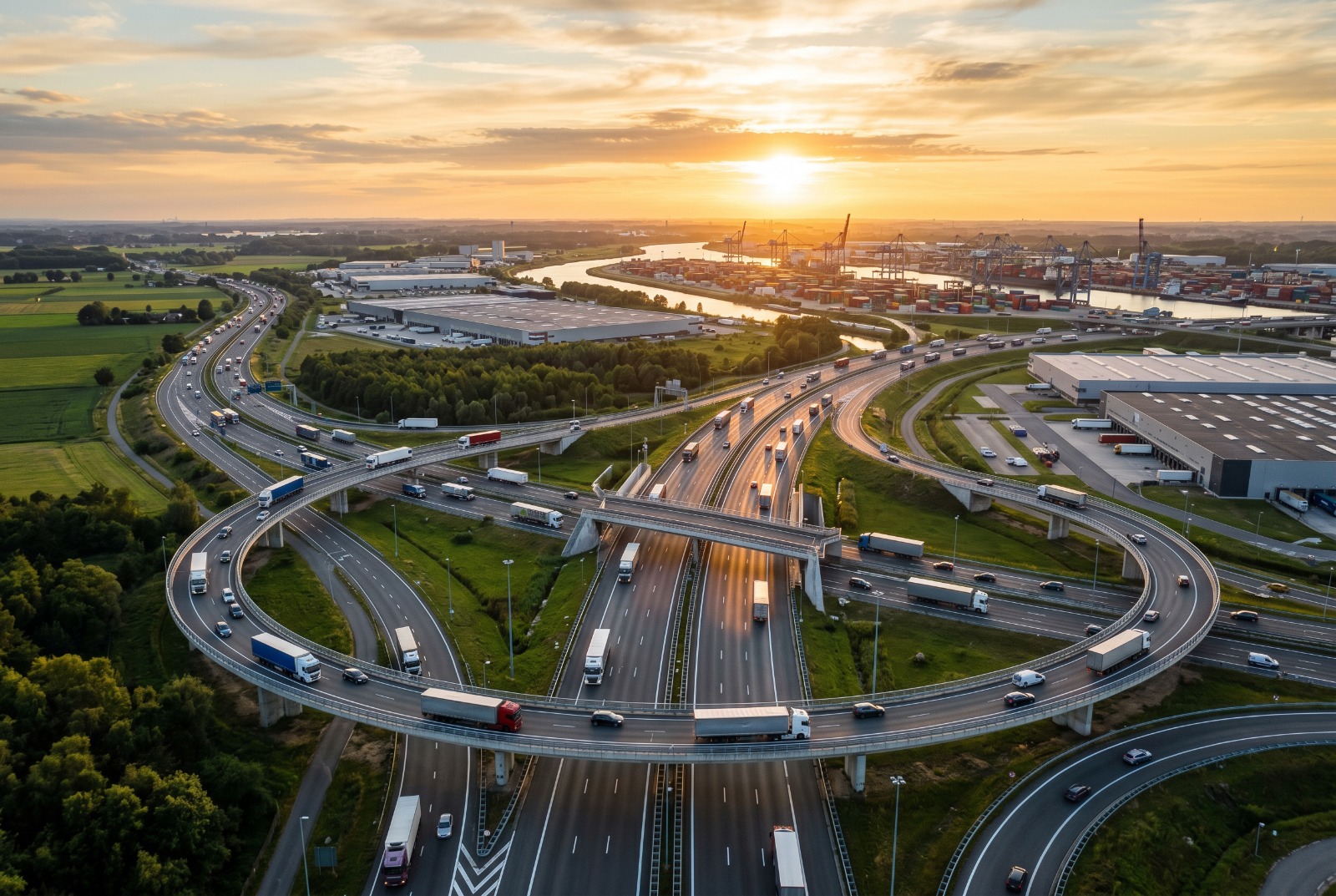
Imagine a country where most of the products consumed by its neighbours pass, at least once, through its roads, ports and warehouses. Belgium is that nation, a logistics colossus in the heart of Europe where transport culture is not a job – it is the lifeblood that keeps its economy alive, one of the most open in the world. With infrastructure that connects motorways as smoothly as a well-oiled machine, and ports that look like cities, Belgium has established itself as the continent’s “revolving door”.
The engine of this logistics giant is a first-class multimodal network. Its flagship port, Antwerp-Bruges, is not only the second largest in Europe by tonnage, but also an intermodal hub where sea, rivers, rail and an extensive motorway network converge. Most of the land-based volume of goods moves by road, and the country is prepared to receive heavy transport with clear rules. An example is the ‘Viapass’ telematic toll system, mandatory for trucks over 3.5 tonnes. The regulations are rigorous but calculated: there are driving bans for exceptional large-sized transport at specific times (such as from Saturday 6:00 a.m. to Monday 9:00 a.m.) and on public holiday weekends, although on normal days traffic is more flexible than in other European countries.
The profile of Belgian carriers is defined by specialisation and innovation in highly sensitive types of cargo. It is not a country that depends on raw materials; Belgium is a factory of high-value added products that require precise logistics. The star sectors are pharmaceuticals, automobiles and diamonds, along with oil refining. This specialisation requires fleets prepared for temperature-controlled transport (chemicals and medicines), extreme security (diamonds) and millimetric efficiency in the assembly chain (automobiles).
Regarding the destination of its production, Belgium understands that its natural market is the world, but its backyard is the European Union. About 80% of its trade takes place within the EU bloc, with its main partners being Germany, France and the Netherlands. Outside the EU, the United States is consolidating itself as a key market. This mutual dependence means that when Europe’s economic heart beats strongly, Belgium’s arteries are the first to pump goods towards France or Germany.
Belgium is the gateway par excellence for goods seeking to flood the European market. Its strategic location means Brussels is just a four-hour drive from Paris, Amsterdam and Frankfurt. Foreign trade accounts for approximately 70% of its Gross Domestic Product (GDP), which underlines its fundamental role. With a GDP per capita of €44,800, significantly above the European average, Belgium is an indispensable trading partner and a high-spending customer. It is not just a country to pass through, but a first-class final market.
In conclusion, paraphrasing industry experts, Belgium is the logistics heart of Europe. Its success lies in a perfect alchemy of geography, infrastructure and a business culture that has turned the transit of goods into an art. However, this heart beats under pressure: the dense motorway network suffers from frequent jams, especially on the approaches to Antwerp and Brussels, and carriers must navigate a mosaic of regional regulations that demand exhaustive planning. For the international carrier, Belgium remains both a challenge and an opportunity – a country that cannot conceive its present or its future without the constant roar of engines on its roads.
Have any thoughts?
Share your reaction or leave a quick response — we’d love to hear what you think!
-
 0
0
-
 0
0
-
 0
0
-
 0
0
-
 0
0
