
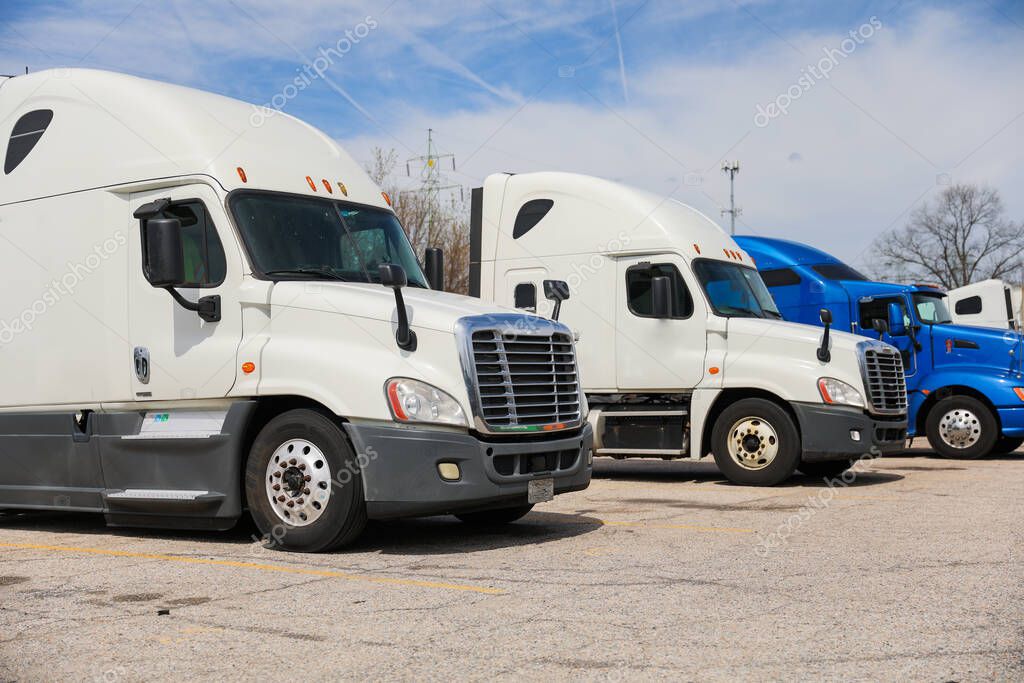
Estonia has established itself as an essential logistics hub in the Baltic region, and its road transport regulatory framework is as dynamic as it is strict. The legal basis rests on the Traffic Act and the Road Transport Act – a system that extends its powers to any foreign vehicle circulating on its roads. This body of law not only governs traffic but also imposes precise obligations on domestic and international carriers, who must certify the training of their managers and comply with rigorous cargo safety requirements.
As regards load levels and dimensions, Estonia is preparing for a major logistical leap: the introduction of European Modular System (EMS) road trains. Currently, the standard limit for a tractor with a semi‑trailer is 16.5 metres in length, 2.55 metres in width, 4 metres in height, and a total weight of 40 tonnes. However, the country is aligning with its Nordic neighbours and, as of 2026, will allow – under strict special permits – combinations of up to 25.25 metres and a gross weight of 60 tonnes. These EMS units, which can carry up to 25% more freight, are seen as a tool to increase efficiency and reduce emissions, although they will require pre‑approved routes and additional safety systems. For exceptional loads exceeding 30 metres or 80 tonnes, the use of civil escort vehicles will be mandatory.
Estonian weather conditions impose a mandatory chapter in any carrier’s preparation. The law is unequivocal: the use of non‑studded winter tyres is compulsory from 1 December to 1 March, regardless of the weather. These must bear the 3PMSF (Three‑Peak Mountain Snowflake) marking and a minimum tread depth of 3 to 5 mm. Studded tyres are permitted between 15 October and 31 March for vehicles up to 3.5 tonnes, but prohibited for trucks over 3.5 tonnes. Beyond tyres, there are extreme scenarios such as ice roads, where driving is prohibited and a minimum safety distance of 250 metres must be maintained.
The mandatory rules for carriers in Estonia begin with the use of the tachograph. All vehicles over 3.5 tonnes must record driving and rest times via a digital tachograph. Maximum driving times are 9 hours per day (extendable to 10 hours twice a week) and 56 hours per week. Furthermore, driving with non‑handsfree headphones is forbidden, and dipped headlights must be used 24 hours a day all year round. A crucial novelty from July 2025 is the prohibition to stop or park on pavements for loading or unloading – a measure aimed at protecting pedestrians but which complicates urban logistics.
For carriers arriving from other parts of Europe, Estonian regulations apply with the same rigour as for locals. The Traffic Act extends to all road users, regardless of nationality. Traffic fines are enforceable against foreign drivers, and ignorance of the law is no excuse. Moreover, from 1 July 2026, category B vans between 2.5 and 3.5 tonnes engaged in international or cabotage transport will be subject to the same driving time rules and the use of the tachograph, requiring immediate adaptation by the sector.
As regards tolls, Estonia simplifies the system for heavy vehicles. There are no traditional toll booths; instead, all vehicles over 3.5 tonnes must purchase an electronic vignette before driving on any public road. The vignette can be bought for periods ranging from one day to one year, and its cost depends on the vehicle’s weight, number of axles and emission class. Passenger cars and light vehicles under 3.5 tonnes circulate completely toll‑free. Purchase can be made easily on the official portal teetasu.ee or at physical points of sale at petrol stations and customs offices, and non‑compliance incurs fines starting at €100.
Industry experts view these changes with caution. While the head of the mobility planning department of the Transport Administration, Johann Peetre, notes that EMS vehicles do not represent an inherent threat to road safety, the CEO of Via 3L Logistics, Urmas Uudemets, criticises the new pavement‑loading regulation, arguing that it will complicate deliveries in central Tallinn and force carriers to walk long distances on foot. The focus is on 2026: with the arrival of road trains of up to 60 tonnes, the modernisation of the vehicle fleet with intelligent tachographs, and the harmonisation of cabotage rules, Estonia seeks to consolidate its logistical efficiency, but the challenge will be to balance productivity with safety and respect for an increasingly restrictive urban environment.
Practical summary for the carrier:
- Before entering Estonia, purchase the electronic vignette for your vehicle over 3.5 tonnes at teetasu.ee.
- Check your tyres: from December to March, require winter tyres with 3PMSF marking and at least 3 mm tread depth (trucks cannot use studs).
- Prepare your documentation: always carry a functioning digital tachograph and your driver card.
- Always drive with dipped headlights on, 24 hours a day.
- In the city, avoid pavements: from July 2025, stopping on the pavement to load or unload is forbidden.
- Keep weight limits in mind: as of this year 2026, combinations of up to 60 tonnes are allowed under permit.
- Respect rest breaks: maximum 9 hours of daily driving and a 45‑minute break after 4.5 hours at the wheel.
- Check the weather: consult weather and road condition reports (especially in winter) on the official channels of the Transport Administration.
Have any thoughts?
Share your reaction or leave a quick response — we’d love to hear what you think!
-
 0
0
-
 0
0
-
 0
0
-
 0
0
-
 0
0
