
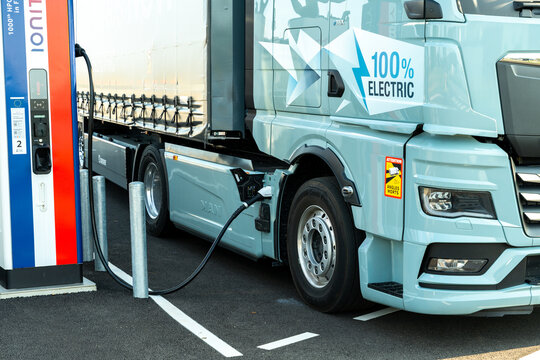
In China’s logistics corridors, a silent army is taking shape.
It is not the roar of diesel engines that dominates the landscape, but the nearly imperceptible hum of electric and autonomous trucks.
What began as isolated trials in ports like Tianjin and Yangshan around 2018 has evolved, by 2026, into a bold and structured national strategy.
The Asian giant is not only electrifying its heavy fleet; it is reinventing it, merging autonomous driving, high-capacity batteries, and smart infrastructure into a model that could redefine global freight transport and its carbon footprint.
The drive is largely a matter of state policy.
Commitments such as “Made in China 2025” and the ambitious “Blue Sky Defense” have created an ecosystem of subsidies, tax exemptions, and mandates that make the transition economically irresistible.
As reports from the China Association of Automobile Manufacturers (CAAM) note, the result was tangible: in 2025, electric vehicles already captured 22 percent of the new heavy-duty truck market, a figure projected to exceed 60 percent this year.
According to international analyses, this massive migration is already reducing daily oil demand by more than a million barrels.
The real novelty in 2026, however, lies in the convergence of electrification with Level 4 automation.
The recent announcement by SANY and Pony.ai about mass production of their fourth-generation autonomous truck, with batteries exceeding 400 kWh, is paradigmatic.
These vehicles not only promise to eliminate about 60 tons of CO₂ per unit annually but, operating in “1+4” convoys (one driver supervising five vehicles), reduce logistics costs by up to 29 percent.
Energy efficiency and operational efficiency reinforce each other.
Infrastructure is the other pillar of this revolution.
The vision does not depend solely on advanced trucks, but on a network that supports them.
Here, initiatives such as CATL’s ultra-fast battery swapping system are crucial.
With plans to cover 150,000 km of highways, this “swapping network” eliminates the Achilles’ heel of heavy electric transport: long charging times.
It enables nearly continuous operations, replicating the practicality of diesel but with zero direct emissions, as promoted by the Ministry of Transport.
Experts consulted by state media such as Xinhua emphasize that this advance is not merely technological, but geopolitical.
China is consolidating a complete domestic supply chain—from lithium extraction to autonomy software—that ensures its leadership in the industry of the future.
By simultaneously electrifying and automating its logistics sector, the country addresses two critical goals: energy security and the carbon neutrality target for 2060, turning its highways into real-scale laboratories.
Where China is heading in 2026 is clear: toward a freight transport model that will, by default, be electric, connected, and increasingly autonomous.
Ports and corridors are no longer the final destination of this transformation, but its starting point.
The combination of an aggressive policy framework, dizzying industrial innovation, and massive infrastructure deployment places the country in a unique position to export not only vehicles but an entire ecosystem of clean logistics.
The race to decarbonize heavy transport has, for now, a clear leader accelerating at full battery power.
Have any thoughts?
Share your reaction or leave a quick response — we’d love to hear what you think!
-
 0
0
-
 0
0
-
 0
0
-
 0
0
-
 0
0
