
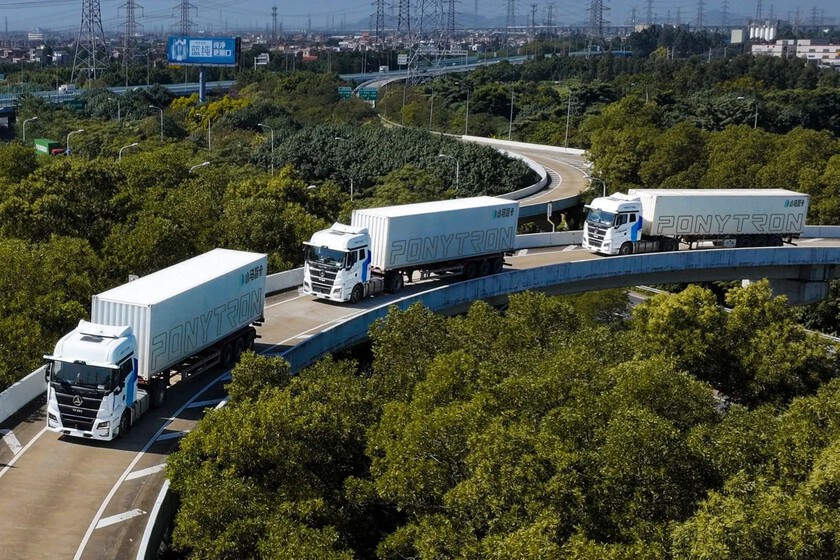
The recent announcement by the SANY Group and Pony.ai consortium in China, starting January 2026, confirming the mass production of their fourth-generation heavy-duty autonomous truck for commercial operations from 2027, is not an isolated event. On the contrary, it represents the culmination of a meticulous, long-term national strategy that we have been following.
This milestone is the commercial realization of a vision that began with experimental trials in ports like Tianjin almost a decade ago and was articulated through policies such as “Made in China 2025” and the “Blue Sky Defense.”
The true revolution announced lies not only in autonomy or electrification separately, concepts previously explored. The radical novelty is their synergistic integration into a scalable operating system: the “1+4” convoy.
This pragmatic model, where a human driver leads a fleet of four autonomous cab-less units, solves multiple frictions at once. It elegantly addresses regulatory and social acceptance challenges by maintaining supervisory human control while exponentially multiplying operator productivity and optimizing costs in controlled logistics environments, such as ports and industrial corridors that were its initial testing grounds.
This advancement is inseparable from the parallel maturation of energy infrastructure. The electrification of these logistics mastodons with swappable batteries exceeding 400 kWh, supported by CATL’s rapid battery-swapping station network, has been the other fundamental pillar.
The solution to the charging time bottleneck, transforming it into minutes of swapping, is what makes 24/7 operational viability possible—something that would otherwise be an interesting but impractical technological exercise for heavy-duty transport demand.
What lends unprecedented industrial credibility to this announcement are the concrete and quantified performance metrics that accompany it.
These are not futuristic promises but pilot results: a 29 percent reduction in cost per kilometer and a decrease of up to 60 tonnes of CO₂ per unit annually.
These figures make the proposal an irresistible financial and environmental equation for logistics managers, aligning economic incentives with the imperative of decarbonization.
The technical architecture reveals a maturity designed for hostile industrial environments. The “drive-by-wire” system with full redundancy in all critical components—from braking to computing—and its validation in electromagnetic and thermal stress tests indicate that this development has moved beyond the laboratory phase. It is built from the ground up for resilience and operational safety in the real world, alongside cranes, in sandstorms, or amid the radio-frequency bustle of a smart port.
With this step into mass production, China is not simply launching a new vehicle; it is institutionalizing a new industrial standard for freight transport.
The commercially viable convergence of autonomy, electrification, agile infrastructure, and an intelligent operating model marks a turning point.
This episode continues its prior history by demonstrating how a persistent state strategy, combined with public-private collaboration and a focus on specific application scenarios, can catalyze the transition from experimental prototypes to the total reinvention of a global industry. In China, the future of logistics—electrified and autonomous—has begun its irreversible deployment phase.
Have any thoughts?
Share your reaction or leave a quick response — we’d love to hear what you think!
-
 0
0
-
 0
0
-
 0
0
-
 0
0
-
 0
0
