
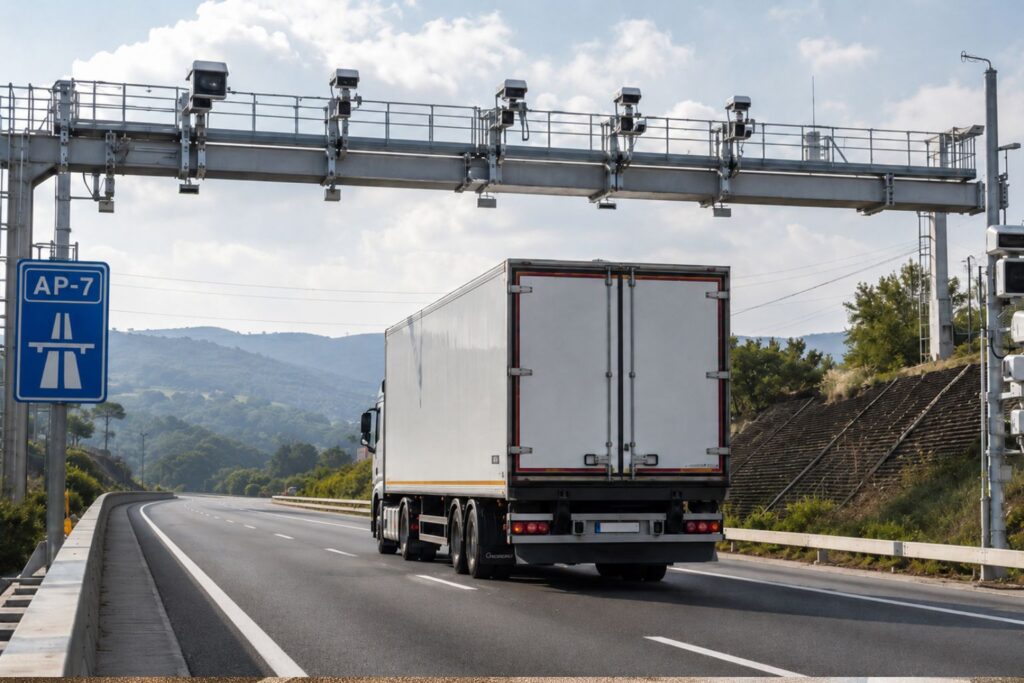
The Government of Catalonia has just launched a pioneering system in Spain that promises to revolutionise road transport surveillance on the AP-7. With an investment of €4.4 million, the network of smart stations turns the old toll booths – those orange-roofed cabins that became obsolete after the barriers were removed – into advanced technological gantries capable of detecting infractions in trucks and coaches while they are moving, without the need to stop them. The first point, already in the testing phase, is located near the former Martorell toll plaza.
The AP-7, officially the Mediterranean Motorway, is much more than a road: it is the main logistics artery of the Spanish Mediterranean arc. Along its route through Catalonia, it covers 262 kilometres connecting the French border with Tarragona, crossing the provinces of Girona (92 km), Barcelona (119 km) and Tarragona (51 km). Its strategic importance is paramount: it channels long-distance traffic skirting the Barcelona metropolitan area and, since tolls were scrapped, it has become a congested route, with heavy vehicle traffic exceeding 20,000 trucks per day and peaking at 28,000 on the Martorell stretch.
The new system, already operational in July 2026, combines high-definition cameras, sensors, automatic licence-plate readers, radars and dynamic weighing platforms embedded in the road surface, capable of estimating a vehicle’s weight even at speeds of up to 200 km/h. In real time, the technology verifies the validity of the MOT/ITV, the existence of compulsory insurance, transport authorisations and accesses data from the second-generation smart tachograph to control driving and rest times. Eight control points – seven on the AP-7, from La Jonquera to Vila-seca, and one on the C-33 – make up this network. If an irregularity is detected, a variable-message sign tells the driver, by means of their licence plate, to pull into a designated area, where Mossos d’Esquadra officers and transport inspectors are waiting to carry out an in-person check and, where necessary, issue a penalty.
The significance of this initiative goes far beyond mere surveillance. Between January and April 2026, 8,264 trucks were inspected in Catalonia, resulting in 7,219 reports, most of them for driving without the mandatory rest breaks. The technology now makes it possible to multiply the effectiveness of checks without generating tailbacks, easing the pressure on a saturated road. It is not a system that fines automatically: human supervision is always present. But it does represent a paradigm shift: the AP-7, the motorway that connects the north and south of the Mediterranean, becomes the first Spanish corridor where artificial intelligence and sensors keep silent watch, without halting the flow of goods that drives the country’s economy.
Have any thoughts?
Share your reaction or leave a quick response — we’d love to hear what you think!
-
 0
0
-
 0
0
-
 0
0
-
 0
0
-
 0
0
