
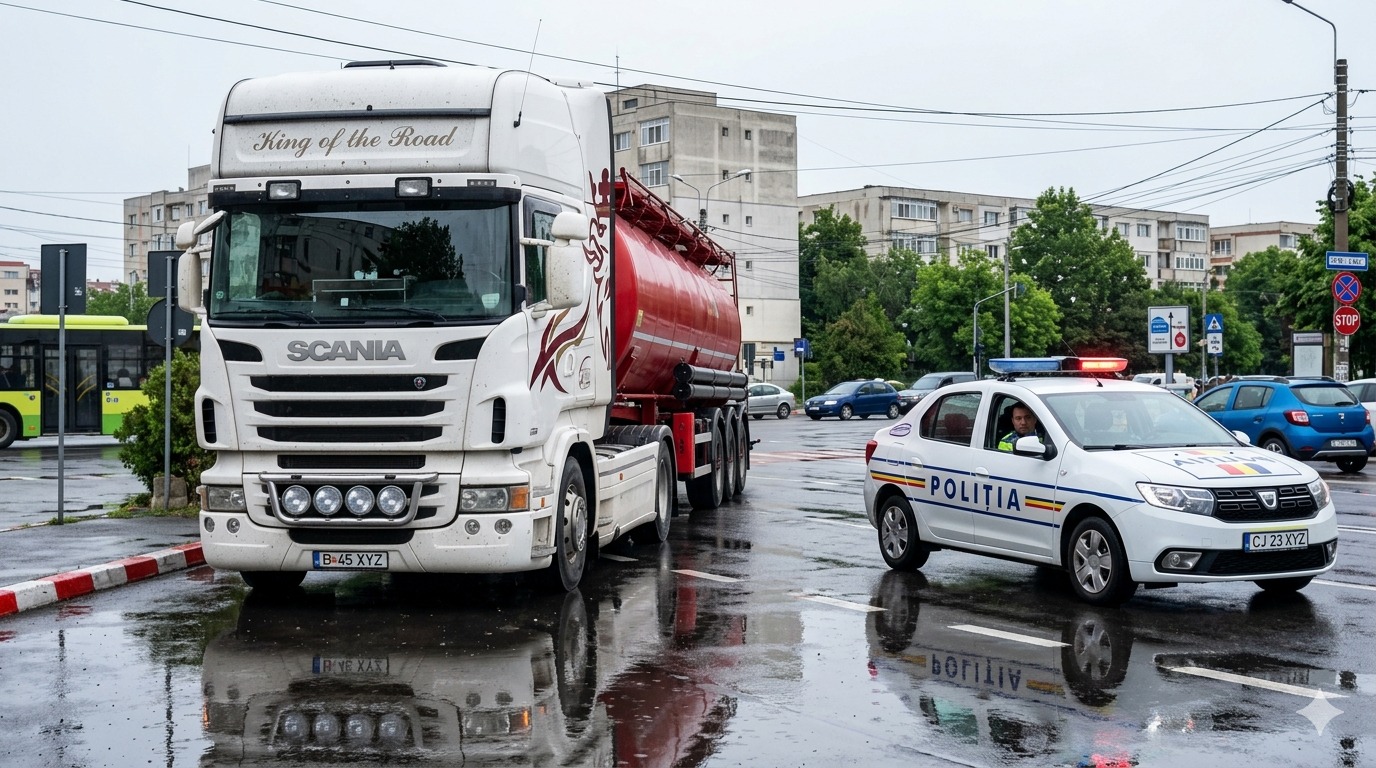
This year, Romania has undertaken a profound transformation of its toll system, aligning with European environmental guidelines, as highlighted by several Spanish-language digital publications.
Although the country already operated with the electronic Rovinieta vignette for almost its entire non-urban road network (motorways, national and European roads), the big change has come with the new TollRo system.
Although its full implementation was postponed from 1 January to 1 July 2026 due to technical delays in the central IT system, the new regulation already marks a before and after, especially for heavy transport. This model, which applies the “polluter pays” principle, is already in force for vehicles over 3.5 tonnes, while for cars and light vehicles the traditional system remains in place.
For heavy vehicle drivers, the financial impact is more than notable. The traditional Rovinieta system, which cost €1,210 per year for a four-axle truck, has been replaced by a pay-per-kilometre system. The new TollRo rates are calculated based on weight and, crucially, on the vehicle’s Euro emission class.
For example, on a motorway, a heavy truck (Category III, >12 t) with clean technology (Euro VI) pays 0.48 lei/km, while a more polluting one (Euro III) can pay up to 0.62 lei/km, which is almost 30% more. To put it in perspective, a Euro VI truck covering 100,000 km per year on motorways will pay around €7,000 per year, which is six times the cost of the old annual Rovinieta. This drastic increase was designed precisely to encourage fleet renewal towards less polluting models.
Regarding the location of tolls, Romania has opted for a model that combines generality with specific exceptions. The Rovinieta is a general levy applied to all motorways (Autostrăzi), express roads (Drumuri expres) and national roads, except for sections that pass through urban areas. The main network covers about 1,075 km of motorways connecting Bucharest with major cities such as Constanța, Sibiu and Timișoara. To this are added additional physical tolls on large infrastructures, such as the bridges over the Danube at Fetești–Cernavodă (on the A2 motorway towards the Black Sea coast) or the international bridges Giurgiu-Ruse and Calafat-Vidin, where an extra fee is paid for crossing. Paying is simple: the vignette is purchased at service stations, post offices, online or via apps, and is linked to the licence plate, with no need for stickers.
This regulatory change directly affects transport operators’ bottom line. Replacing a fixed annual fee with a per-kilometre, emissions-based payment favours those who cover few kilometres in Romania or already operate modern fleets (Euro VI), but severely penalises those with extensive routes or old vehicles. For example, a heavy truck operating mainly outside Romania and covering less than 50,000 km per year in the country would potentially benefit. However, the industry now faces cost volatility and the need to plan routes more precisely, as the final cost will depend on actual kilometres travelled. The initial unpredictability has been such that the Romanian government first planned to implement the system in January and finally postponed it to July, leaving a six-month transition period in which the rules for the sector are still being defined.
Failure to pay the Rovinieta or the new toll can be very expensive. The Romanian authorities, through CNAIR and the police, carry out exhaustive checks with fixed and mobile cameras that read licence plates throughout the country. Fines are exemplary and deterrent, especially for heavy transport. While for a car the minimum penalty is equivalent to twice the price of the annual vignette, for a truck over 12 tonnes the fine can go up to 4,000-4,500 lei (about €800-900). In the most serious cases, fines can reach €5,600. To avoid problems with the new regulation, drivers are advised to always purchase the Rovinieta in advance and to check official platforms such as e-rovinieta.ro to verify its validity before starting any route.
When you pay a toll, whether with a sticker on the windscreen, an electronic tag or at a physical booth, it is easy to think that you are only buying the right to step on the asphalt. But the reality is much broader. In most European nations, toll collection has two main objectives. The first and most obvious is to finance the construction, conservation and operation of the roads themselves: motorways, bridges and tunnels do not pay for themselves. In countries such as France, Italy or Spain, tolls support private or semi-public concessions that guarantee road maintenance, winter cleaning, signage and emergency services. In nations like Germany, the truck toll is specifically dedicated to a fund for transport infrastructure, including roads, railways and waterways.
But the purpose of tolls has evolved beyond a simple “usage fee”. Today, many governments use it as an environmental policy and traffic management tool. For example, the so-called “per-kilometre toll” already in operation in Germany, Austria and the Czech Republic, and which Romania has just adopted, applies higher rates to older, more polluting trucks, following the “polluter pays” principle. In cities like London or Stockholm, urban congestion charges not only seek to raise revenue but also to discourage car use during peak hours and reduce emissions. In Switzerland, the flat-rate annual toll for heavy vehicles is partly used to shift freight from road to rail. So next time you pass through a toll booth or buy your vignette, remember: you are not only paying for the asphalt you tread, but also for the air you breathe and the traffic jam you might just avoid.
Have any thoughts?
Share your reaction or leave a quick response — we’d love to hear what you think!
-
 0
0
-
 0
0
-
 0
0
-
 0
0
-
 0
0
