
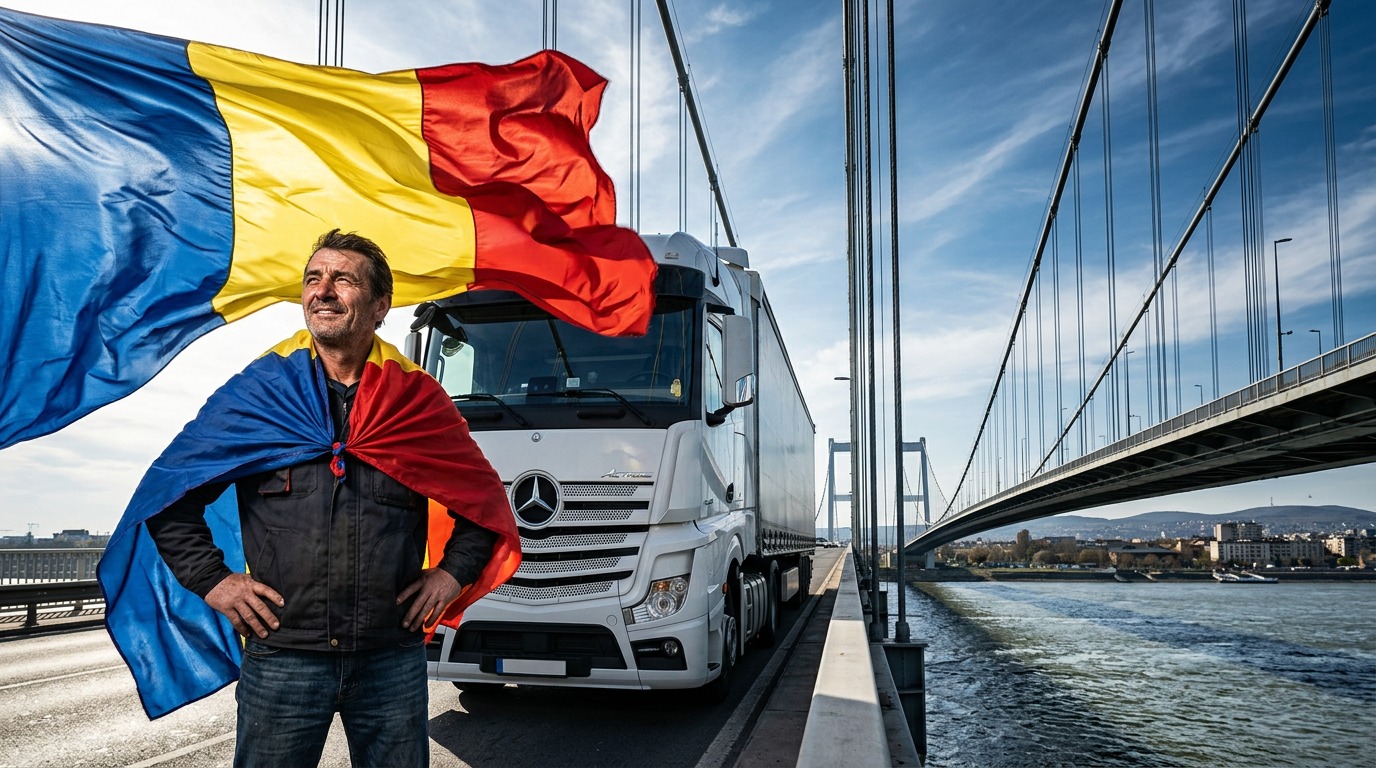
At the foot of the imposing Carpathians and bathed by the waters of the Black Sea, Romania presents itself as a country of geographical contrasts that condition its logistics network. However, in 2026, it is not only its geography that sets the pace for carriers, but a new, strict wave of legislation. While truck drivers struggle with long distances and driving bans on public holidays, the Romanian authorities have deployed a regulatory arsenal aimed at leaving little room for error.
A country of three natural regions: The geographical challenge of Romanian transport
The Romanian territory, with an area of 238,391 square kilometers, is divided into three geographical regions that pose a constant challenge for heavy transport: the Carpathians, which cross the country from north to south with peaks exceeding 2,500 meters; the hills and plateaus surrounding these mountains; and the vast plains of the south and east, bathed by the Danube River before it flows into the Black Sea. This diversity, offering landscapes ranging from the mists of the Danube Delta to the peaks of Moldoveanu, forces truck fleets to face difficult mountain passes and communication routes that, although improved, still demand meticulous logistics planning.
The digital revolution of transport: The UIT code and the logistics fee
January 1, 2026 marked a before and after for the sector. Romania has fully activated the RO e-Transport system, which requires that all international shipments exceeding 500 kg in weight or 10,000 RON in value generate a unique UIT code before starting the route. “Failure to generate or present a valid UIT code may result in fines, transport delays, or even confiscation of undeclared goods,” authorities warn. Additionally, a new logistics fee of 25 RON (approximately 5 euros) has been implemented for each package entering Romania from a non-EU country, adding an extra layer of bureaucracy to international operations.
Tolls, tachographs, and new technical requirements for trucks
The new rules are not limited to the digital realm. As of July 1, 2026, vehicles between 2.5 and 3.5 tonnes engaged in international transport must be equipped with a second-generation smart tachograph (Smart Tachograph G2V2). In parallel, the TollRo toll system, which came into force on July 1, 2026, establishes per-kilometer rates for heavy vehicles based on their weight and emission levels (Euro VI, V-IV or III-0). The most polluting trucks will pay a surcharge of up to 30%, while Euro VI vehicles will benefit from reduced rates.
The truckers’ ordeal: Driving restrictions and legal loopholes
For drivers behind the wheel, the pressure is even greater. Romania has published its heavy traffic restriction calendar for 2026, affecting vehicles over 7.5 tonnes on the eve of public holidays (from 4:00 PM to 10:00 PM) and during full public holidays (from 6:00 AM to 10:00 PM). Dates such as Orthodox Easter (April 10-13) or Christmas force carriers to find secure parking and rethink their routes. However, in a relieving gesture, a recent law passed by the Romanian Senate exempts drivers from the obligation to load or unload goods themselves, under threat of fines of up to 5,886 euros for offenders.
The heavy burden of legislation: A sector in check?
It is a fact that truck drivers always feel the weight of laws more than any other link in the chain. While managers see UIT codes as a computer procedure, for the driver it is added pressure at a border or during a routine check. With Romania’s full entry into the land Schengen area, cargo flows have intensified, but so have checks. Foreign carriers must ensure they carry the community license (valid for 10 years) and conforming copies for each vehicle, as well as respect the strict driving and rest times set by the European Union.
Looking to the future: Adaptation as the only way forward
Romania, with its mix of rugged mountains and endless plains, consolidates itself in 2026 as a market of opportunities, but also as a scenario where improvisation is very costly. The combination of green tolls, the mandatory tachograph for lighter vehicles, and the complete digitalization of cargo through RO e-Transport paint the picture of a country that demands high-level professional management. For the truckers who travel its roads, the maxim remains the same: in Romania, the landscape is spectacular, but the regulations are relentless.
Have any thoughts?
Share your reaction or leave a quick response — we’d love to hear what you think!
-
 0
0
-
 0
0
-
 0
0
-
 0
0
-
 0
0
