
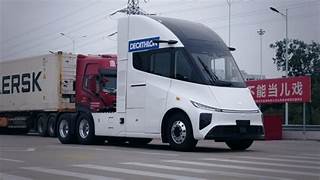
The fleets of delivery trucks and vans that now silently cruise China’s highways are the result of a technological feat that began more than two decades ago, when the Asian giant secretly bet on electrifying freight transport.
In 2008, while Beijing dazzled the world with a fleet of 50 electric buses during the Olympic Games, Dongfeng Motor was discreetly testing the country’s first zero-emission delivery trucks in the city of Wuhan.
Those early vehicles — which required five hours of charging to achieve between 100 and 150 kilometers of range, carried barely one ton, and cost four times as much as a diesel — were the timid starting signal for a revolution that no one imagined at the time.
But the seed of the electric cargo vehicle had been planted even earlier. In 2003, some Chinese truck manufacturers were already experimenting with diesel-electric hybrid systems, although the technology at the time failed to lower operating costs. Five years later, after failed tests of trucks with swappable batteries, the sector began to gain momentum with government support that became more consistent from 2009 onward. That was when the Chinese state began injecting massive subsidies, not only for passenger cars but also for commercial vehicles, in a ten-year plan that would completely transform the industrial landscape. Although the initial focus was on buses and light vans, the commitment to heavy freight vehicles was already outlined as a medium-term strategic objective.
The real turning point for electric trucks would come in the 2020s, when the central government forced key sectors such as steel, cement, and energy to include a minimum percentage of new energy vehicles in their fleets. This policy, combined with generous subsidies to replace diesel trucks, caused the domestic market to explode: while in 2021 new energy trucks accounted for barely 0.7% of heavy vehicle sales in China, by 2025 that percentage was approaching 30%. The result is an ecosystem of manufacturers — BYD, Farizon, Sany, Sinotruk — that have integrated their own supply chains and drastically reduced costs, to the point that today driving one kilometer with an electric truck in China costs approximately one third of what it would cost with an equivalent diesel.
Battery technology has been the great catalyst of this race. China has gone from having just two battery manufacturers for electric vehicles in 2005 to producing more than three quarters of all lithium-ion batteries in the world. Giants like CATL and BYD have developed battery swapping systems that allow recharging in five minutes, and the country has deployed so-called “green corridors”: fast-charging networks for heavy vehicles that connect ports and industrial regions across thousands of kilometers, such as the 2,200-kilometer route linking Tianjin to Gansu with 27 stations.
Already in 2026, China has consolidated its global leadership with measures that reflect the maturity of its industry. As of January 1, the world’s first mandatory regulation limiting the energy consumption of electric passenger cars and conditioning tax incentives on compliance came into force, forcing manufacturers to further increase their efficiency. At the same time, Beijing has required export licenses for electric cars in an attempt to regulate foreign competition. The figures speak for themselves: between January and February 2026, China exported nearly 670,000 electrified vehicles, 88% more than in the same period the previous year. More than half a dozen Chinese manufacturers plan to break into the European heavy truck market this year with prices up to 30% below the continent’s average. What began as a discreet experiment in Dongfeng’s workshops nearly two decades ago has become an unstoppable industrial machine that is redefining the future of freight transport across the planet.
The Chinese assault on the global electric truck market in 2025
Last year, China not only consolidated its domestic dominance but literally flooded the global market for electrified heavy vehicles. According to specialized digital transport publications in Spain, the Asian giant led the global ranking with approximately 29-30% of sales of pure and hybrid heavy electric trucks, which translated into more than 231,000 units registered in 2025 alone. The trend was so overwhelming that in December of that year, electric trucks surpassed diesel in monthly Chinese registrations for the first time, reaching a 54% share. Meanwhile, in Europe, the percentage of electric trucks barely touched 4%, with about 23,700 vehicles — an abysmal difference that highlights the competitive gap.
The factors behind a silent flood and lessons for the world
How did China achieve this global assault? Spanish industry media highlight three keys that explain the “flooding” of the market by Chinese manufacturers. First, state subsidies, which offered up to €17,400 for each diesel truck replaced by an electric one. Second, the cost advantage: Chinese trucks cost up to 30% less than their European equivalents. Third, a recharging infrastructure for heavy vehicles that already has 136,000 high-power points in China, compared to barely 1,519 in the European Union. While Europe struggles with tariffs, regulations on battery origin, and a still-green network, China has leveraged its scale and speed to reshape global heavy transport, shifting the innovation center toward Asia and offering a clear lesson for emerging markets like Latin America: the combination of technology, coordinated subsidies, and massive infrastructure deployment can generate unbeatable disruptions.
Have any thoughts?
Share your reaction or leave a quick response — we’d love to hear what you think!
-
 0
0
-
 0
0
-
 0
0
-
 0
0
-
 0
0
