
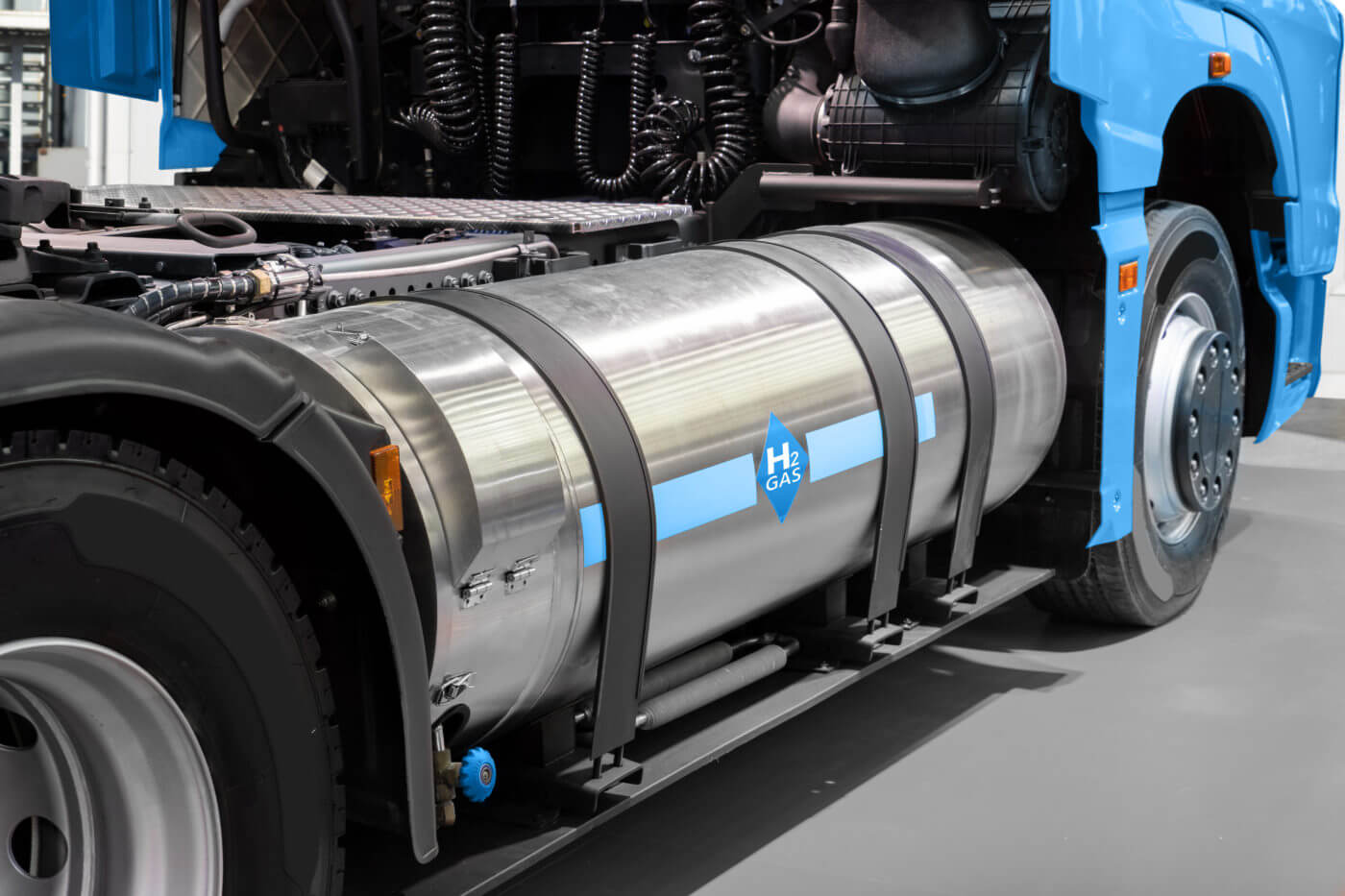
Hydrogen is positioning itself as an alternative with great potential to decarbonize the transport sector, especially in the heavy vehicle segment. Its use in trucks is based on a technology known as a fuel cell (Fuel Cell Electric Vehicle or FCEV). It works similarly to an electric vehicle, but instead of storing electricity in a giant battery, it generates it on board. The process is simple: compressed hydrogen stored in tanks is introduced into the fuel cell, where it mixes with oxygen from the air. This chemical reaction generates the electricity that powers the engine, and the only byproduct emitted from the exhaust pipe is water vapor. For the driver, the experience is identical to that of a traditional diesel truck, as hydrogen refueling takes only 3 to 5 minutes, offering great range and no waiting times for battery recharging.
The history of hydrogen as a fuel goes back much further than one might imagine, although its application in the automotive industry has had an intermittent development. The first documented attempt was in 1806, when the Franco-Swiss inventor François Isaac de Rivaz designed an internal combustion engine that ran on a mixture of oxygen and hydrogen, albeit with no commercial success. Later, in 1863, the Belgian Étienne Lenoir created the “Hippomobile,” a vehicle that burned hydrogen and sold nearly 400 units. However, the modern concept of the fuel cell was born in 1842 by the Welsh physicist William Grove. We had to wait until 1966 for General Motors to develop the first van with this technology, the Electrovan, a pioneering project that demonstrated technical viability but was unfeasible due to its high cost and the enormous space occupied by the tanks. The true modern impetus would come decades later, with Toyota as a major advocate, starting its research in 1992 and launching the Mirai in 2014, the first mass-produced fuel cell car.
In terms of energy efficiency, hydrogen presents a very significant conceptual advantage for heavy transport. Its main virtue is its extremely high energy density: one kilogram of hydrogen contains approximately 33.3 kWh of energy, almost three times more than gasoline or diesel. Furthermore, fuel cells convert this energy into electricity with an efficiency of around 60%, far superior to the 20-30% of a traditional internal combustion engine. However, it is crucial to analyze “well-to-wheel” efficiency. While it is very efficient in the vehicle, the processes of producing, compressing, and transporting hydrogen entail considerable energy losses. In this complete cycle, a battery electric vehicle makes better use of primary energy, but for long-distance and high-load applications, where the weight of batteries is prohibitive, hydrogen becomes the technically most efficient and practical option.
The cost is, today, one of the main challenges for its mass implementation. Currently, the price of hydrogen at the pump makes the cost per kilometer slightly higher than that of traditional fuels, although it can be similar to that of a diesel vehicle, estimated at around €8.5 per 100 kilometers. The biggest burden is the purchase price of the vehicle, which is very high due to the complexity and materials of the fuel cells and the sophisticated high-pressure tanks. However, forecasts point to a drastic reduction in these costs in the coming years. Initiatives like the “Hydrogen Hubs” in the United States, with an investment of $7 billion, seek to scale up production and make green hydrogen cheaper, which is expected to be competitive with natural gas by 2050. Furthermore, the maintenance of these engines is minimal compared to combustion engines, which can lower the total cost of ownership in the long run.
The environmental benefit is, without a doubt, its biggest asset. When used in a fuel cell, hydrogen generates no local polluting emissions or greenhouse gases, emitting only water vapor. This makes it an indispensable tool for meeting emission reduction targets, especially in sectors that are difficult to electrify such as maritime transport, rail, and of course, road freight. It is important to note that the overall emissions balance depends on the origin of the hydrogen. Only the so-called “green hydrogen,” produced by electrolysis of water using renewable energies such as solar or wind, guarantees a completely carbon-free cycle. Therefore, the development of this technology goes hand in hand with the expansion of renewable energies to ensure its sustainability.
Despite its clear advantages, the adoption of hydrogen in freight transport faces logistical and infrastructure challenges reminiscent of the early years of the automobile. The network of refueling stations, known as hydrogens stations, is still very scarce and insufficient for long-distance routes, creating a vicious circle that hinders investment in fleets and vice versa. Furthermore, the large-scale production of green hydrogen requires huge amounts of renewable electricity, which poses a technical and economic challenge. Despite these obstacles, the potential is so immense that governments around the world and large corporations are betting heavily on its development, convinced that, for heavy transport, hydrogen is not just an alternative, but the key piece for a truly sustainable future.
Have any thoughts?
Share your reaction or leave a quick response — we’d love to hear what you think!
-
 0
0
-
 0
0
-
 0
0
-
 0
0
-
 0
0
