
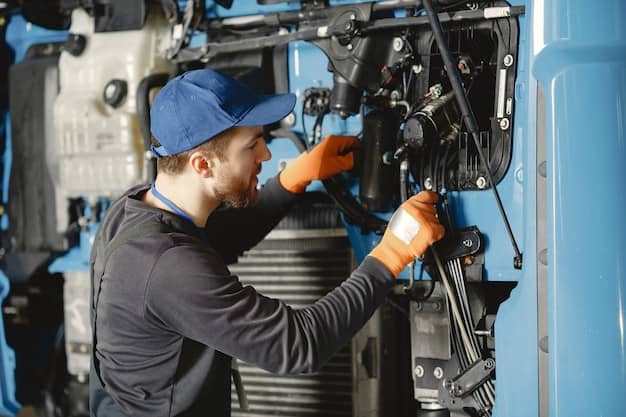
The arrival of summer and the consequent heatwaves sweeping across Spain and the rest of Europe not only affect people, but also pose an extreme challenge for road freight transport. Large vehicles, subjected to continuous strain and temperatures that turn the asphalt into an oven, require more rigorous mechanical attention than ever. It is not just about maintaining operability, but about guaranteeing driver safety, cargo integrity and punctuality on an increasingly demanding journey.
The first and perhaps most critical point of focus is the engine cooling system and the tyres. The rise in ambient temperature reduces the system’s ability to dissipate heat, making the engine more prone to overheating if the coolant level is inadequate or if the radiator is dirty. At the same time, the risk of tyre blowouts soars in summer. The friction inherent to the road combines with the external heat, and incorrect inflation pressure can be the difference between a safe route and a serious accident. Experts recommend checking pressure always when cold and adjusting it according to the load to avoid premature wear and dangerous punctures.
Another vital front is the air-conditioning system and the battery. Air conditioning is not a luxury, but a safety tool, since a cabin at high temperatures causes fatigue, dehydration and affects the driver’s reflexes. Kögel experts warn that dehydration can lead to circulatory problems and recommend consuming at least two or three litres of water per day, avoiding iced drinks that overload the circulatory system. Furthermore, intensive use of the air conditioning puts the battery to the test, as its discharge can be accelerated by extreme heat, so checking it before each route is essential.
As for brakes and fluids, summer is particularly unforgiving. Brake overheating, caused by friction and ambient heat, can lead to a loss of braking effectiveness or even complete system failure. It is vital to check the wear of pads and discs and ensure that the brake fluid is in good condition so that it does not boil and lose its force-transmission capacity. At the same time, engine oil and brake fluid must be inspected, as high temperatures can degrade their properties more quickly, compromising lubrication and safety.
To offer an extra layer of reliability in this context, the sector is adopting new technological and service solutions. Scania, for example, has launched its “Services 360” platform, which unifies maintenance and repairs across Europe, offering everything from basic packages to predictive services such as “Scania Guardian”, which warns the carrier before a component fails, based on data and algorithms. In addition, services such as “Max24” promise to resolve a breakdown in less than 24 hours anywhere on the continent, and TRP autonomous air conditioners allow the cabin to be kept cool during stops without needing to leave the engine idling, saving fuel and reducing engine wear.
But maintenance does not end with the engine. Correct tensioning of the load tarpaulins is crucial in summer, as heat causes the material to expand, potentially damaging the goods or even compromising load stability if they are overtightened when cold. From the driver’s point of view, maintaining concentration is an absolute priority. Experts agree that heat fatigue is a silent enemy, so regular breaks in the shade, light clothing made of natural fibres and light meals to avoid drowsiness are recommended. Even the simple act of ventilating the cabin before starting to expel trapped hot air improves the air conditioning’s efficiency.
In conclusion, preparing a heavy vehicle for the European summer is an exercise in foresight that combines checking traditional mechanical elements with a new generation of digital services and, above all, with a deep awareness of the human factor. Safety and efficiency are achieved not only through good route planning, but through a maintenance roadmap that prioritises cooling, tyre pressure and driver wellbeing. In a scenario of extreme heat, acting preventively is the only guarantee that the cargo and the journey will reach their destination safely.
Have any thoughts?
Share your reaction or leave a quick response — we’d love to hear what you think!
-
 0
0
-
 0
0
-
 0
0
-
 0
0
-
 0
0
