
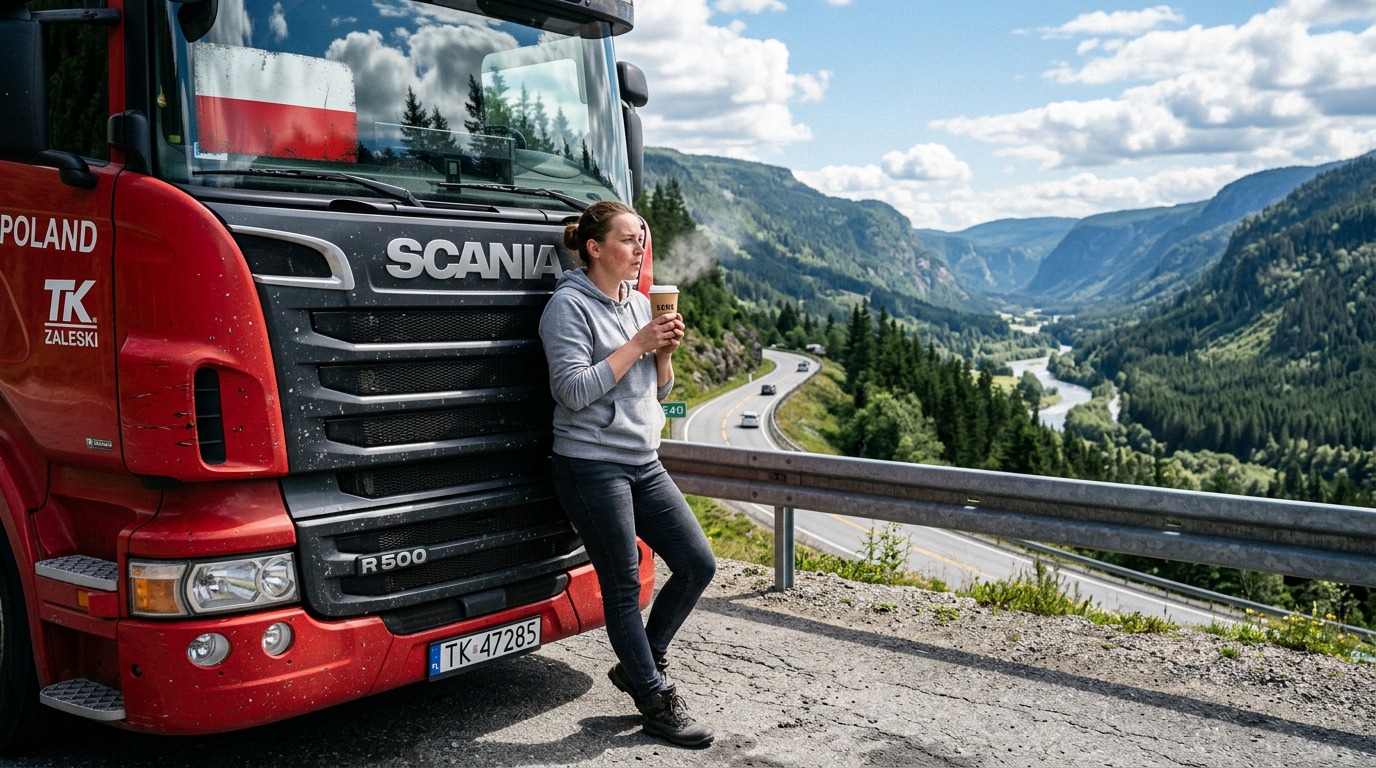
Polish roads are a mix of modern motorways and cracked asphalt. The country’s central location in Europe has turned it into a key logistics hub. Although highways like the A1 and A2 offer wide, modern stretches, the main network—some 18,000 km of national roads—barely exceeds 5,000 km of motorways. The rest are secondary routes, some in “very poor condition,” which punish punctuality and keep investment as a pending subject, since the trucks themselves cause between 35% and 70% of the deterioration.
Perhaps the most defining trait of these drivers is a solidarity that goes beyond the anecdotal. Heirs to the spirit of the “Solidarity” trade union movement, they are the first to show mutual aid on the road. In 2020, a stranded Iranian driver in a Polish town received a collection from fellow truckers and neighbours that raised nearly 100,000 zlotys in just 24 hours to buy him a new truck. A similar story occurred during the invasion of Ukraine, when a Polish trucker picked up an entire family walking to the border, simply saying: “we have to help each other.”
The truck fleet mirrors Poland’s transition: modern and dynamic. With a park of over 840,000 units, Poland has the third largest fleet in the EU, behind Germany and France. Brands like Volvo and Scania lead new registrations, although the average age hovers around 13.3 years, revealing a paradox: a large but ageing fleet, half of its units old. Regarding regulation, Polish truckers deal with a compulsory electronic toll system (e-TOLL) on motorways, and circulation restrictions for heavy vehicles, especially during peak-season weekends or holidays.
Their foresight is both a virtue and a commercial necessity. Punctuality is a deeply rooted custom in Polish culture, seen as a sign of respect. For these professionals, meeting deadlines and delivery times is the key to success in a market where working conditions are often harsh.
Although progress has been made, accident rates remain a challenge. With a rate of 52 fatalities per million inhabitants, Poland is above the European average of 46, putting the spotlight on road safety. However, there is notable progress: by applying a general strategy and measures such as the Traffic Act, the country managed to reduce road deaths by 35% in just five years. No journalistic comment would be complete without mentioning the recent protests by Polish truckers on the border with Ukraine, anticipating geopolitical challenges that will transform transport in the heart of Europe.
There are two more facets that enrich the portrait of these Polish drivers. On the one hand, their idiosyncrasy reflects a mix of roughness and tradition: they are famous for their love of homemade food at “bar mleczny” (milk bars) at service stations, where pierogi or bigos are served, and for maintaining an unwritten warning code with flashing lights for police checks or accidents ahead.
Also noteworthy is the figure of the “trucker couple”, where many wives or partners travel as co-drivers to comply with strict EU driving times, sharing the wheel on routes of up to 4,500 kilometres to the Iberian Peninsula. This nomadic lifestyle has created a subculture with its own Polish CB radios, creative nicknames, and even patron saints, such as Saint Christopher, to whom they entrust their luck before each trip.
Another striking aspect is the paradox between their technical efficiency and the human drama of “wild parking”. Poland suffers from a severe shortage of secure truck parking—barely 3,200 monitored spaces for more than 800,000 vehicles—forcing many to sleep on the hard shoulders of secondary roads or in unmonitored industrial areas. This fuels an illicit business of fuel and cargo theft, especially in the border region with Germany. However, Polish truckers have organised themselves through mobile apps such as “Truck Parking Poland”, where they share real-time locations of safe spots and denounce abusive service stations. In winter, when temperatures drop to -20°C, that collaborative network becomes vital to prevent diesel engines from freezing, showing that, despite the harshness of the trade, solidarity never stops.
Have any thoughts?
Share your reaction or leave a quick response — we’d love to hear what you think!
-
 0
0
-
 0
0
-
 0
0
-
 0
0
-
 0
0
