
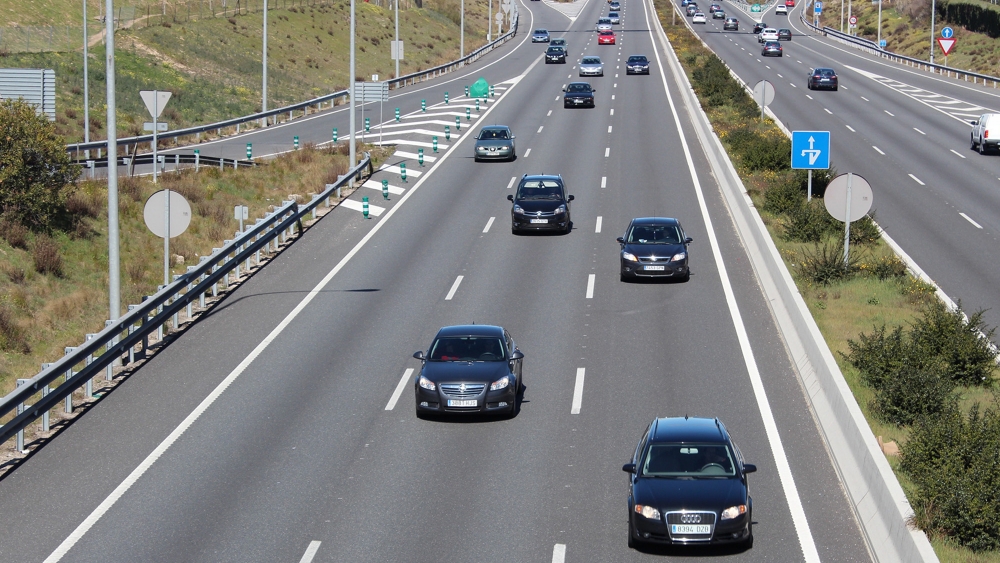
Between El Vendrell and Maçanet de la Selva, along 150 kilometres of the congested AP-7, Spain has just launched a motorway that thinks for itself. This stretch of the Mediterranean corridor – one of the country’s most critical traffic hotspots since tolls were removed – has become the testing ground for a pioneering system: variable speed limits controlled by artificial intelligence.
Gone are the fixed signs that drivers memorise. Instead, technology decides in real time what the safe maximum speed is based on what is happening on the road. And make no mistake: this is not a suggestion. The number lit up on the panel has the force of law.
What was this road like before? On this section, the AP-7 had accumulated decades of well-deserved notoriety: chronic jams, a high accident rate, and difficult coexistence between holidaymakers in cars and trucks carrying half the country’s goods. Previously, limits were static and rigid, oblivious to whether it was pouring with rain, a phantom traffic jam was forming, or fog blanketed everything. Drivers went at their own pace, then came the sudden braking, then the rear-end collision.
Now, a network of sensors, cameras and algorithms processes traffic in real time and orders the electronic signs to reduce speed – down to 80 or even 60 km/h – if danger is detected. The real novelty is anticipation: AI doesn’t just react; it predicts collapse patterns before they happen.
For lorry drivers and transport workers, this has clear pros and cons. On the positive side: fewer unexpected brakes, smoother and more constant traffic that saves fuel, and a real reduction in accidents that so often delay deliveries. A trucker who drives this stretch daily will notice less of the “accordion effect” that wears out both vehicles and nerves. But the downside is equally evident: they lose control over their own pace, and a system that abruptly cuts speed to 60 can frustrate anyone on a tight schedule. Moreover, the fine for disobeying the panel is just as real as with a fixed limit. The question many will ask is: how long does it take the AI to react once the danger has passed?
The importance of control on this stretch is no technological whim. The AP-7 between El Vendrell and Maçanet is a historic black spot where breaking the rules – speeding, ridiculous safety distances, reckless overtaking – was paid for in blood. Road regulation here is not bureaucracy; it is the line that separates a traffic jam from a multiple collision. With this system, compliance is no longer voluntary or dependent on a fixed radar. The road itself shapes driver behaviour in real time. And it does so without ambiguity: if the panel says 80, it is 80, no matter where the order comes from.
What is truly attractive about this experiment is how artificial intelligence enables something unthinkable a decade ago: managing traffic as if it were a living organism, adjusting second by second. Before, the road was dumb – just asphalt and lines. Now it has eyes (cameras), a brain (algorithms) and a voice (panels). This Catalan pilot could be extended to the entire high-capacity network if results are positive. The great lesson for transport operators and drivers in general is that technology is no longer just there to inform – it is there to decide. And on a motorway as strategic as this one – the gateway to the Barcelona metropolitan area and a key link with France – that decision can make the difference between arriving or not arriving at all.
Have any thoughts?
Share your reaction or leave a quick response — we’d love to hear what you think!
-
 0
0
-
 0
0
-
 0
0
-
 0
0
-
 0
0
