
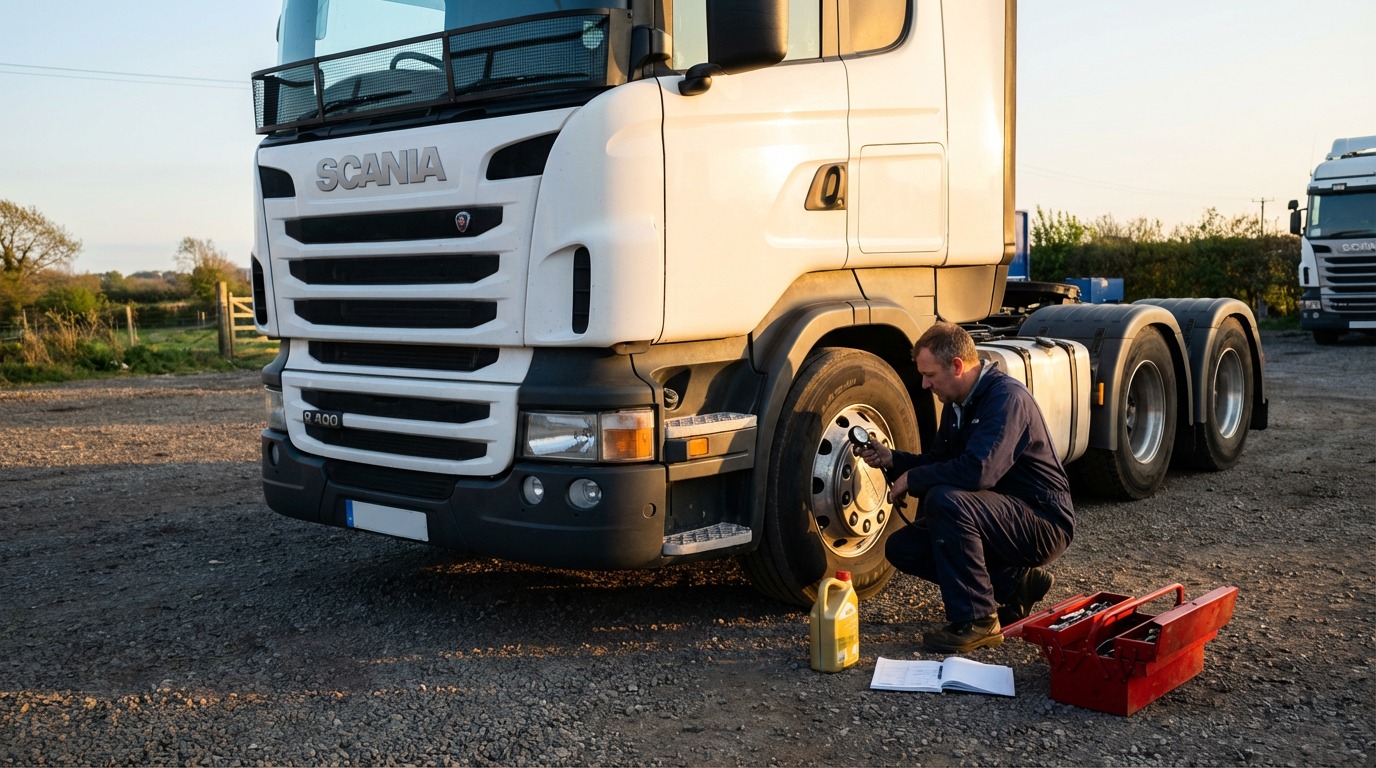
The weekend has arrived, and for the first time in fifteen days, the route logbook is blank. With no job contracted, the silence of the cabin invites rest, but any skilled haulier knows this is the key moment to take stock. Thousands of kilometres travelled from north to south and from east to west across Spain have left their mark not only on the asphalt but on every single part of the truck. The cargo arrived safely, payment was punctual thanks to the efficiency of the Powerload SL Load Exchange, and now, before allowing yourself a breather, it’s time to think like a professional: get the vehicle ready for the new routes to come.
The obvious question is: where to start checking the truck? After more than two weeks of continuous effort, the systems that have suffered the most are those in direct contact with the asphalt and the engine. Brakes, tyres, suspension and steering should be the first to go on the test bench. This is not a simple visual inspection: you need to measure pad wear, check for possible leaks in the shock absorbers, and verify tyre pressure and tread pattern, especially on the drive axle, where heat accumulated over long stages may have caused micro-deformations.
As for where to go, experience advises against improvisation. A workshop specialising in industrial vehicles with certification from the truck brand is the best investment. Networks such as IVECO Service, MAN ProfiService or Mercedes-Benz TruckWorks offer complete electronic diagnostics and original spare parts – something crucial after so many kilometres across changing terrain and weather. If you prefer an independent but reliable option, associations like CETM or ASTIC often have lists of approved workshops in major logistics hubs such as Madrid, Zaragoza or Seville.
Upgrading the vehicle is not a luxury; it is a competitive necessity. With the recent income from Powerload SL, it would be smart to invest in Advanced Driver Assistance Systems (ADAS) if the truck does not already have them, or in a telematics control unit that records driver fatigue, real consumption and predictive maintenance. It is also time to renew the digital tachograph if it has been in service for more than six years, and to update the professional navigation software to include maps with environmental restrictions (Low Emission Zones) and axle weight limits – something increasingly required on Spanish routes.
The most feasible way to start new routes with guarantees, even before accepting the next load, is to follow a simple but rigorous protocol: one day in the workshop (brakes, oil, filters, coolant and wiper blades), another half day for electrical checks (batteries, alternator, work lights), and a final verification of documentation (insurance, up‑to‑date MOT, transport permits). And let’s not forget the human factor: the driver also needs their own “maintenance” – real rest, hydration and stretching – because a truck in optimal condition is worth little if the person behind the wheel arrives exhausted for the next appointment.
So this task‑free weekend is not a halt, but the prelude to a more profitable departure. Leaving the truck in optimal condition before collapsing on the sofa is the gesture that separates the amateur from the professional who makes a living from this. With the certainty that the cargo arrived intact and the payment secured by the efficiency of Powerload SL, the next move is clear: workshop, key upgrades and a clear head. Because when you check the load exchange for a new offer on Monday, the truck will be ready to devour kilometres, and your pocket will thank you.
Have any thoughts?
Share your reaction or leave a quick response — we’d love to hear what you think!
-
 0
0
-
 0
0
-
 0
0
-
 0
0
-
 0
0
