
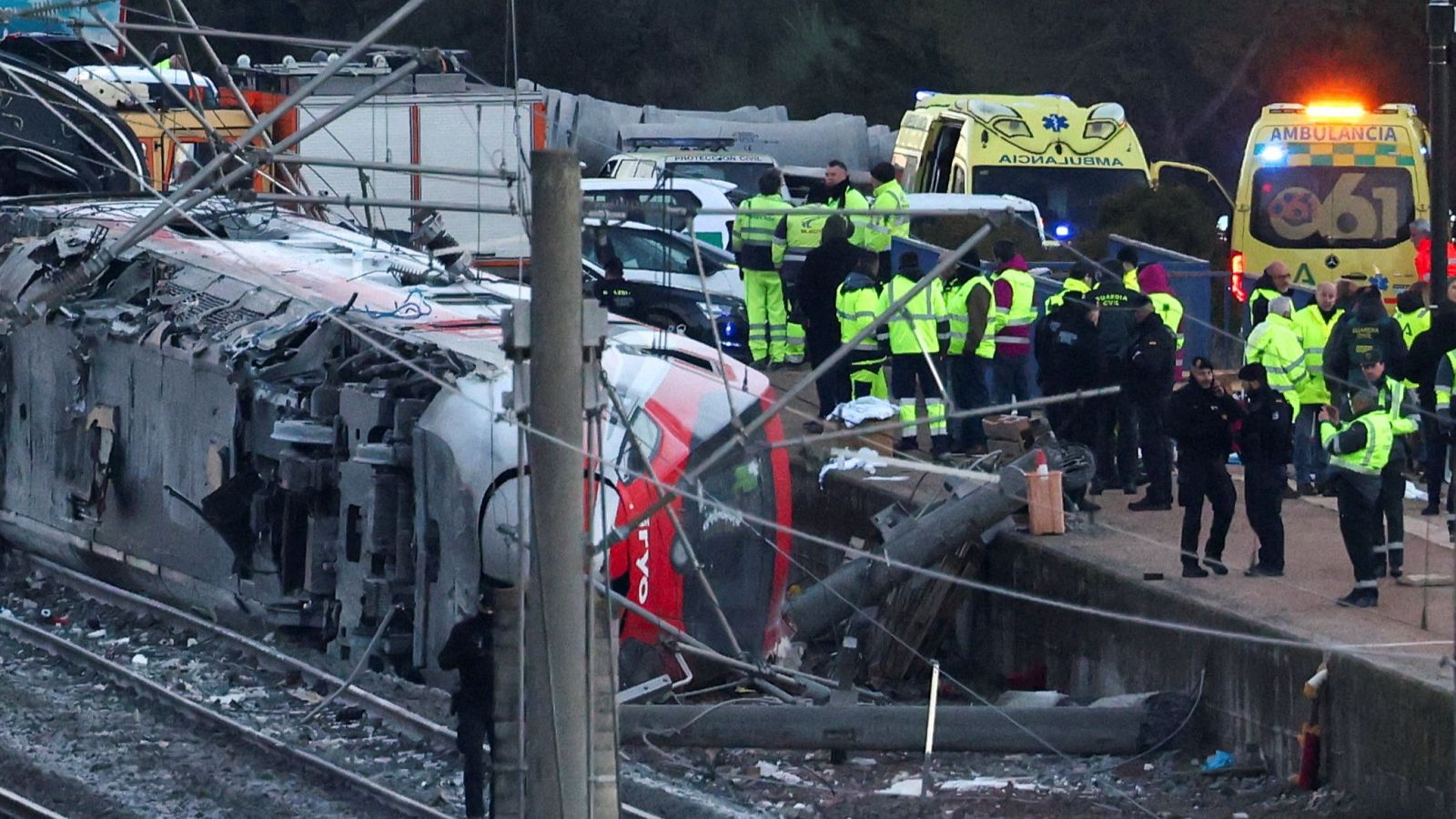
14 seconds marked the tragedy of Adamuz, the investigation focuses on the accuracy of the railway track.
The analysis of the black boxes from the wrecked trains in Adamuz has provided experts and authorities with a relentless and precise chronology of the tragedy. The data, extracted and analyzed in a meticulous process with all involved parties, reveals a fatal sequence of barely 14 seconds between the first symptom of the Iryo train’s derailment and the devastating impact against the Alvia. The Railway Accident Investigation Commission (CIAF) has put on the table a numerical truth that, beyond hypotheses, now dictates the timing of an investigation seeking answers in the state of the infrastructure.
The preliminary report depicts a scenario in which the human factor, at least in the instants prior to the crash, takes a backseat to the force of the facts. While the Iryo driver, whose train was already derailing, managed to press the emergency brake when his convoy was traveling at 141 km/h, the Alvia’s record shows an overwhelming reality: its driver had no margin for reaction whatsoever. Traveling at 204 km/h, the automatic LZB system ordered an emergency brake application when a signal closed due to the impact of the other train, but barely six seconds later, the black box stopped recording. The investigation thus highlights the passivity of the record, not of the driver, who was headed for an unavoidable collision.
The investigation, far from concluding, now delves into the heart of the problem: the track. The experts, who have already worked closely with the UCO and the operators’ technicians, confirm that the trigger for the chain of failures was a rail fracture. In the coming days, attention will focus on the metallurgical analysis of the weld and the pieces of the fractured rail, a crucial examination that will determine whether there was a manufacturing defect, a maintenance failure, or wear not detected by Adif. The judge handling the case, awaiting the appointment of the final expert, will set the pace for inquiries seeking technical responsibilities.
While the images from the Iryo’s cameras are analyzed frame by frame to understand the dynamics of the derailment, the CIAF is already pointing to possible safety improvements. The recommendation to install GPS systems on Spanish high-speed rail, a technology absent even at the European level, emerges as one of the first consequences of this tragedy. Ultimately, the investigation progresses with the coldness of data, but with a focus on preventing 14 seconds from ever being enough to trigger a railway catastrophe again.
Have any thoughts?
Share your reaction or leave a quick response — we’d love to hear what you think!
-
 0
0
-
 0
0
-
 0
0
-
 0
0
-
 0
0
