
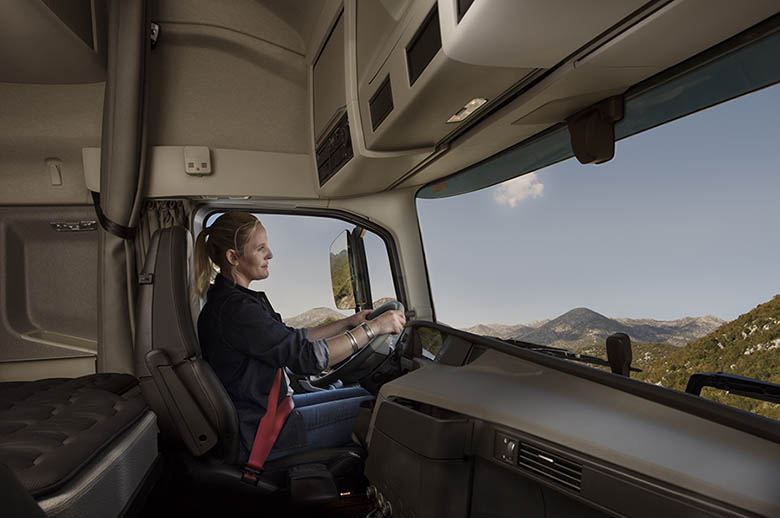
The Madrid School of Civil Engineering hosted the 4th National Women in Transport Congress this past weekend, an event that brought together female drivers, business owners, managers, and experts to address the major challenges of road transport and to vindicate the role of women in a sector that is strategic for the Spanish economy.
The conference, which concluded its successful fourth edition, delivered key pronouncements on the urgent need to attract female talent to alleviate the growing shortage of professional drivers.
A Unanimous Pronouncement: More Women to Combat the Driver Shortage
The main pronouncement of the event, which resonated across all panel discussions, was the conviction that the incorporation of women is not just a matter of equality, but a structural necessity for the survival of the sector.
The Secretary General for Transport at the Ministry of Transport and Sustainable Mobility, Rocío Báguena, who was in charge of the institutional opening, emphasized “the importance of promoting the female presence in transport to move towards a more competitive, safe, and inclusive sector.” This diagnosis was shared by all participants, who agreed that the shortage of truck drivers in Spain—one of the most pressing problems—can only be reversed by improving working and salary conditions, and by breaking down the stereotypes that keep women away from truck cabs.
Experiences from the Cab: Conciliation and Security as Challenges
One of the most emotional and revealing moments of the Congress came from the protagonists themselves. On the panel titled “Transport Seen by Women,” professional drivers Adriana Muresan and Dolores Jiménez shared their daily experiences behind the wheel, offering a raw but hopeful vision of the profession. Both agreed on pointing out the difficulties of work-life balance and safety as the main obstacles women face on the road. “It’s not just about driving a truck, but about being able to do so with the peace of mind of knowing that, at the end of the route, you can balance your personal life with your professional one,” Jiménez noted, while Muresan called on companies to adapt their fleets and policies to a more diverse reality.
Innovation and Solutions: From Digitalization to Sustainability
The Congress not only looked at the problems but also at the tools to overcome them. The panel “The Truck Seen by Women,” the most technical of the day, featured the participation of experts such as Ágatha Gracia (UTA Edenred), Belén Gómez (VDO), Camila Costa (Michelin Connected Fleet), and Rosa Zapico (Mercedes-Benz). Together, they analyzed how digitalization, smart tachographs, connected fleet management, and the advancement of electric vehicles are transforming road transport. Meanwhile, the third panel, “Solutions for Transport,” focused on sustainability and efficiency, with interventions from Celia Gómez (Repsol), Cristina Serrano (Afersa), and Gloria Ibáñez (FASERTRANS), who advocated for greater public-private collaboration and the energy transition as levers for change.
The event was attended by prominent figures from the business and association sectors, turning the School of Civil Engineering into a true forum for reflection. In addition to Rocío Báguena, managers such as Mireia Sedano (Transportes Sedano) and Anna Bronicka (Moeve) participated, contributing their vision from a business management perspective. But without a doubt, the most relaxed moment of the day was led by comedian and stand-up artist Pepa Golden, who, with her ironic and relatable performance, managed to draw laughter from the audience, demonstrating that humor also has a place in the most serious debates about the future of transport.
The “Impulsoras del Transporte” Awards: A Fitting Tribute to Female Talent
The grand finale of the Congress came with the presentation of the “Impulsoras del Transporte” Awards, an initiative promoted this year by the Scania brand to recognize the careers, talent, and contribution of women to the development of the sector. Sonia García, Director of Marketing and Communication at Scania, was in charge of presenting the awards in a ceremony filled with emotion. The award for Entrepreneurship Driver went to the WinRED project by Repsol, received by Celia Gómez, for its work in promoting female talent in the energy field applied to transport. Anna Bronicka, from Moeve, was awarded as the Equality Driver, while Marta Serrano received recognition in the Training category. The Career Driver award went to Beatriz García, and the Special Behind-the-Wheel Award “Oti Cabadas”—a tribute to one of the sector’s most beloved drivers—was granted to Liliana Condurache, in recognition of her career and dedication behind the wheel.
A Congress Consolidated as a Benchmark
The fourth edition of the National Women in Transport Congress, held at number 42 Calle Almagro, has once again demonstrated that the event is becoming an essential space to make female talent visible and to debate the future of road transport. With a program structured around panel discussions that addressed everything from the driver shortage to technological innovation, including sustainability and work-life balance, the Congress reaffirmed that the perspective of women who contribute daily to the sector’s development is key to building a more equal, innovative, and sustainable transport system. The event, which is already looking ahead to its fifth edition, leaves a clear message: the future of transport will be female, or it will not be at all.
Have any thoughts?
Share your reaction or leave a quick response — we’d love to hear what you think!
-
 0
0
-
 0
0
-
 0
0
-
 0
0
-
 0
0
