
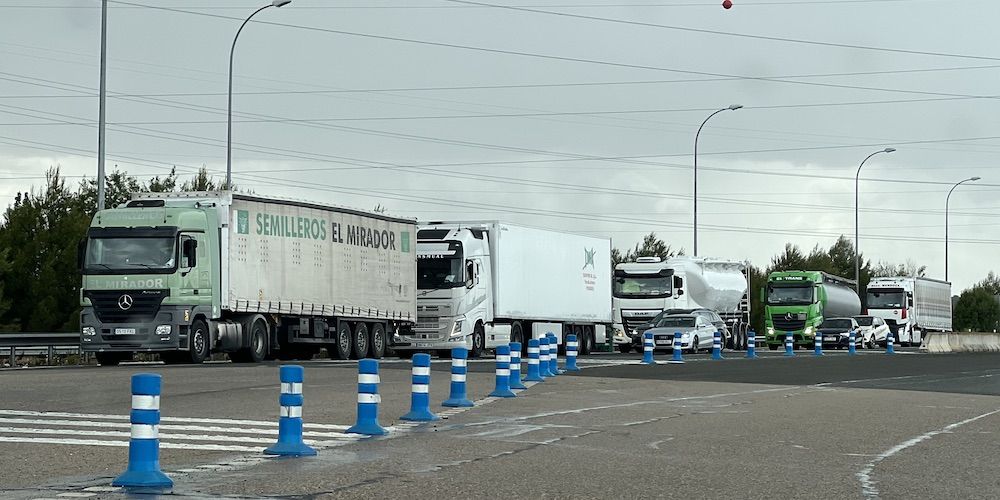
In the very heart of the Balkans, Bulgaria is consolidating its position as a trading partner of growing interest for Spain, especially for the road transport sector, which is always attentive to the flow of goods.
With an economy revolving around fuels, manufactured goods and machinery, the Balkan country is not only a key supplier of raw materials and semi‑finished products, but also an increasingly attractive destination for Spanish exports. Bulgaria’s recent accession to the eurozone, effective from 1 January 2026, has injected an extra dose of financial stability that, according to experts, paves the way for an even more dynamic trade flow.
However, the latest figures for 2025 and early 2026 paint a mixed picture: Bulgarian exports to the European Union fell by 3.8% last year, to €27.55 billion, weighed down by the industrial slowdown in its main partners, Germany and Italy. Hauliers operating on the Iberian route are asking themselves: is the journey east still worthwhile? The answer, according to the specialists consulted, is a resounding yes, albeit with nuances.
Bulgaria mainly exports fuels, manufactured goods (such as clothing and footwear), machinery and transport equipment, as well as chemical products. Its main customers are Germany, Romania, Italy, Greece and France, which account for more than 63% of its sales to the EU. But the flow is not one‑way. Bulgarian imports from the EU increased by 4.5% in 2025, reaching €30.953 billion, and those from third countries also rebounded by 5.3% in January 2026.
“What we see is an economy that, despite headwinds, continues to consume and need products from abroad. For Spain, which is seeking to diversify its markets beyond saturated central Europe, Bulgaria presents itself as a strategic alternative with relatively low logistical costs and a gateway to southeastern Europe,” explains Javier Moral Escudero, Economic and Trade Counsellor at the ICEX office in Sofia.
Spanish cargo destined for Bulgaria travels in a very defined direction and with a favourable balance for our country. In 2024, Spanish exports to the Balkan country reached €1,022.3 million, 8.4% less than the previous year, while imports also fell by 3.8%. Despite that drop, the trade balance remains positive, as shown by the most recent data: in January 2026 alone, Spain exported goods worth €80.4 million, compared to €69.9 million imported from Bulgaria, yielding a surplus of €10.5 million. Among the star products of the Spanish offer, fresh fruit and vegetables stand out, with their value soaring by 22% in the first ten months of 2025 compared to the same period in 2024, to €18.8 million, while volume grew by 4%.
Spanish wine has also made deep inroads into the Bulgarian market: in 2024, exports amounted to €3.28 million, 85% more than in 2019, placing Spain fifth as a supplier country.
And how do the two markets interact? The answer lies in a constant flow of fleet vehicles covering the more than 2,500 kilometres that separate the Iberian Peninsula from the heart of the Balkans. For hauliers, the route offers the advantage of a usually guaranteed return load, since trucks carrying Spanish agricultural products and manufactures to Bulgaria often return with manufactured goods, machinery or even construction materials.
Behind this traffic lies a growing commercial relationship, reinforced by high‑level political contacts and entry into Schengen. “Logistics is the thermometer of commercial confidence. If orders grow, hauliers immediately notice it in their schedules,” says a spokesman for the International Road Transport Association (ASTIC) in statements to this media outlet. And the data backs up this perception: in the first ten months of 2025, the agricultural sector – one of the biggest movers of freight – increased its sales to Bulgaria both in volume and value.
However, the road is not without bumps. Spanish hauliers have to contend with growing regulatory and cost pressures. “The Bulgarian market, although attractive, requires millimetric planning. Tolls are changing to align with the CO2 emission directives of the Eurovignette, which makes routes more expensive for less efficient vehicles,” warns a manager of a large Spanish fleet with operations in eastern Europe. Added to this is geopolitical volatility: Bulgarian exports to third countries contracted by 9% year‑on‑year in January 2026, with significant falls towards Turkey and Ukraine.
Nevertheless, the euro’s appreciation and entry into the eurozone offer a shield of exchange‑rate stability that specialists value very positively. “The elimination of exchange rate risk and accounting harmonisation are a huge incentive for Spanish SMEs that were taking the plunge,” agrees a foreign trade analyst.
In short, Bulgaria is consolidating itself as a first‑class complementary market, where Spanish exports are finding a growing niche for value‑added products, from wine to machinery. Despite cyclical ups and downs, the trade balance is healthy and the flow of goods constant. For hauliers, the key will be to optimise routes, adapt to new environmental requirements and take advantage of improved European infrastructure. As a sector entrepreneur concludes: “He who stops, loses. Bulgaria is not an easy market, but for those who know how to operate, it is a two‑way highway that is beginning to yield very interesting returns.” The question is no longer whether to go, but how to do it more intelligently.
Have any thoughts?
Share your reaction or leave a quick response — we’d love to hear what you think!
-
 0
0
-
 0
0
-
 0
0
-
 0
0
-
 0
0
