
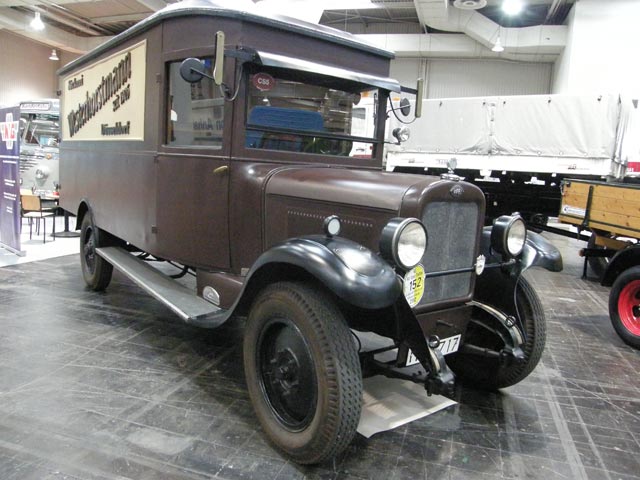
It was 1927 when the German automotive industry began to awaken to the potential of motorized transport. Amidst this landscape, Adam Opel AG, a firm that had until then distinguished itself with its sewing machines and bicycles, decided to take a bold step: to launch a truck with a 1.5-ton capacity onto the market. This vehicle did not yet carry the name that would make it legendary, but it laid the foundations for what would soon become a true myth on wheels. Germany, immersed in the reconstruction following the Great War, urgently needed reliable commercial vehicles to move its economy, and Opel, which was already the country’s largest automobile manufacturer, saw a goldmine in the cargo sector.
The Forging of a Legend Under the Lightning Bolt
It was in 1930 that this 1.5-ton truck received a name that would resonate in the history of European transport: Opel Blitz, which in German means “Lightning”. The name came from an internal company contest, seeking a term that reflected speed, dynamism, and power. And certainly, the name could not have been more fitting. This vehicle was characterized by its mechanical robustness and versatility. Initially equipped with four or six-cylinder engines, it stood out for its adaptability, being offered in different wheelbase and body configurations that made it useful both for urban commerce and the demanding rural routes of interwar Europe.
Technical Quality and an American Heart
One of the qualities that distinguished the Opel Blitz from its origin was the solidity of its engineering, strongly influenced by the brand’s American affiliation. Since 1929, Opel was part of the giant General Motors, which gave it access to advanced mass-production technologies and mechanical concepts proven on the other side of the Atlantic. From its inception, this truck incorporated elements that were synonymous with modernity for the era, such as a robust steel chassis and efficient lubrication systems. Although its early versions retained a classic design with a long hood and independent fenders, its internal mechanics reflected Opel’s ambition to industrialize freight transport with criteria of reliability and ease of maintenance.
The Expansion That Forged an Industry
The importance of the Opel Blitz for German and European automotive development is unquestionable. Opel became the largest truck manufacturer in Germany before the Second World War. The demand for these vehicles was such that, in 1935, the company inaugurated a specific plant in Brandenburg dedicated exclusively to their production, with an annual capacity of 25,000 units. This move not only consolidated Opel as an industrial pillar but also established the standards for what a European light truck should be: reliable, easy to handle, and with an excellent power-to-weight ratio. The Blitz became the backbone of German commercial transport, being the choice of bakers, builders, and merchants across the country.
The Golden Age and the Definitive Engine
As the 1930s progressed, the truck continued to evolve. In 1937, a fundamental mechanical update occurred: the incorporation of a new six-cylinder, 2.5-liter engine with 55 horsepower, the same one that equipped the Opel Kapitän and Super passenger cars. This OHV engine (overhead valves) offered superior performance compared to the outdated side-valve engines, providing the Blitz with unprecedented agility in its category. The 1.5-ton versions became the favorites for urban and interurban delivery, earning a reputation for being “indestructible” that persists among collectors to this day.
From War to Classic Legend
The outbreak of the Second World War massively militarized the model, especially the three-ton versions (3.6-36), but the legacy of the small 1927 1.5-ton Opel survived the conflict. With the Brandenburg factory devastated and dismantled, production of the Blitz in more modern versions resumed in Rüsselsheim in 1946. This truck, which had begun its life in the prosperous Weimar Republic, was tasked with leading the reconstruction of post-war Germany. Its image, with the characteristic lightning bolt on the emblem, became a symbol of the German economic miracle, demonstrating that the truck born in 1927 was not just a vehicle, but a pillar upon which modern European transport was built.
The Twilight of a Giant: From Splendor to Farewell
But the history of the Opel Blitz, like that of so many European classics, has a bittersweet chapter marked by war and reconstruction. During the Second World War, the truck’s reliability caught the attention of the German war machine. From 1939 onwards, the three-ton version, known as the Blitz 3.6, was used in large numbers by the Wehrmacht on all fronts. This military chapter, however, tarnished its legend. The Opel plant in Brandenburg, built specifically to produce these trucks, employed forced labor under the Nazi regime. The Blitz itself was adapted for sinister uses, including versions like the “Maultier” (mule) half-track for the Russian front, and tragically, some of its chassis served as the base for the infamous “gaswagen” used in the Holocaust.
The turning point came with devastation. On August 6, 1944, the Brandenburg factory was practically razed by a Royal Air Force bombing raid, permanently halting its production. Following Germany’s defeat, the facilities were dismantled, physically erasing the cradle of the “Lightning”. Paradoxically, the model’s survival fell to its former rival. By order of Minister Albert Speer, production of the Blitz 3.6 had been transferred to the Daimler-Benz plant in Mannheim, where it continued to be manufactured under the name Mercedes-Benz L 701 until 1949, to meet post-war needs.
However, the spirit of the Blitz did not fade. In 1946, at the partially rebuilt Rüsselsheim plant, Opel resurrected the 1.5-ton light version with the Opel Kapitän engine. This truck became one of the great protagonists of the German “Economic Miracle,” the Wirtschaftswunder. In 1952, the model was renewed with a modern, rounded cab design inspired by American Chevrolet pickups, becoming a symbol of reconstruction. Despite this success, the industry was changing, and the lack of an economical diesel engine began to take its toll against competitors like the Mercedes-Benz L 319.
The swan song came in 1965 with the Opel Blitz B, the last development of the line. Although gasoline engines with four and six cylinders were offered, and finally in 1968 a French-origin Indenor diesel engine (the one from the Peugeot 504), it was already too late to recover the lost market share. The American parent company, General Motors, decided not to develop a successor. Thus, in 1975, after 45 years of uninterrupted production and hundreds of thousands of units manufactured, the last Opel Blitz rolled off the assembly line. The name, however, would endure for a few more years in Europe in the form of the Bedford Blitz, a British vehicle imported until 1987. The “Lightning” was saying goodbye, but it left an indelible legacy as the truck that literally helped build and rebuild Europe during the 20th century.
Have any thoughts?
Share your reaction or leave a quick response — we’d love to hear what you think!
-
 0
0
-
 0
0
-
 0
0
-
 0
0
-
 0
0
