The global imperative to decarbonize transport has found a historic ally in a feat of modern engineering. A recent milestone proves it: the first 100 percent electric freight truck has successfully completed its journey through the Channel Tunnel, the Eurotunnel.
This pioneering journey, carried out by the LeShuttle Freight service, symbolizes the perfect convergence between visionary 20th-century infrastructure and 21st-century zero-emission technology, proving that the green transition is viable in Europe’s most critical logistics corridors.
To appreciate the relevance of this achievement, it is essential to understand the magnitude of the Channel Tunnel. It is a colossal engineering work connecting Folkestone (United Kingdom) with Coquelles (France), inaugurated in 1994 after seven years of monumental effort. At 50.5 kilometers long, with 38 kilometers running under the seabed, it is the world’s longest undersea tunnel. Its construction employed eleven giant tunnel boring machines which, advancing from both coasts, met with centimeter precision, extracting over 8 million cubic meters of material.
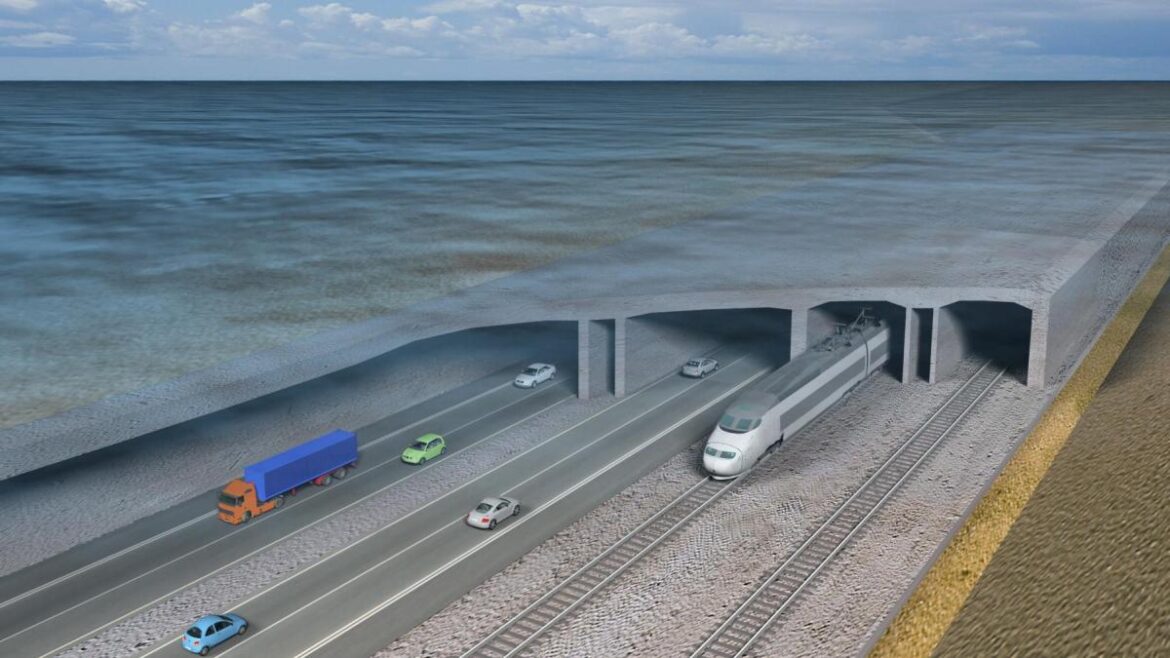
The tunnel’s design is a triumph of functionality and safety. It consists of three parallel galleries: two main rail tunnels 7.6 meters in diameter and a central service tunnel for maintenance and evacuations. A high-power ventilation system completely renews the air every 90 minutes, and it features evacuation cross-passages every 375 meters, surveillance cameras, and specialized response teams operating 24/7, staffed by over 4,000 technicians.
Although the tunnel has always been operated by electric trains, road freight transport is carried out by LeShuttle trains, which load trucks and cross them in about 35 minutes. Therefore, the historic journey of the DAF electric truck did not modify the tunnel’s infrastructure, but demonstrated the maturity of battery-powered heavy road transport, already capable of integrating into long-range international logistics operations.
This success is the direct result of a powerful collaboration between industry leaders. Kuehne+Nagel, LeShuttle Freight, Voltempo, and DAF Trucks, with support from the UK government’s Zero Emission Demonstration program, joined forces to make it a reality.
The milestone depended not only on the vehicle but also on a robust fast-charging and megawatt-scale infrastructure, a pillar as fundamental to the new logistics as the tunnel itself is to the physical connection.
The significance of the Channel Tunnel dates back to its conception. Ideas to connect the two coasts were sketched out as early as the 19th century, but it was the project begun in 1987 that overcame enormous technical, financial, and political challenges. Funded with private capital at a cost that would exceed 15 billion euros today, its inauguration in 1994 by Queen Elizabeth II and President François Mitterrand symbolically sealed a new era of European integration.
Since then, it has established itself as the main artery of Anglo-European trade, having transported over 430 million passengers and 450 million tons of freight. Being a 100% electric route from its inception, its carbon footprint per unit transported is a fraction of that of air or sea transport. Therefore, this first electric truck inside it only enhances its intrinsic ecological value.
Thus, the Channel Tunnel reaffirms itself not only as an icon of physical connection but as an essential bridge towards sustainable mobility. The powerful message of this silent truck crossing the depths of the Channel is clear: the clean transport revolution is already here, and it is advancing at full speed through the infrastructures that made history, guiding the flow of goods towards an unavoidable destination: climate neutrality.