
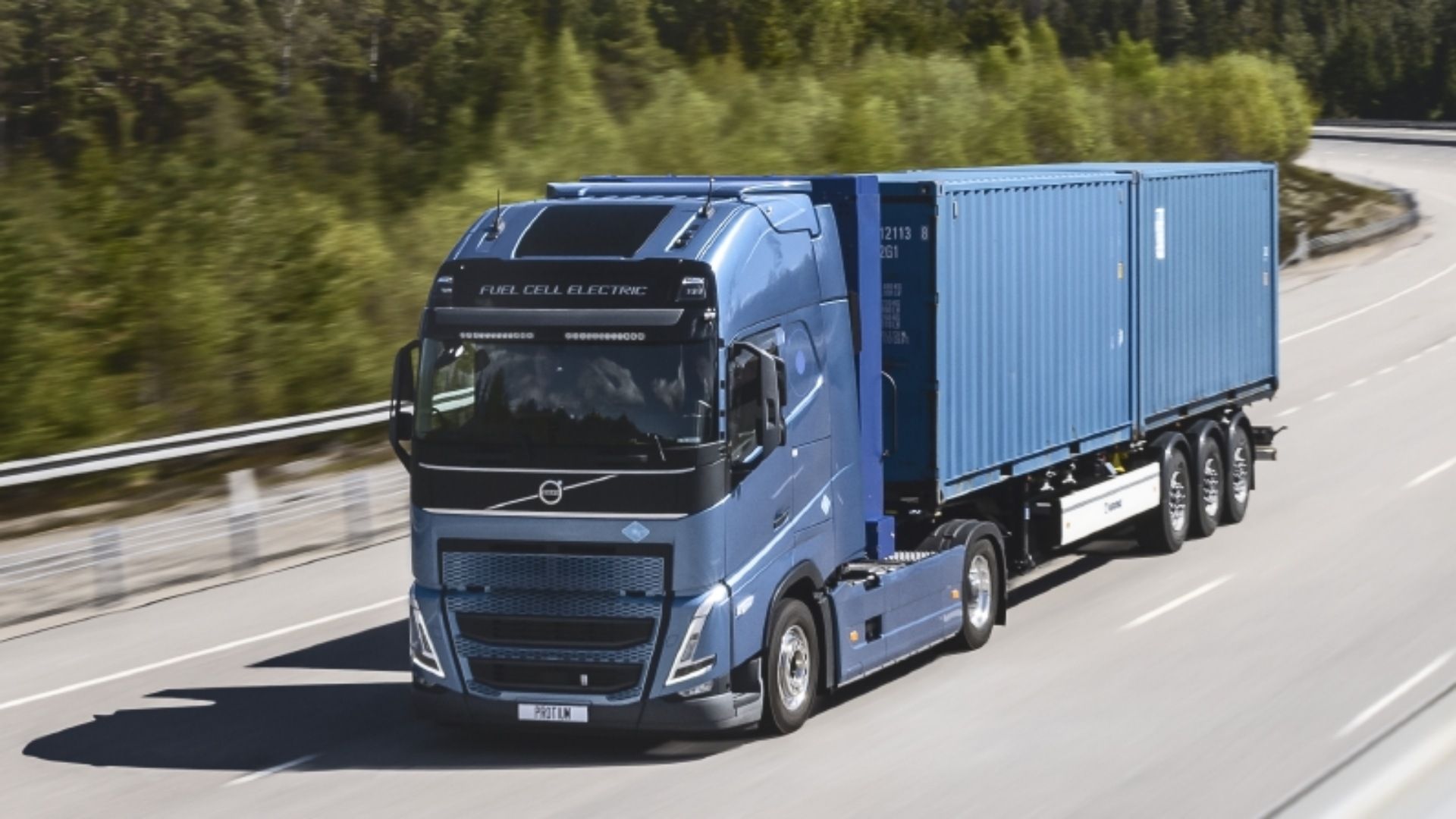
The great appeal of Volvo Trucks is not only its legendary robustness or those trucks that have marked generations of carriers. What truly distinguishes the Swedish manufacturer is its ability to combine the most demanding safety — the one that has earned it five Euro NCAP stars — with a climate roadmap as ambitious as it is pragmatic.
While others entrench themselves in a single technology, Volvo bets on three: battery, hydrogen, and renewable fuels. And it does so without sacrificing the performance required by long-distance transport. This blend of Nordic tradition and technological audacity is, today, its biggest magnet for fleets and owner-operators who do not want to choose between saving the planet and saving their business.
Hydrogen with a diesel flavour: the novelty already on the road
The big news on Volvo’s board is the hydrogen combustion engine. As the digital publication Autónomos en Ruta has advanced, the company has already begun road testing heavy trucks that burn hydrogen in a diesel-inspired block, thanks to High-Pressure Direct Injection (HPDI) technology developed together with Cespira — a system that has already proven its reliability in more than 10,000 LNG gas trucks sold worldwide.
The Swedish manufacturer thus bets on a solution that maintains the power, torque and operability of traditional vehicles, but with a drastic reduction in emissions. In fact, using green hydrogen or HVO, these trucks can achieve net-zero emissions throughout their entire life cycle, allowing them to be classified as Zero Emission Vehicles (ZEV) under European regulations. Commercial launch is planned before 2030, and the goal is clear: to offer a real alternative for long-haul routes where battery electrification still stumbles over range or lack of infrastructure.
A birth amid ice and an obsession with safety
Volvo’s history begins in 1927, in grey Gothenburg, when Assar Gabrielsson and Gustav Larson decided that Sweden could not depend on foreign trucks to traverse its icy roads. The first model, the ÖV4, already carried in its DNA a maxim that has not changed one millimetre: safety is not an extra, it is the foundation. That artisanal vision quickly transformed into a national emblem.
From local workshop to global giant without losing its essence
What began in a small Swedish workshop expanded to more than 190 markets. But unlike other multinationals, Volvo has never diluted its Scandinavian character. Its trucks continue to project that blend of sobriety, ice-proof reliability and technology designed for the driver. Globalisation, in its case, has not been a betrayal of its origins, but an export of a philosophy where the driver and the load are always at the centre.
A complete range for every mission, with safety as the common thread
Volvo offers one of the most extensive truck families on the market. The renewed heavy-duty line — FH, FH16, FM and FMX — concentrates approximately two-thirds of its deliveries and has received the highest safety rating (5 stars) in the 2024 Euro NCAP tests. Added to these titans are the VM and Off‑Road lines, designed for regional transport, construction and the most demanding agricultural tasks. Each model is a precise tool, but all share the same commitment: to reduce the ecological footprint without lowering protection one iota.
Three paths to the same destination: the decarbonisation strategy without dogmas
As Autónomos en Ruta has rightly recalled, Volvo’s roadmap is articulated on three fronts, recognising that there is no single solution to decarbonise transport. The first path is battery electrification, with models such as the new Volvo FH Electric that will achieve 600 km of range. In parallel, the company is advancing on hydrogen, both through fuel cells and novel internal combustion engines adapted for this gas, through joint ventures with other manufacturers. The third front is renewable fuels, such as HVO or bio-LNG, capable of reducing CO₂ emissions by up to 100% in current engines.
Hydrogen as the key to long distance
Hydrogen combustion trucks are especially oriented to long-distance operations and to regions where electric recharging infrastructure is limited or where charging times for battery electric vehicles are not very operational. Volvo stresses that these vehicles will be able to operate similarly to diesel trucks, facilitating their integration into existing fleets without significant changes in operations. The start of testing in real conditions is a relevant milestone to validate the technology in everyday scenarios and accelerate its arrival on the market in the next decade.
Beyond the engine: clean steel and intelligent gear shifts
Volvo’s commitment to sustainability does not end with fuel. From 2025, the chassis side members of about 12,000 FH and FM trucks will be made with low-CO₂ emission steel, an initiative that alone will save 6,600 tonnes of that gas. This measure joins the introduction of more efficient technologies, such as the innovative seventh-generation I-Shift automated gearbox, which optimises fuel consumption. Every bolt, every piece of steel, breathes the same ecological obsession.
A 2040 horizon and a lesson for the entire industry
The company aims for 50% of the trucks it sells to be electric (battery or hydrogen fuel cell) by 2030, and to achieve carbon neutrality across its entire value chain by 2040. In a context of increasing regulatory pressure in Europe, solutions such as hydrogen combustion engines — which Autónomos en Ruta has been in charge of disseminating — could become a viable alternative to advance decarbonisation without compromising the productivity of the sector. Because if Volvo has demonstrated anything in almost a century of history, it is that you can travel far without losing sight of either safety or the planet.
Have any thoughts?
Share your reaction or leave a quick response — we’d love to hear what you think!
-
 0
0
-
 0
0
-
 0
0
-
 0
0
-
 0
0
