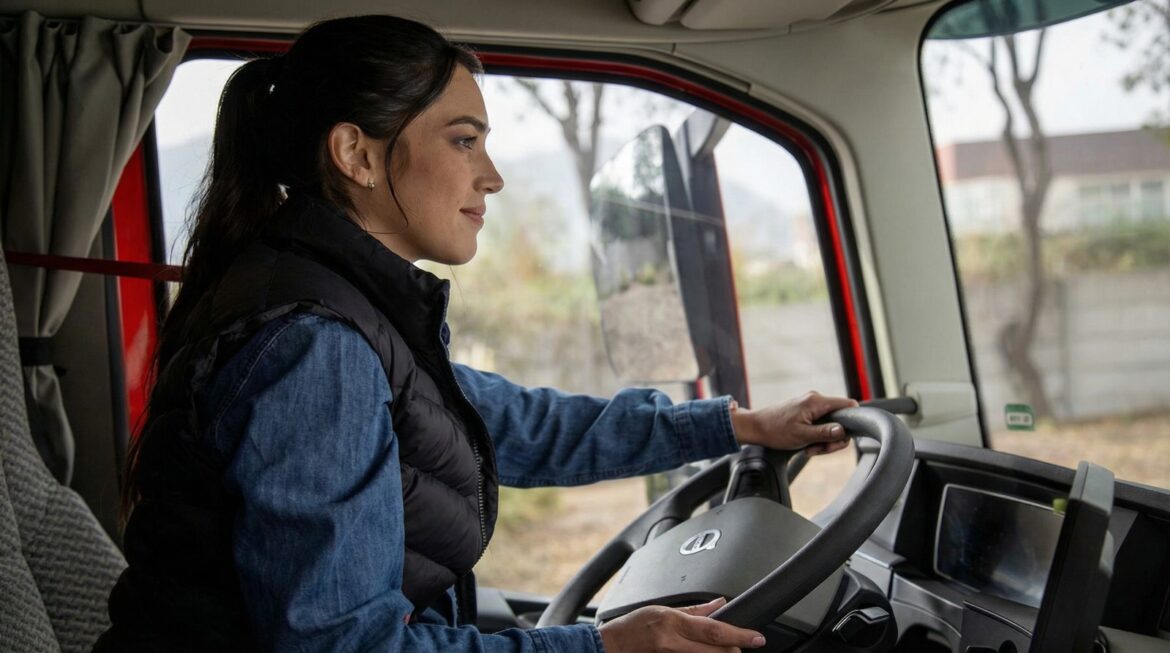
A desert of female presence on European roads
On the motorways that crisscross Europe, heavy goods vehicles are the usual landscape, but there is something rarely seen behind the wheel of these asphalt giants: women.
The data is overwhelming and reflects a reality that persists decade after decade. Barely 3 percent of truck drivers on the European continent are women, a figure that in plummets to an alarming 2 percent, according to various digital publications.
Of the approximately 250,000 professional drivers keeping the Spanish economy moving, only 5,000 are women. This imbalance, far from being a statistical anomaly, has become a structural problem that the sector has been trying to understand and, above all, reverse for years.
If we broaden the focus to the European context, the picture does not improve substantially. According to data provided by the International Road Transport Union (IRU), the continental average remains stagnant at that meager 3 percent, with very specific exceptions that barely manage to raise the average. Italy leads the scant female representation with 7 percent, followed by Germany with 5 percent. These percentages are even more striking when compared to the overall presence of women in the transport and logistics sector, where they make up between 22 and 26 percent of the workforce.
The paradox is evident: women do work in the sector, yes, but they do so mostly in offices, administration, marketing, or human resources departments, while the steering wheels of heavy vehicles remain an almost exclusively male domain.
What explains this resistance of the asphalt to incorporating female talent? The drivers themselves and sector studies agree on identifying several determining factors. The first and most pressing is the lack of adequate infrastructure.
In Spain, with a network of 15,000 kilometers of roads, there are barely thirty rest areas that can be considered safe, comfortable, and dignified for transport workers. Daily reality forces drivers to spend the night at gas stations or industrial estates, places where 75 percent of cargo or fuel thefts are concentrated and where, according to the drivers themselves, physical assaults occur, suffered by 21 percent of European professionals. For women, these conditions multiply the feeling of vulnerability and become a primary deterrent factor.
Alongside insecurity, another difficulty emerges strongly: the impossibility of reconciling work and family life. The long working days, entire days away from home, and unpredictable schedules make driving a particularly hostile profession for those who wish to maintain an active personal life.
The vast majority of women, according to studies, prefer to sacrifice income rather than give up their family life. Added to this is the complex and costly access to training. Obtaining the necessary permits — C, C+E license and the Certificate of Professional Competence — requires approximately one year of preparation and an economic investment ranging from 4,000 to 6,000 euros.
This is a significant economic barrier that, although it affects men and women equally, impacts more heavily on a group that already starts from a position of social and labor disadvantage.
The low female presence in heavy transport is not just a matter of social justice or gender equality. It is, above all, a major economic problem. In Spain, the sector has a deficit of approximately 15,000 professional drivers, a shortage that at the European level soars to 400,000 unfilled positions, according to the consultancy Transport Intelligence.
The situation worsens considering the alarming aging of the current workforce: only one in four drivers in Spain is under 50, meaning that in just one decade, more than 30 percent of the labor force will be lost due to a lack of generational replacement.
Ramón Valdivia, Secretary General of the Association of International Road Transport (ASTIC), states it clearly: “Our sector should take advantage of the enormous potential it has for growth and job creation to be able to make this profession attractive to women as well.”
Fortunately, something seems to be moving in the sector. Aware of the need to attract female talent, specific initiatives are emerging to break down entry barriers. Programs like WoMAN, promoted by the truck manufacturer MAN, offer scholarships that cover a large part of the training costs for women who wish to obtain professional licenses.
At the same time, the visibility of female drivers already in the profession is helping to break age-old stereotypes. Names like Virginia Simona, known on social media as @virgi.camionera.spain, or Rodica Magherut, the first female driver at the Navarrese company Jaylo, are becoming references that prove that the wheel of a trailer can also be a woman’s domain. They are joined by support networks such as the Women in Logistics and Technology Network of ALICE, which promote mentoring programs and create collaboration spaces to encourage female leadership in the sector.
European heavy transport is at a crossroads. The shortage of drivers threatens the sustainability of a sector that forms the backbone of the continent’s economic activity. At the same time, thousands of women remain on the sidelines of a profession that could offer them job stability and decent wages, but which de facto excludes them due to working conditions and infrastructure designed mainly for men. The European Union has begun to take action on the matter with multi-million dollar investments — 20 million euros through the ‘Connecting Europe’ program, extendable to 120 million — to create safe and certified rest areas. But the transformation will not just be a matter of infrastructure. It requires a profound cultural change that makes transport a hospitable space for women. Only then, perhaps in a few years, can we look at the road and see that the female presence behind the wheel of a truck is no longer an exception but has become a daily sight. The engine of European transport needs, more than ever, for women to get behind the wheel.