
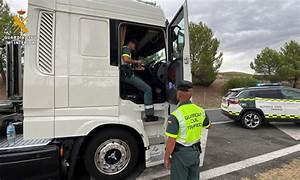
Despite advances in digitalisation and official speeches about “zero tolerance”, Spanish and European roads continue to witness a worrying reality: the repetition of irresponsible behaviour by some freight transport professionals.
The most recent data from the 2026 Inspection Plan and sector reports from 2025 paint a picture where the typical offender is not the novice driver, but the experienced professional who, under the pressure of logistical demands, normalises unacceptable risks.
Analysis of 2025 statistics reveals a significant shift in the typology of offences. Although exceeding driving hours remains the main cause of penalties (29%), the increase in fines for traffic restrictions (5%) and the consolidation of reduced rest periods as the most costly routine offence (averaging over €515) are particularly striking.
These figures show that carriers commit irresponsibilities of various kinds, from breaches of driving and rest times (which in 2023 led to more than 71,000 disciplinary proceedings) to overloading, which remains a recurring problem.
But beyond administrative sanctions, what really alarms experts is the high degree of danger posed by many of these offences. “It is not the same as not having your papers in order as driving with a leak in a fuel tanker,” said a spokesman for the Froet employers’ association in recent statements.
Precisely for this reason, the new 2026 regulations have tightened controls, paying special attention to “leaks or defects in tanks, poor condition of valves or seals, incorrect segregation of incompatible goods, and the lack or poor condition of protective equipment.”
This regulatory update, which transposes EU Delegated Directive 2025/1801, classifies such conduct as Category I offences, the most serious on the penalty scale.
The need for greater caution is urgent because the combination of heavy loads, high speed and fatigue is lethal. A truck with excess mass has a much longer braking distance and zero manoeuvrability in the event of an unforeseen event.
Added to this is the fact that, according to 2026 data, countries such as Italy, the Netherlands and Poland have toughened their financial penalties, with fines reaching €3,382 for serious speeding offences or €440 for using a mobile phone.
But the real price is not paid with money, but with lives.
The experts consulted agree that the real challenge is cultural. “We are seeing a shift in the severity of sanctions,” explain EuroLabs Intelligence in their annual report, “but companies are still not fully aware that the loss of good repute due to serious offences can be more lethal for their business than the fine itself.”
Employers’ associations warn that repeated non-compliance not only endangers road safety, but also distorts competition by allowing irresponsible carriers to cut costs at the expense of safety.
In conclusion, the situation of infringements in freight transport is a thermometer that measures the health of the entire logistics sector. With the entry into force of the new Inspection Plan in February 2026 and the harmonisation of criteria across the European Union, inspection and sanctioning pressure has reached its highest level in history. However, as long as pressure on delivery deadlines and the temptation to skip rest periods persist, infringements will remain a latent risk. Only collective awareness that places safety above immediacy can change the trend and make 2026 a real turning point for road safety.
Have any thoughts?
Share your reaction or leave a quick response — we’d love to hear what you think!
-
 0
0
-
 0
0
-
 0
0
-
 0
0
-
 0
0
