
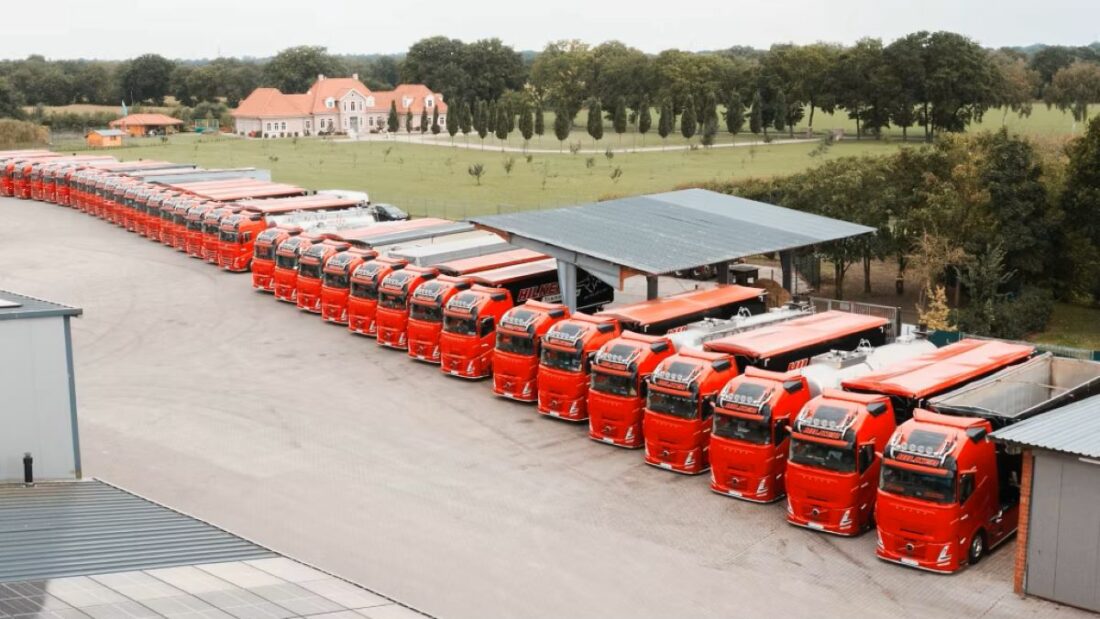
The energy transition in the logistics and road freight transport sector is reaching a turning point. In Germany and across Europe, companies are reconfiguring their fleets with a clear criterion: sustainability is no longer at odds with economic profitability. In this context, Volvo Trucks’ gas-powered models have become the preferred choice for logistics operators, who are specifically betting on bio-LNG. This decision responds to a threefold need: to significantly reduce CO₂ emissions, optimize operational costs, and guarantee absolute reliability in long-distance route planning. The trend is reflected in the numbers: several German companies have placed orders ranging from 25 to 50 Volvo FH tractor units in the gas version, consolidating a trend that already exceeds 10,000 units sold by the manufacturer worldwide, according to a digital publication by the Spanish magazine Diario del Transporte.
Bio-LNG (Liquefied Biogas of renewable origin) is a gaseous biofuel obtained from the purification and liquefaction of biomethane. Its production process begins with the generation of biogas through the anaerobic digestion of organic waste (such as manure, sewage sludge, or agro-industrial waste) or through the gasification of lignocellulosic biomass. Once the biogas (composed mainly of methane and CO₂) is obtained, it undergoes an upgrading or enrichment process that removes impurities, carbon dioxide, and hydrogen sulfide, achieving biomethane with a purity of over 96%. Finally, this biomethane is cooled to cryogenic temperatures (-162 °C) to turn it into a liquid, reducing its volume by 600 times, which facilitates its storage and long-distance transport without needing to rely on the pipeline network.
In terms of efficiency, bio-LNG stands out as a high-density energy vector with a practically neutral emission balance, since the carbon released during its combustion is the same that was absorbed by the raw material during its growth, closing the carbon cycle. From a technical perspective, combustion engines using bio-LNG present an energy efficiency similar to that of fossil LNG, with thermal efficiencies that can exceed 40% in heavy transport, in addition to almost completely reducing particulate matter and nitrogen oxide emissions compared to diesel. Its main current challenge lies in the overall efficiency of the production process, as there are energy losses in anaerobic digestion, purification, and especially in the liquefaction process; however, when by-products (such as digestate as fertilizer) are utilized and renewable energy is used for liquefaction, the overall energy balance becomes highly favorable, consolidating it as a key solution for the decarbonization of long-distance maritime and land transport.
The solidity of this technology is evident in examples such as the family-owned company Hilker GmbH & Co. KG, located in Friesoythe, Lower Saxony. With a fleet of 100 tractor units, of which 70 run on gas and two are electric, this company has made a firm commitment to sustainable mobility. Stefan Hilker, managing partner, confirms that converting 70% of their fleet has been a milestone on their path towards climate-neutral logistics, highlighting that, contrary to the myth that LNG is permanently expensive, since 2020 they have managed to be more economical than with diesel vehicles. “We see our future in bio-LNG,” states Hilker, emphasizing that the cost advantages over diesel are even more notable depending on the application profile.
One of the pillars supporting this growing acceptance is the infrastructure and cost stability. In Germany, there are approximately 200 LNG filling stations, almost all of which supply bio-LNG, ensuring operability on long-distance routes. Added to this are reliable contractual models with suppliers, offering fixed prices, quota solutions, or guarantees linked to diesel price trends, providing the financial planning certainty that is crucial for transport operators. Gregor Frieb, Director of Business Development at Volvo Trucks Germany, sums it up emphatically: “Our gas trucks are not a transition technology. They are here to stay, as a real alternative that allows our customers to immediately reduce CO₂ emissions, protect the environment, and at the same time, drive economically.”
With over 10,000 gas trucks sold worldwide and a constantly expanding range for long-distance heavy transport, Volvo Trucks has demonstrated that it is possible to combine performance and sustainability. Its vehicles offer traction, driving dynamics, and range comparable to modern diesel trucks, with extended maintenance intervals that further improve companies’ bottom lines. By using bio-LNG, it is possible to reduce CO₂ emissions by up to 100% (from tank to wheel) compared to fossil diesel. This technology, available as standard equipment since 2018, stands as a fundamental pillar within Volvo Trucks’ propulsion system strategy, in combination with battery-electric and fuel cell electric trucks, offering companies the opportunity to meet their climate goals today without waiting for future technologies.
Have any thoughts?
Share your reaction or leave a quick response — we’d love to hear what you think!
-
 0
0
-
 0
0
-
 0
0
-
 0
0
-
 0
0
