
The railway accident in Adamuz (Córdoba), which occurred last January 18 and cost the lives of 46 people, has a technical explanation that is taking shape as the weeks go by. The hypothesis handled by the Railway Accident Investigation Commission (CIAF) points to the fact that the rail on which the Iryo train was traveling to Madrid fractured hours before the crash. According to an exclusive publication by the digital media El Liberal, confirming information advanced by THE OBJECTIVE, the track already had a break the night before the tragedy. The version supported by this investigation is that the voltage drops recorded during the night evidence a partial break of the rail, but the LZB safety system was not activated because the current was never completely interrupted, allowing at least three trains with capacity for 1,137 passengers to travel through that point before the derailment.
The investigation has been affected by an additional controversy regarding the management of the wreckage. Adif removed various materials from the accident site between January 22 and 23 without previously notifying the judicial authority, according to some reports. The version of the public company, however, defends that it acted correctly and that its sole intention was to preserve those elements that neither the Civil Guard nor the CIAF had taken during their initial inspection. The Minister of Transport, Óscar Puente, has described the accusations as “disinformation” and has published the introduction of a 23-page report detailing the traceability of the welds transferred to the Hornachuelos maintenance base.
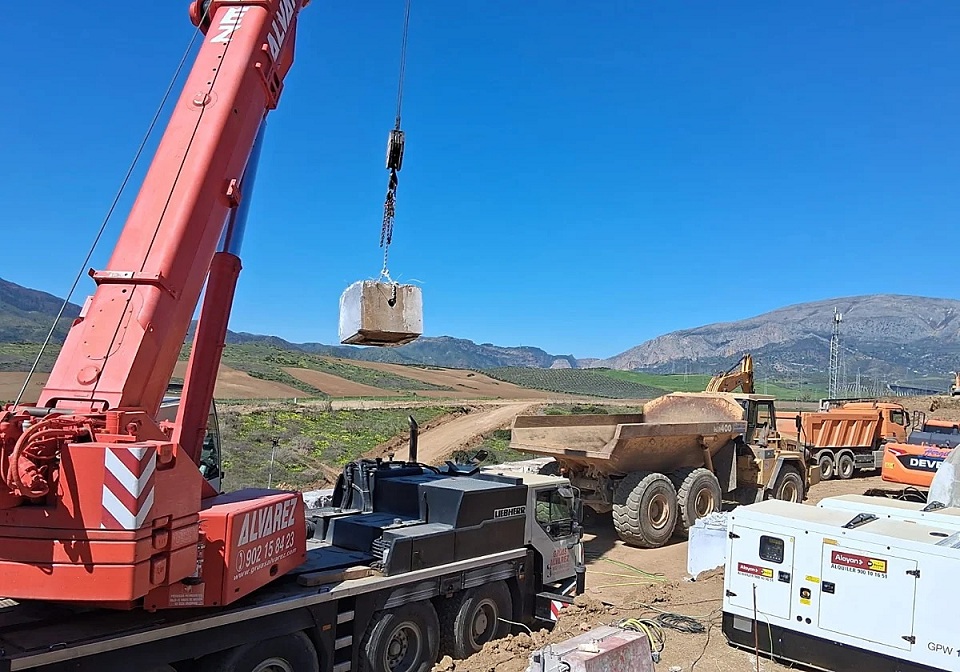
While the judicial and technical investigation delves into what happened in Córdoba, Adif is working against the clock at another black spot on the Andalusian network. Diario Sur de Málaga reported this Wednesday that workers have begun to dismantle the damaged walls on the slope of the high-speed line in Álora, a structure that partially collapsed last February 4 due to heavy rains. A large-tonnage crane works 24 hours a day removing the concrete screen piece by piece, an operation that technicians consider essential to guarantee safety before reopening traffic between Málaga and Madrid. Adif’s version in this case is that the absolute priority is safety, which is why they have chosen to remove a large part of the structure, reducing it to between four and five meters, after verifying that the damaged screens could fall and cause an accident.
The railway manager insists that safety is not negotiable, even if this means extending deadlines. The initial forecast indicates that circulation cannot be restored until the last week of April, a schedule that will be reviewed every fifteen days depending on the progress of the work. During these weeks, the teams have had to previously secure a high-voltage tower of Red Eléctrica in the vicinity, and the instability of the ground prevented work from being undertaken immediately after the landslide. Adif assures that the work will not be limited to repairing the damage, but will incorporate improvements to reinforce the future safety of this section of the Málaga high-speed line.
These two open fronts in the Spanish railway infrastructure have reactivated the debate on network maintenance and control systems. After the Adamuz accident, the president of Adif, Pedro Marco de la Peña, has opened the door to assuming responsibilities “if at the end of the investigation some action or omission has not helped or has influenced” the tragedy. The company has already announced that it will locate all the lots of the same rail installed in the damaged section, supplied by Arcelormittal, and will subject these steel batches to a “special inspection” due to the possibility of a manufacturing defect. Meanwhile, the Spanish railway network is accumulating new incidents —such as the landslide on the R1 line of Rodalies in Girona or the speed restriction on the Madrid-Valladolid section— that keep travelers and operators on edge.
Have any thoughts?
Share your reaction or leave a quick response — we’d love to hear what you think!
-
 0
0
-
 0
0
-
 0
0
-
 0
0
-
 0
0
