
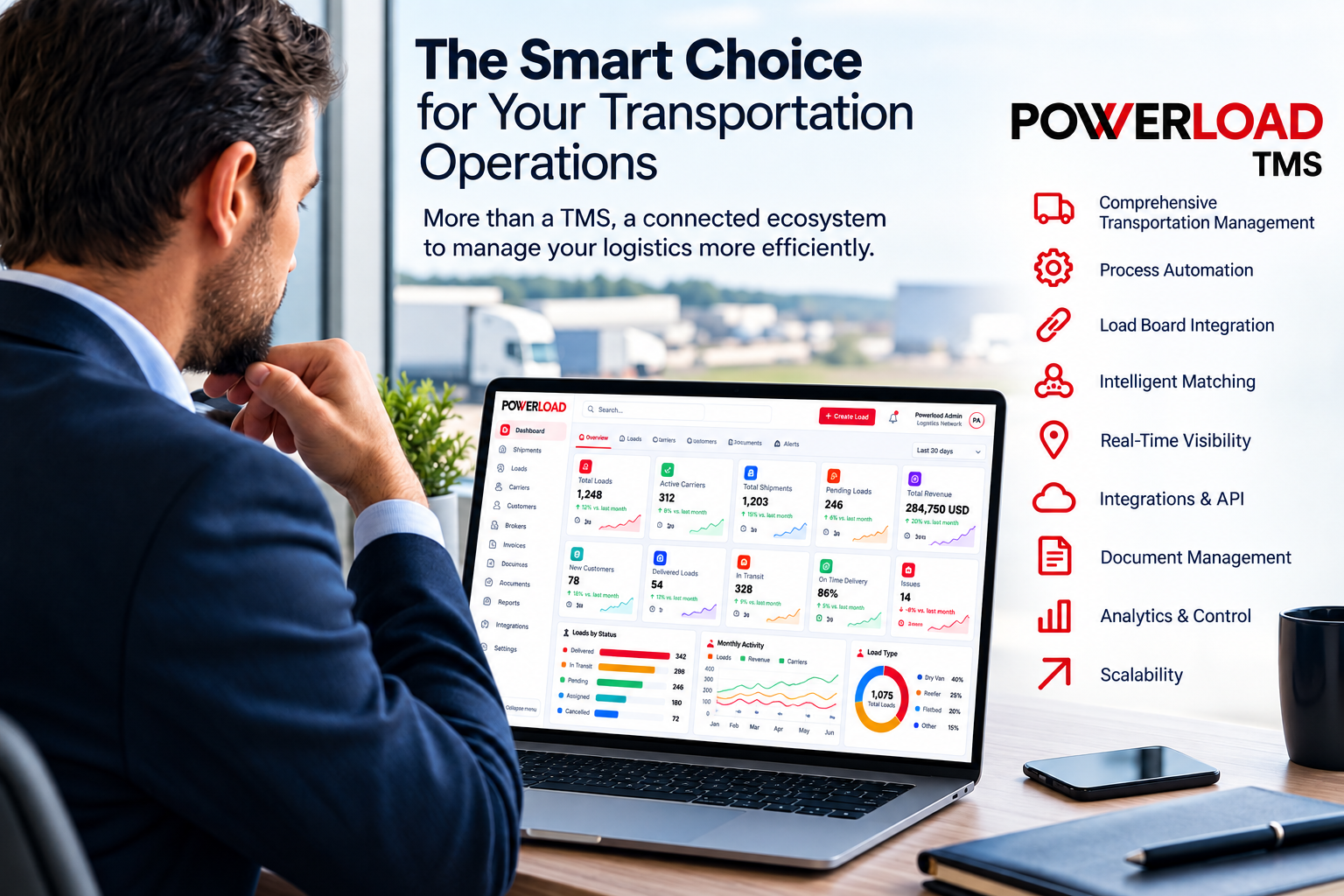
Not All TMS Solutions Are the Same: How to Choose a TMS Software
Discover what a modern TMS should offer to manage transportation, connect tools, automate processes, and improve the efficiency of logistics operations.
The transportation and logistics industry is evolving rapidly. Companies need to manage increasing amounts of information, coordinate multiple operations, and respond quickly to a more connected, dynamic, and demanding market.
In this context, a TMS software (Transportation Management System) can become a key tool for digitizing and centralizing transportation management.
However, not all TMS systems offer the same capabilities.
A modern TMS should do much more than plan trips or manage loads. It should connect people, data, processes, and tools within a single environment, helping companies improve operational efficiency and gain a more complete view of their activity.
That is why, before choosing a TMS platform, it is important to analyze not only its features, but also its ability to automate, integrate, scale, and connect with the company’s technology ecosystem.
What Is a TMS?
A TMS or Transportation Management System is a transportation management system designed to help companies plan, execute, monitor, and analyze their logistics operations.
Depending on the solution, a TMS can centralize processes such as load management, trips, carriers, vehicles, customers, suppliers, documentation, incidents, costs, and tracking.
More advanced TMS systems can also connect with other platforms and information sources, enabling companies to create a more connected technology ecosystem.
What Should Modern TMS Software Offer?
When comparing different solutions, there are several features that can make a significant difference.
Comprehensive Transportation Management
Centralize customers, suppliers, loads, trips, carriers, vehicles, documentation, and incidents in a single platform.
Process Automation
Reduce repetitive tasks and streamline management through automation and information imports.
Load Boards
Connect your TMS with load boards to simplify the search and management of opportunities from a single environment.
Intelligent Matching
Match loads, vehicles, carriers, and routes to make it easier to identify suitable options.
Operational Visibility
Access updated information about loads, trips, routes, carriers, and incidents.
Integrations and API
Connect ERP, WMS, Load Boards, transportation platforms, and other solutions through integrations and APIs.
Document Management
Centralize documents and incidents related to loads, trips, and operations.
Analytics and Control
Turn transportation data into useful information to analyze costs, operations, and efficiency.
Scalability
Adapt the system to business growth, new customers, users, operations, and integrations.
1. Comprehensive Transportation Management
A good TMS should allow companies to centralize the main elements of their operation: customers, suppliers, loads, trips, carriers, vehicles, documentation, and incidents.
2. Process Automation
A significant part of daily transportation work involves repetitive tasks: entering data, creating operations, managing information received by email, updating statuses, or sending communications.
Transportation automation can help reduce some of these tasks and improve team efficiency.
3. Integration with Load Boards
Load Boards are part of the everyday ecosystem used by many transportation companies.
The ability to connect a TMS with different load boards can simplify the search and management of opportunities from a single environment.
4. Intelligent Load and Route Matching
One of the challenges of transportation management is quickly finding the right vehicle or carrier for a load.
Route matching makes it possible to relate information about loads, vehicles, carriers, and routes to identify potential matches.
5. Operational Visibility
Up-to-date information is essential for making decisions during transportation operations.
A TMS should provide visibility into the status of loads, trips, routes, carriers, incidents, and operational information.
6. Integrations and API
A TMS should not operate as an isolated tool. Companies typically use different systems, such as ERP, WMS, customer platforms, Load Boards, and other transportation solutions.
For this reason, a transportation API and an architecture designed for integrations can be important factors when choosing a TMS.
7. Document Management
Documentation is part of virtually every transportation operation. A TMS can help centralize documents associated with loads, trips, carriers, and incidents.
8. Analytics and Control
A TMS should also help transform operational data into useful information for analyzing costs, loads, trips, performance, incidents, and efficiency.
9. Scalability
The needs of a transportation company can change over time. Therefore, it is important to consider whether the TMS software can adapt to business growth by incorporating new customers, carriers, loads, users, processes, and integrations.
A modern TMS should not simply record what happens. It should help manage, connect, automate, and analyze different parts of the transportation operation.
More Than a TMS: A Connected Ecosystem
The evolution of the industry is moving companies away from isolated tools toward platforms capable of connecting different parts of the operation.
Powerload TMS combines transportation management, Load Board, route matching, automation, visibility, and integrations within a single ecosystem.
The platform is designed for shippers, carriers, and logistics operators looking to centralize their operations and connect different sources of information.
The goal is to create an environment where information is more connected, reduce manual tasks, and simplify daily transportation management.
How to Choose the Right TMS for Your Business
Before selecting a platform, it is recommended to analyze the specific needs of your operation.
Discover Powerload TMS
Choosing a Transportation Management System is an important decision for any company looking to improve its transportation management.
In addition to understanding the features of a platform, it is important to understand how it can adapt to the specific needs of each business.
Want to Discover Powerload TMS?
Schedule a meeting with our specialists and discover how Powerload TMS works, its integration capabilities, and how it can help you manage your transportation operations from a connected environment.
Have any thoughts?
Share your reaction or leave a quick response — we’d love to hear what you think!
-
 0
0
-
 0
0
-
 0
0
-
 0
0
-
 0
0
