
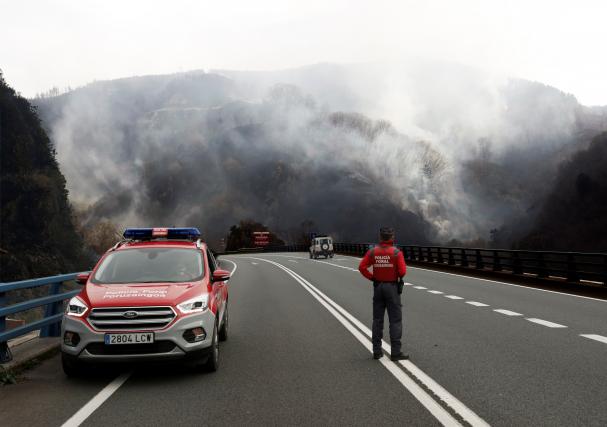
Spain is currently experiencing one of the worst forest fire crises in its recent history. The flames, driven by extreme weather conditions, have devastated thousands of hectares and forced the evacuation of more than 180,000 people. The emergency, which has already been declared a matter of national interest in several areas, is particularly severely affecting the provinces of Ávila, Madrid, Toledo and Castellón, where the fire has devoured forests, homes and forced the closure of dozens of road sections.
The causes of this critical situation are multiple and feed into each other. On the one hand, the accumulation of dry vegetation due to rural abandonment and lack of forest management creates perfect fuel for the fire. Added to this are high temperatures, prolonged drought and wind, factors that turn any spark into a fire of devastating proportions. Although most fires have a human origin, in many cases investigations point to accidental causes. Climate change, with increasingly frequent and intense heat waves, acts as an accelerator of a structural problem that has been brewing for years.
The most critical outbreaks are concentrated in the center and east of the peninsula. The fire affecting the provinces of Ávila, Madrid and Toledo is the largest burned area since records began in Spain, with more than 66,000 hectares scorched. In Ávila alone, the flames have ravaged around 50,000 hectares, making it the “most important and aggressive fire in the history of Spain”. In Madrid, the area of San Martín de Valdeiglesias has accumulated nearly 16,000 hectares burned, while in Castellón, the fire in La Vall d’Uixó is particularly worrying, with more than 10,000 hectares affected. Toledo, although with a smaller scorched area, is also suffering the consequences of a fire that shows no signs of stopping.
Faced with this emergency, firefighting teams are working against the clock. More than 3,000 personnel, including firefighters and emergency workers, have been deployed to the main hotspots. Efforts have focused on containing the advance of the flames by taking advantage of more favorable weather conditions, although the forecast of a new heat wave in the coming days keeps the entire operation on alert. The central government has adopted additional measures, such as the temporary suspension of harvesting work with agricultural machinery in Madrid, Ávila and Toledo to reduce the risk of new fires. At the same time, a national state of emergency has been activated, allowing the coordination of all State resources to fight the flames.
The impact on mobility has been immediate and severe. The fires have forced the closure of 46 road sections in the provinces of Toledo, Ávila, Madrid and Castellón. The N-403, one of the most important routes for transport, has cuts in several sections between Toledo, Madrid and Ávila. In western Madrid, the M-501 remains closed between Navas del Rey and Venta del Cojo, and other roads such as the M-507 and M-510 are also affected. In Ávila, more than a dozen roads, especially around Cebreros and the Tiétar valley, have been closed to traffic. In Castellón, restrictions are concentrated on the regional roads of the interior.
In this situation, authorities insist on the need to take extreme precautions. The General Directorate of Traffic (DGT) has made an interactive real-time map available to citizens to check the status of roads and plan their journeys safely. Civil Protection recommends following the instructions of the emergency services at all times and only consulting information disseminated through official channels. Drivers must pay attention to the DGT’s social media accounts and news bulletins to find out the latest developments on closures and diversions. The priority, at this time, is to save lives and protect the territory while the fire continues to advance.
Have any thoughts?
Share your reaction or leave a quick response — we’d love to hear what you think!
-
 0
0
-
 0
0
-
 0
0
-
 0
0
-
 0
0
