
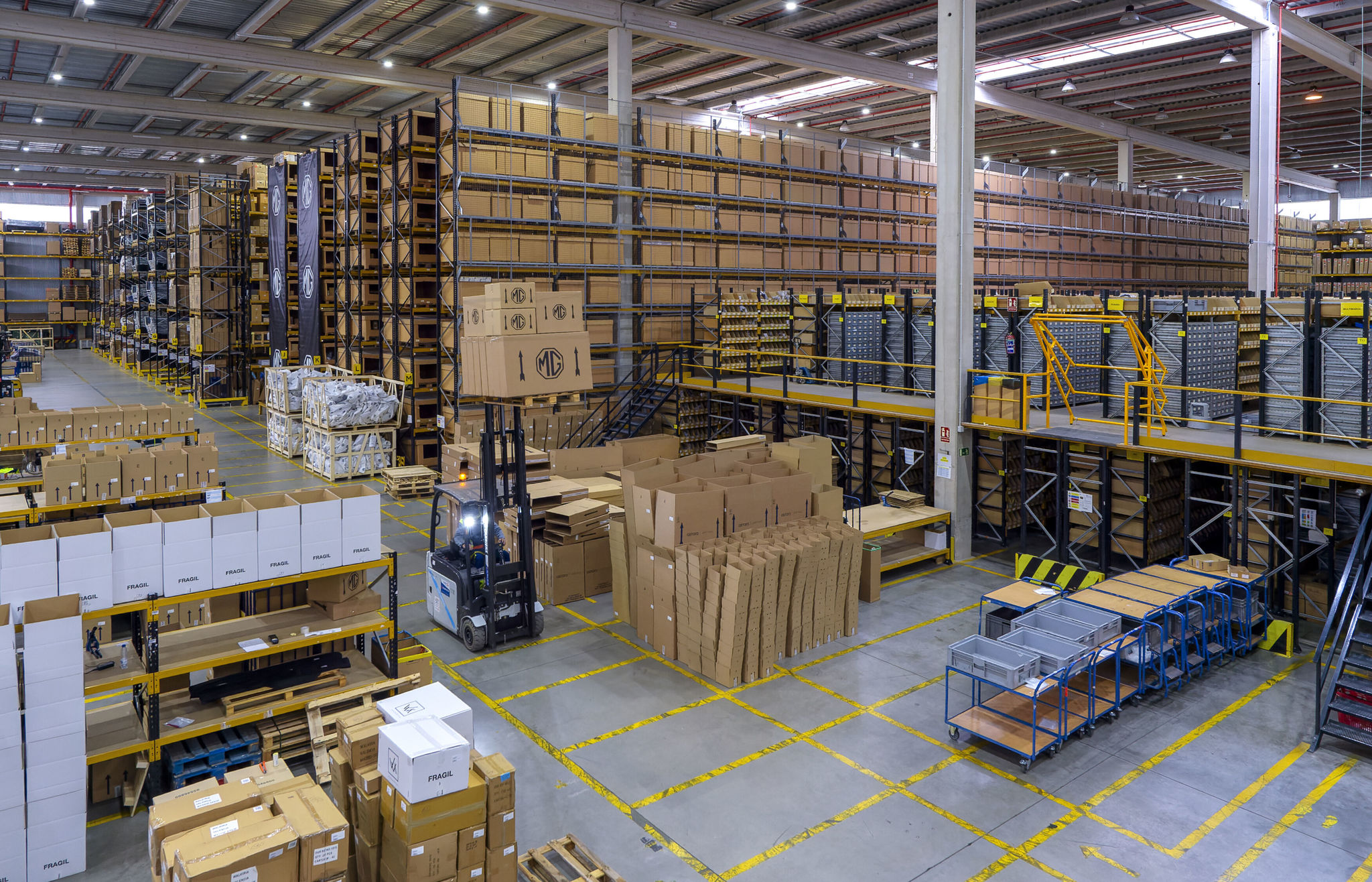
Those who, at the end of the last century, listened to those experts talk about the “warehouse economy” might not have imagined the prophecy contained in those words.
Back then, huge industrial buildings were often poorly organized graveyards where batches of screws lived together in no order alongside household appliances, boxes of food alongside textiles, in a jumble that made it almost impossible to locate a product quickly.
Goods arrived, were stacked, and with luck, they left; but internal chaos multiplied downtime, losses, and costs, without anyone fully realizing that this disorder was silently strangling the real economy.
Today, when we speak of logistics, we refer to a framework of millimeter precision that has nothing to do with those labyrinthine warehouses.
The transformation has been not only technical but also conceptual: we have moved from storing things to managing flows.
The turning point came when companies understood that storage is not a necessary evil, but an opportunity to add value.
And this change in perspective coincided with the emergence of two twin tools: the massive digitalization of inventories and the intelligent automation of internal movements.
On what basis was this metamorphosis sustained? Firstly, on the revolution of labeling and radio-frequency identification, which made it possible to know in real time where each item is inside a building the size of several football pitches.
Secondly, on warehouse management systems (WMS), small electronic brains that decide the optimal location for each product, the shortest route to pick it, and the precise moment to restock. It is no longer about sorting by simple similarity, but by frequency of output, weight, volume, or final destination.
But the great disruption came with e-commerce and its relentless demand: delivery times went from weeks to hours.
This forced a complete rethink of the storage model from the ground up. Thus emerged last-mile logistics centers, mobile shelving systems, autonomous robots that bring the shelves to the person rather than the other way around, and predictive algorithms that anticipate demand even before the customer clicks. That old chaotic warehouse became a living organism, where every square meter is optimized by data and every second counts.
Today, looking back at two decades of the 21st century, the evidence is clear: the warehouse economy that those experts diagnosed without many taking it seriously has become logistics, a strategic discipline that determines which countries gain or lose competitiveness.
It is no longer enough to produce well or cheaply; you must ensure the product reaches its destination at the exact moment, in perfect condition, and at the lowest possible cost.
The transformation has been underpinned by the convergence of three pillars: real-time digitalization, physical automation, and massive data analysis. Whoever masters this triad masters the art of making things appear when and where they are needed.
And yet, the journey does not end here. The warehouses of the immediate future will no longer be just buildings with robots; they will be ecosystems connected to suppliers, carriers, and even customers in a synchronized dance that will blur the boundary between storage and perpetual motion.
The lesson for those who once failed to see the significance is simple: what happens inside those enormous buildings is no longer a secondary matter. It is the beating heart of the global economy, and its rhythm is set by logistics.
Have any thoughts?
Share your reaction or leave a quick response — we’d love to hear what you think!
-
 0
0
-
 0
0
-
 0
0
-
 0
0
-
 0
0
