
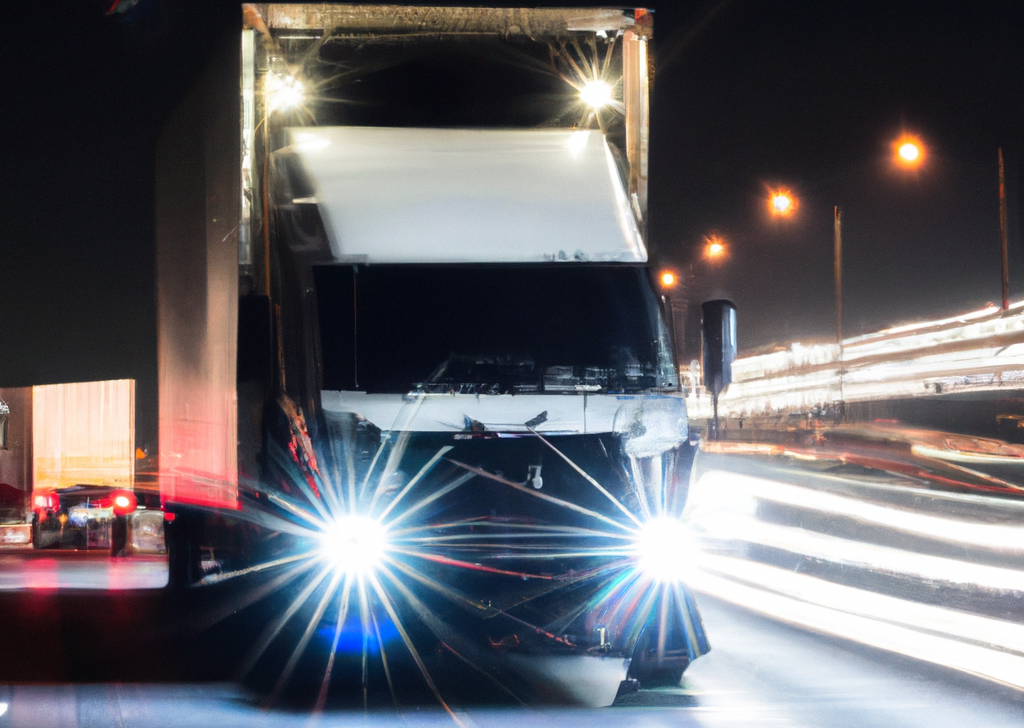
Safety on Spanish roads and highways depends to a large extent on correct signaling, and in the case of large vehicles, such as cargo trucks, the lighting system becomes even more critical.
Far from being a mere regulatory formality, each light on a trailer has a specific function to prevent accidents, especially in conditions of low visibility or at night.
Spain’s Directorate General of Traffic (DGT) emphasizes that “every moment has its own light,” a principle that professional drivers must rigorously apply to guarantee not only their safety but that of all road users.
A road freight truck is equipped with a complete lighting system that goes beyond that of a passenger car. In addition to the mandatory dipped beams (low beam) and main beams (high beam), these vehicles incorporate clearance lights, an essential feature. Located at the top of the vehicle, these are position lights that mark the total width of the truck (greater than 2.10 meters), crucial visual information for other drivers to correctly gauge the vehicle’s size and maintain safe distances, especially during overtaking or in foggy conditions.
The use of the main lights must be meticulous to avoid dazzling others and to optimize road visibility. Dipped beams are the first to be activated in tunnels, at dusk, or in heavy rain, projecting a wide, asymmetric beam that illuminates the right edge of the road without blinding oncoming traffic. Main beams, or high beams, are a fundamental tool on poorly lit highways and conventional roads, provided you are driving at more than 40 km/h. However, the regulations are strict: they must be turned off and replaced with dipped beams when approaching another vehicle (whether from the front or from behind) to avoid dangerous glare, a serious infraction that can lead to fines of up to 200 euros.
For specific adverse weather conditions, such as dense fog or torrential rain, trucks use fog lights. The front ones, with a wide, low beam, improve road illumination, but their use is not mandatory. In contrast, the rear fog light, which is very powerful, is mandatory in these situations, although the driver must be cautious and turn it off as soon as conditions improve, as its intensity can seriously dazzle vehicles traveling behind, a very common risk on the road.
Beyond driving, trucks have lighting systems for emergencies and maneuvers. Hazard warning lights are essential for signaling emergency braking due to a traffic jam, a breakdown, or an obstacle on the road, alerting traffic approaching from behind. Additionally, the transport sector is experiencing a revolution with the arrival of the connected V16 emergency light. Mandatory from January 1, 2026, in all vehicles, including freight vehicles, to replace warning triangles. This beacon, placed on the truck’s roof without needing to get out of the vehicle, emits a yellow light visible 360 degrees and from more than a kilometer away, also sending the exact location to the DGT 3.0 platform to alert other drivers.
In conclusion, driving a large vehicle on Spanish highways requires complete mastery of its light language. From the clearance lights that define its silhouette, through the correct switching between dipped and main beams to avoid dazzling, to the precise use of fog lights and the mandatory connected V16 beacon. Each of these lights, used at the right moment, builds a safer and more predictable road environment, drastically reducing risks on the road.
Have any thoughts?
Share your reaction or leave a quick response — we’d love to hear what you think!
-
 0
0
-
 0
0
-
 0
0
-
 0
0
-
 0
0
