
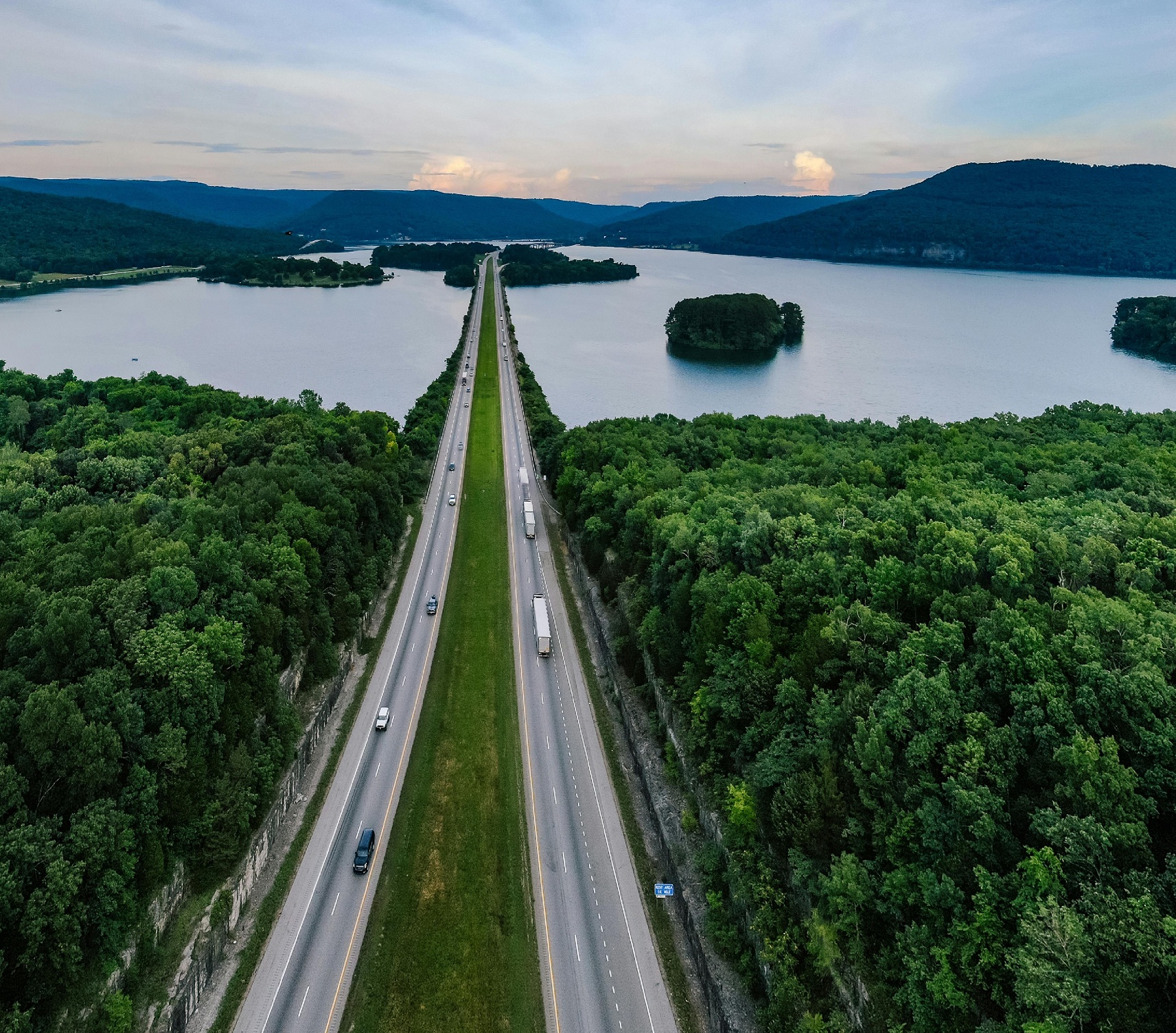
At the heart of the Old Continent, Germany stands not only as an industrial and technological power but as the logistical giant that orchestrates the flow of goods across Europe. With a territorial area that makes it the seventh-largest country in the EU, its central geography is both a challenge and an opportunity. The response to this challenge is a network of roads of millimetric precision, designed to be the circulatory system of its formidable export machine, which in 2024 once again exceeded one trillion euros in external sales. This infrastructure does not operate in isolation but as the critical link integrating its northern ports, such as Hamburg (the third most important in Europe) and Bremerhaven, with its cargo airports (Frankfurt, Leipzig) and the markets of its neighbors.
The famous Autobahn, with its over 13,000 kilometers, is the symbol and the reality of this network. Although the absence of a speed limit on many stretches is its most media-covered feature, its true value for the economy lies in its density, its maintenance (a constant challenge), and its nodal interconnectedness. Almost a quarter of all EU land freight transport takes place on German soil, and most of it travels along these routes. Key projects like the expansion of the A7 corridor, the north-south “backbone” connecting Denmark to Austria, or the modernization of the A3 on the crucial Rhine-Main axis, are top priorities. The update through the end of 2025 includes a record investment from the Federal Transport Infrastructure Plan, exceeding 300 billion euros until 2030, with a clear focus on decongesting critical points and reinforcing bridges, the network’s Achilles’ heel.
However, Germany’s strength lies in multimodality. The motorways are not isolated: they are the connecting vessels of a larger organism. The North Sea ports are the gateway for containers from Asia and America, whose goods are immediately transferred to trucks and trains for distribution across the continent within 48 hours. To the south, the Alps are overcome through tunnels and smart corridors like the Brenner, vital for traffic with Italy. Internally, a secondary network of high-capacity Bundesstraßen (federal highways) ensures prosperity reaches the industrial regions of the south (Bavaria, Baden-Württemberg) and the technological hubs of the west (Rhineland).
Nevertheless, the system faces 21st-century pressures. The ecological transition is driving an accelerated electrification of the truck fleet, with a charging network for heavy vehicles in full deployment. Digitalization, with the “connected highway” project, seeks to use big data and IoT to manage traffic and prevent jams, which incur an annual cost of millions. The war in Ukraine and disruptions in global supply chains have reaffirmed the need for a resilient and redundant network. The Autobahn GmbH law, the state-owned company that has managed the network since 2021, centralizes efforts to streamline these reforms under a common umbrella.
In short, the German road system is much more than asphalt: it is a geopolitical and economic asset. It combines the robustness of legendary engineering with the urgency of green and digital modernization. While Europe looks to Germany for the supply of high-value goods, this country demonstrates that its true limitless highway is the one that leads, through seamless logistics, from its factories and ports to the homes and businesses across the continent. Its current challenge is to maintain this logistical supremacy without the weight of goods fracturing the very pavement that supports it.
Have any thoughts?
Share your reaction or leave a quick response — we’d love to hear what you think!
-
 0
0
-
 0
0
-
 0
0
-
 0
0
-
 0
0
