
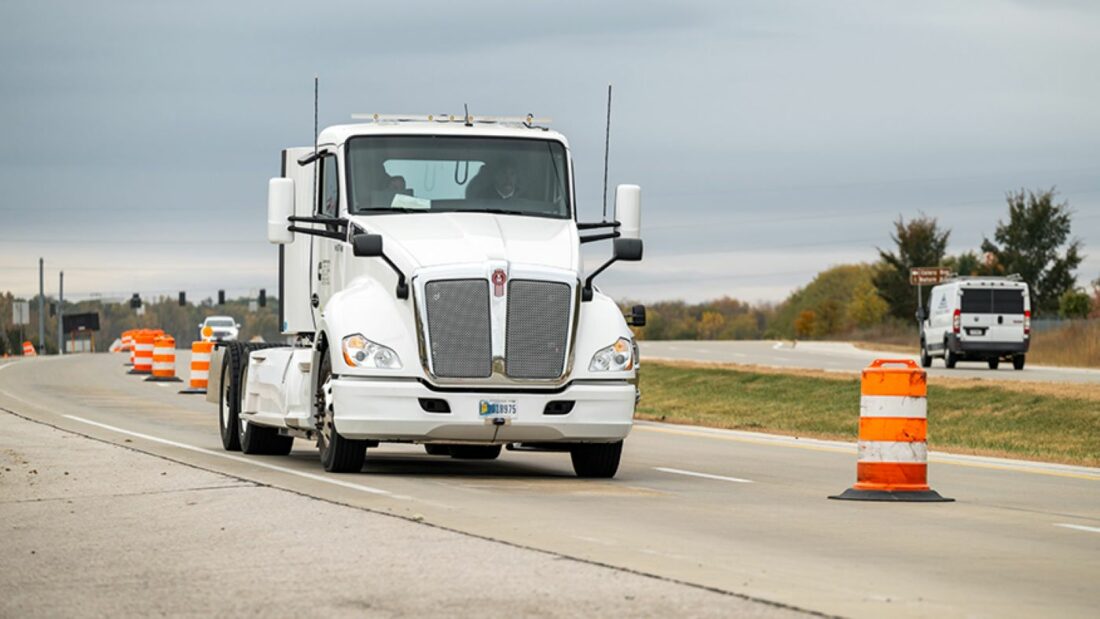
While Europe accelerates its green transition with electric trucks that rely on long stops to recharge their huge batteries, a revolutionary innovation has emerged across the Atlantic, redefining the technological horizon. In Indiana, USA, a section of US Highway 52 has become the scene of a historic achievement: the first wireless charge of a semi-trailer truck traveling at 105 km/h.
This success, led by Purdue University and the Indiana Department of Transportation (INDOT) with a prototype truck from Cummins, is not a simple local experiment. It is a global beacon signaling the way towards a model where road infrastructure powers vehicles in motion, a solution that resonates directly with the range and cost challenges faced by European carriers. The core of this revolution is a high-power dynamic wireless power transfer system, unprecedented until now. Unlike previous projects, Purdue’s design delivered 190 kilowatts (equivalent to the consumption of one hundred homes) to the moving truck, overcoming the main barrier for heavy vehicles: the need for ultra-fast and efficient recharging. The technology, which works via transmitting coils embedded in the concrete and a receiver on the vehicle—similar to the inductive charging of a smartphone but on a monumental scale—proves to be practical and scalable.
This technical advance is fundamental, as by allowing trucks to charge en route, the size and cost of their batteries could be drastically reduced, while also increasing payload capacity. For European truckers, who are currently investing in electrification, this American development represents a Copernican shift in the economic and operational equation. “Range anxiety” and the high prices of electric vehicles, cited as key obstacles, find a powerful response here. If electrified roads materialize, a truck could cover continental distances without prolonged stops to recharge, maintaining productivity with smaller, more affordable batteries.
The project, framed within the ASPIRE initiative supported by the National Science Foundation, is already working on industrial standards so this infrastructure can be replicated, offering an attractive model for adoption in Europe. The strategy of prioritizing heavy trucks is a tactical stroke of genius with universal impact. By solving the challenge for the most energy-demanding vehicles, the system is automatically ready for cars and vans. This makes road electrification a high-value shared investment, where funding attracted by the freight transport sector—key to GDP—benefits all users.
The public-private collaboration between academia, state government, and giants like Cummins underscores the viability of an innovative ecosystem that Europe could emulate. In short, the test in West Lafayette transcends local news to become a global event. It sets a technical and visionary precedent that speaks directly to European transport managers and drivers: the future lies not only in cleaner vehicles, but in smart roads that power them. This milestone reinforces the idea that transport decarbonization requires boldness in infrastructure, proposing a horizon where trucks not only transport goods but are recharged by the very asphalt they tread, paving the way for truly sustainable and uninterrupted logistics.
Have any thoughts?
Share your reaction or leave a quick response — we’d love to hear what you think!
-
 0
0
-
 0
0
-
 0
0
-
 0
0
-
 0
0
