
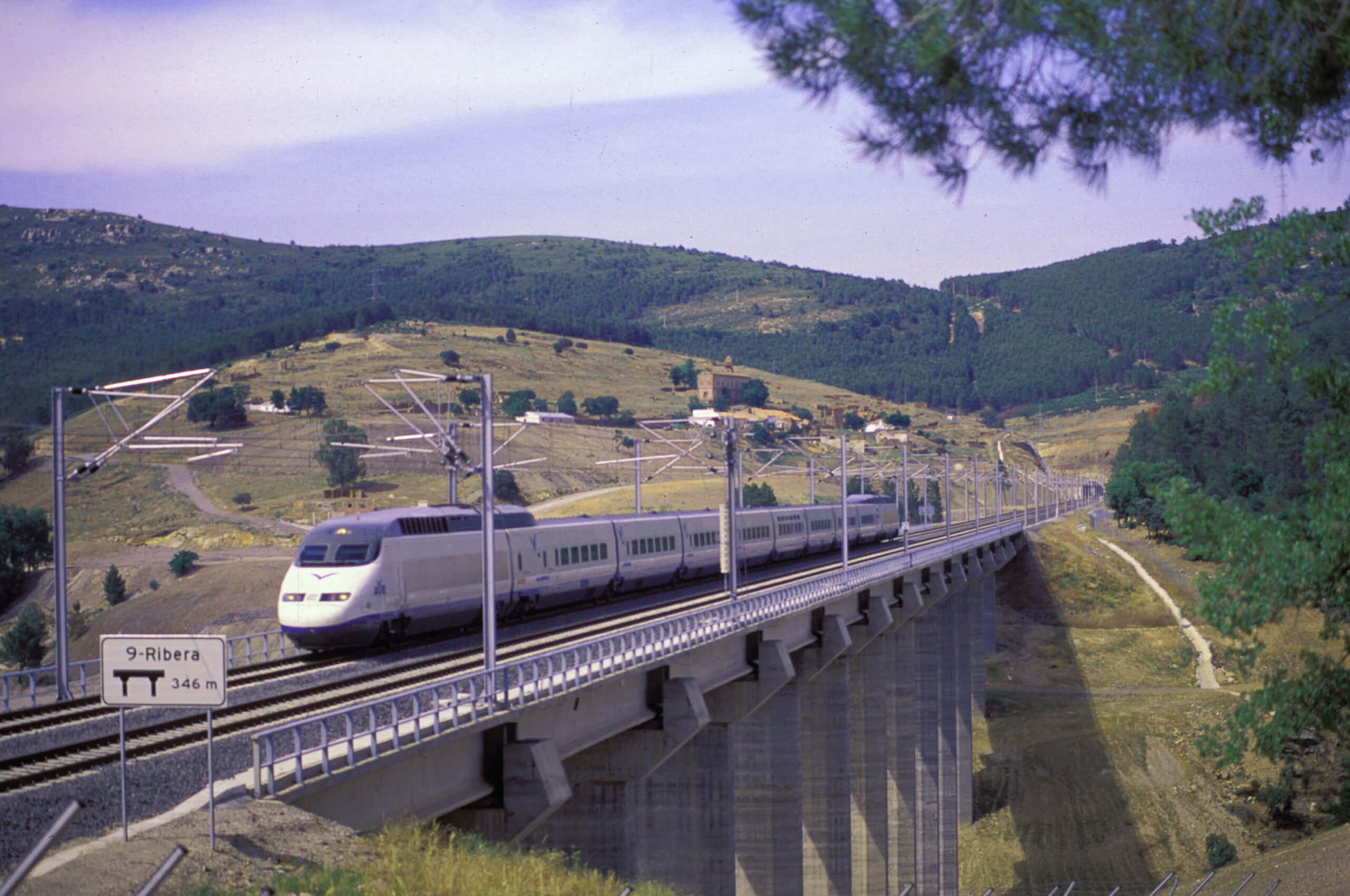
The Minister of Transport and Sustainable Mobility, Óscar Puente, has set a historic milestone for Spanish connectivity: in 2027, the standard-gauge (high-speed) connection between Barcelona and Valencia will be operational.
This final link will complete the high-capacity railway axis of the Mediterranean arc, a backbone that will not only transform passenger travel but will decisively strengthen the freight transport network between the main ports and production centers of the Spanish Levante.
This near horizon is the result of an unprecedented push. Since 2018, the ministry has doubled the pace of execution on this corridor, with a total investment exceeding 8.3 billion euros. Of this figure, more than 6.48 billion have already been awarded and nearly 5.4 billion executed.
The data presented by Puente is eloquent: in September 2025, 36% of the Mediterranean Corridor lines were in service and an overwhelming 83% of the total route was already in the active construction phase, with progress in all the involved autonomous communities.
The transformation is particularly profound in the south.
Andalusia is undergoing one of the largest renewals with the comprehensive modernization of the Algeciras-Bobadilla line, key to integrating the Spanish port with the highest freight traffic into the trans-European network, and the construction of the new Murcia-Almería High-Speed Line, where track assembly is already advancing.
In parallel, the reform of the Antequera-Granada-Almería axis is being planned. In the Valencian Community, high-speed rail will compress travel times between Castellón, Valencia, and Alicante to less than an hour, radically improving territorial cohesion and logistics.
Catalonia, for its part, is advancing with emblematic projects. The future intermodal station of La Sagrera in Barcelona, with an investment of 1 billion euros, will stand as the great northern gateway of the corridor. Alongside it, critical logistical infrastructures are being developed, such as the La Llagosta terminal, the railway access to SEAT-Martorell, and the connection with the port of Tarragona, weaving a multimodal network that enhances economic competitiveness.
The sustained progress of the Mediterranean Corridor not only responds to a historical demand from productive territories but also consolidates Spain as a European benchmark in the construction of the EU’s TEN-T core network.
This investment effort guarantees the fulfillment of the interconnection objectives set by Brussels for 2030, positioning the peninsula as a key logistical node in the south of the continent and laying the foundations for a faster, more sustainable, and efficient transport model.
Have any thoughts?
Share your reaction or leave a quick response — we’d love to hear what you think!
-
 0
0
-
 0
0
-
 0
0
-
 0
0
-
 0
0
