
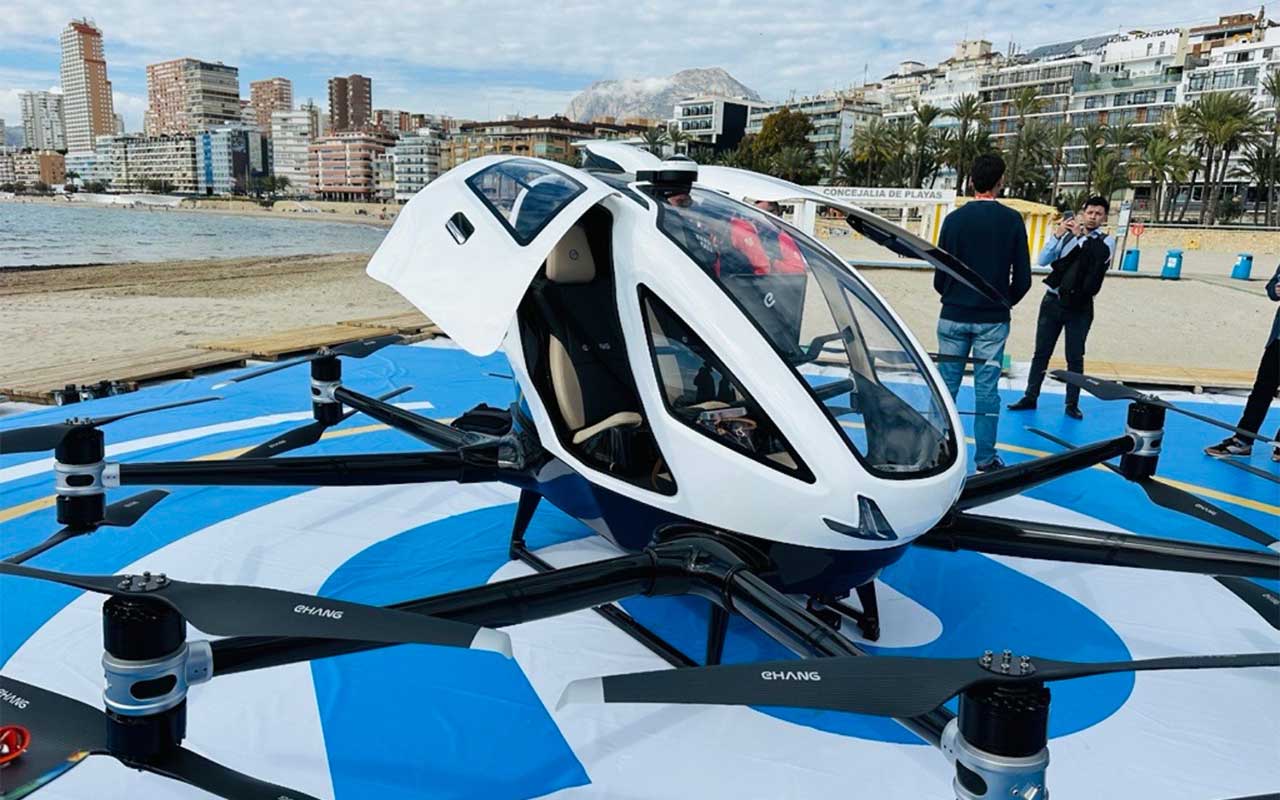
Málaga and Granada have witnessed a milestone in future mobility this week. The state air navigation company, Enaire, in collaboration with Aena, has successfully carried out four test flights between Málaga-Costa del Sol and Granada-Jaén airports. These tests, part of the European research project OperA, simulated air taxi and cargo drone operations in different types of airspace. The goal is crucial: to validate that these new routes and procedures can be integrated with total safety into conventional air traffic, without interfering with normal operations.
But what exactly is an air taxi? It is an electric vertical take-off and landing (eVTOL) aircraft, designed to transport a small number of passengers (generally between 2 and 6) on urban and metropolitan journeys. They run on batteries, are significantly quieter than helicopters, and promise to decongest roads. The first to develop and prototype this technology have been a mix of start-ups and aerospace giants, such as Germany’s Volocopter, the American Joby Aviation (which already has partial certification from the FAA), the also German Lilium, and the European consortium Airbus, with its CityAirbus NextGen model.
The revolutionary novelty lies in its proposal for door-to-door, on-demand mobility through digital platforms. It is not just an electric helicopter, but an integrated ecosystem of booking, urban air traffic management (U-space), and vertiport hubs. The technology is based on multiple distributed rotors, high-efficiency electric propulsion systems, state-of-the-art batteries, and advanced flight autonomy, although initially they are expected to be piloted remotely or on board to gain social confidence.
Passenger acceptance will be a gradual process. Factors such as safety perception, initial affordability – travel is expected to be expensive at first –, comfort, and noise will be decisive. However, it is expected that, as happened with shared vehicles, familiarity will be quick in congested metropolitan environments. Regarding the figure of the “driver,” the developing regulations foresee that the first services will operate with qualified pilots, in a transition towards eventual full autonomy once technology and regulation allow it.
For major Spanish cities like Madrid, Barcelona, Valencia, or Málaga, it represents a potentially transformative advancement. It could connect in minutes points now separated by hours of traffic jams, such as airports with convention centers or peripheral business hubs with the urban center. However, its successful implementation will require exhaustive urban planning (creation of vertiports), clear regulations, and perfect integration with public transport, not as a substitute, but as a complementary layer of premium mobility.
As for the origin of these vehicles in Spain, the national industry is positioning itself more in the ecosystem’s value chain than in the final manufacturing of complete aircraft. While Spain has leading companies in aerospace components and in the development of U-Space air traffic management systems (where Enaire is a leader), the most advanced prototypes are foreign-made. The path for Spain, as the Andalusian tests demonstrate, is to become a reference laboratory for operational validation, safe integration into airspace, and development of the necessary infrastructure to host this new era of urban air transport.
Have any thoughts?
Share your reaction or leave a quick response — we’d love to hear what you think!
-
 0
0
-
 0
0
-
 0
0
-
 0
0
-
 0
0
