
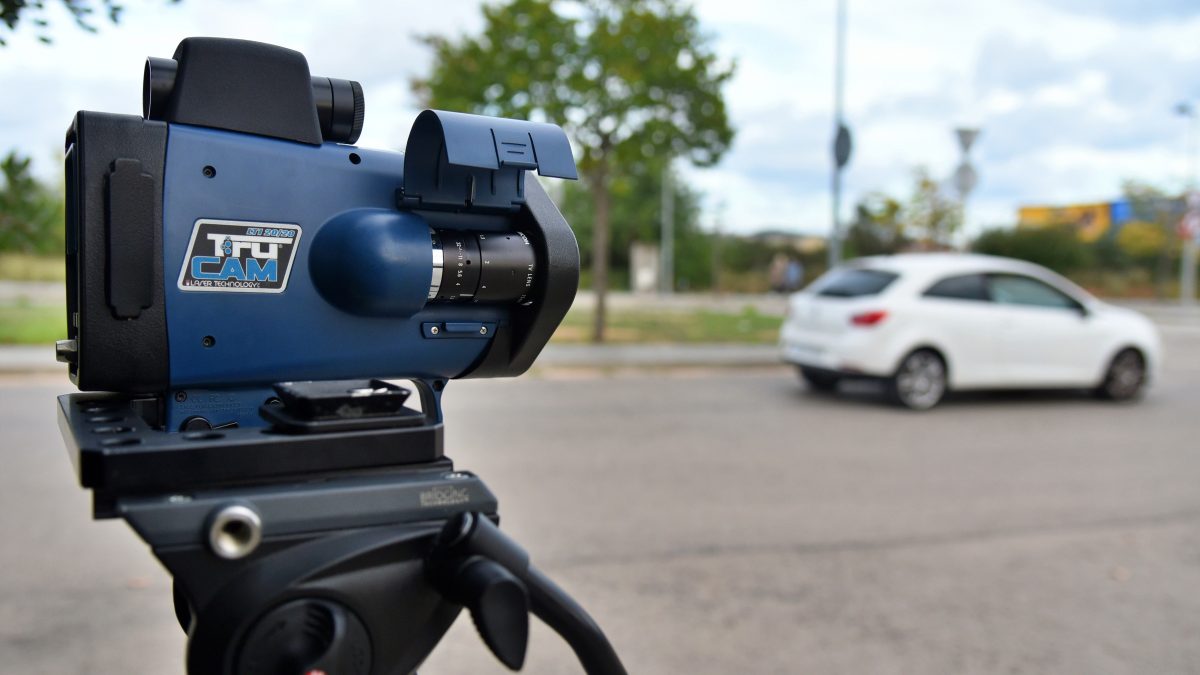
The news of the Navarra radar that fined 57,961 drivers in 2025 is often read as a record number of penalties or a debate about revenue collection. But we must listen to the urgent message hidden in that data: it is the alarm cry from a specific kilometer point where the physics and geometry of the road conspire against carelessness.
Each of those tens of thousands of detections is not just an administrative offense; it is technological proof of an ignored risk, of a disregarded traffic sign. Far from being a “trap,” this device is the relentless witness to a real and present danger.
As a driver, I start from a fundamental basis: vertical and horizontal signage is the materialization on the road of a rigorous traffic engineering study. Specialists do not set a speed limit on a whim, but after analyzing curvature, slope, visibility, and historical accident rates.
Section 128 of the A-15 in Navarra, with its steep descent towards the Leitzaran valley, is the perfect example: a slope that silently and treacherously accelerates vehicles. The limit there is not a suggestion; it is the calculated speed to maintain control.
Therefore, the extremely high number of fines—an average of nearly 160 per day—does not speak of a revenue-raising zeal, but of a collective failure in attention and respect for that lifesaving technical design.
Many of those penalized will claim they didn’t notice, that it was a lapse, or that they were carried away by inertia. However, precisely in such a complex section, a “lapse” is the prelude to an accident. Driving demands active vigilance, and obeying the limit on a dangerous slope is not optional; it is an ethical imperative toward oneself and others.
These fines, in essence, are meant to save lives. They are the pedagogical—and sometimes painful—consequence of crossing a safety line. The radar acts as an ironclad reminder: at that specific point, exceeding the set speed exponentially increases the probability of losing control, especially when the road curves and gravity pushes. It is not speed that is fined; it is the violation of a threshold that separates safe driving from imminent risk.
Public debate often swings between safety and revenue, but that dichotomy is misleading. The real question posed by these 58,000 detections is: why, despite the signage and the notoriety of the spot, do so many drivers fail to comply?
The answer lies not in the radar’s severity, but in the relaxation of our driving culture. Road prevention is not an abstract concept; it is the concrete act of lifting your foot off the accelerator when you see a restrictive sign on a steep descent.
In short, the story told by Spain’s most active radar is not one of persecuting drivers, but of protection. It is a lesson written in numbers: trusting and obeying signage, especially in the most delicate sections, is the only infallible life insurance.
Engineering warns us, the rule protects us, and technology corrects us. Our part of the pact, as road users, is simply to obey. Because on the road, the knowledge of experts must translate into everyone’s responsibility. Complying with what is established is, ultimately, the most rational and solidary decision we can make.
Have any thoughts?
Share your reaction or leave a quick response — we’d love to hear what you think!
-
 0
0
-
 0
0
-
 0
0
-
 0
0
-
 0
0
