
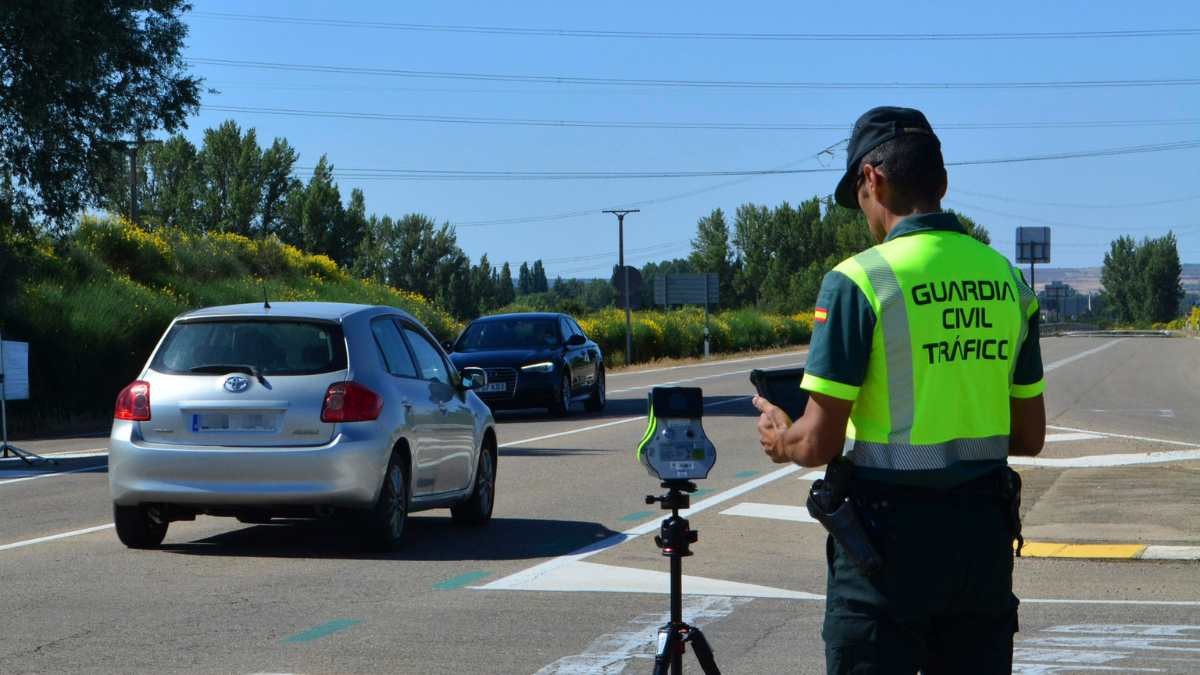
There was a time when the strident sound of a whistle and the energetic arm of an agent on the sidewalk were the embodiment of traffic control. It was a direct, human, and almost artisanal supervision. That era is now obsolete, buried by a technological revolution that has transformed the road into a space of permanent digital surveillance. The journey from that manual gesture to the automated notification that arrives by certified mail reflects a fully computerized society, where a driver’s error is detected, processed, and penalized with impeccable coldness and efficiency.
Today, the landscape of Spanish roads is dotted with electronic eyes whose precision is indisputable. Speed cameras, whether fixed or mobile, have become more sophisticated, but it is the average speed camera (section control) that represents the greatest qualitative leap. This system is not limited to capturing a single speed reading but calculates the average over a segment, eliminating the possibility of evasive braking and ensuring that sustained reckless driving is penalized. The fine, with its photographs and data, travels automatically from the DGT’s server to the offender’s mailbox, in a process that minimizes human intervention and maximizes certainty.
This control architecture is not limited to the ground. The General Directorate of Traffic (DGT) has deployed a multimodal strategy that includes aerial surveillance. Helicopters equipped with speed guns and drones, deployed especially on secondary and rural roads where a driver might feel less observed, expand the field of action. These tools make it possible to capture infractions from a long distance and record risky behaviors, such as using a mobile phone or failing to maintain a safe distance, demonstrating that the concept of a “surprise control” has literally reached a new, vertical dimension.
Faced with this road “Big Brother,” technology also presents itself as an ally for the prudent driver. Modern vehicles integrate driver assistance systems such as speed limiters, adaptive cruise control, and automatic traffic sign recognition. These tools not only facilitate compliance with limits but also represent a paradigm shift: artificial intelligence at the service of prevention, complementing the punitive work of speed cameras with proactive assistance that seeks to prevent the infraction before it is committed.
In this ecosystem of total control, the driver’s responsibility is redefined. Planning the journey, using apps that alert about speed cameras, and, above all, maintaining a speed adapted to the circumstances, ceases to be a mere recommendation to become the only viable strategy. The exhaustive network of the DGT, which spans from the asphalt to the air, has a clear objective: to deter. The message is that the road no longer has blind spots, and that haste or recklessness has a sure and almost immediate price.
In conclusion, the evolution of speed control in Spain and Europe is the story of technification in the service of an unquestionable principle: safety. These systems are not mere automatic revenue collectors but the instruments of a policy that prioritizes life. Respecting the limits, aided by the technology integrated into our cars, transcends the mere act of avoiding a penalty. It is an act of civility and shared responsibility in a public space that, now more than ever, watches over us to protect us. Driving prudently is the only intelligent response to an environment that has learned to see everything.
Have any thoughts?
Share your reaction or leave a quick response — we’d love to hear what you think!
-
 0
0
-
 0
0
-
 0
0
-
 0
0
-
 0
0
