
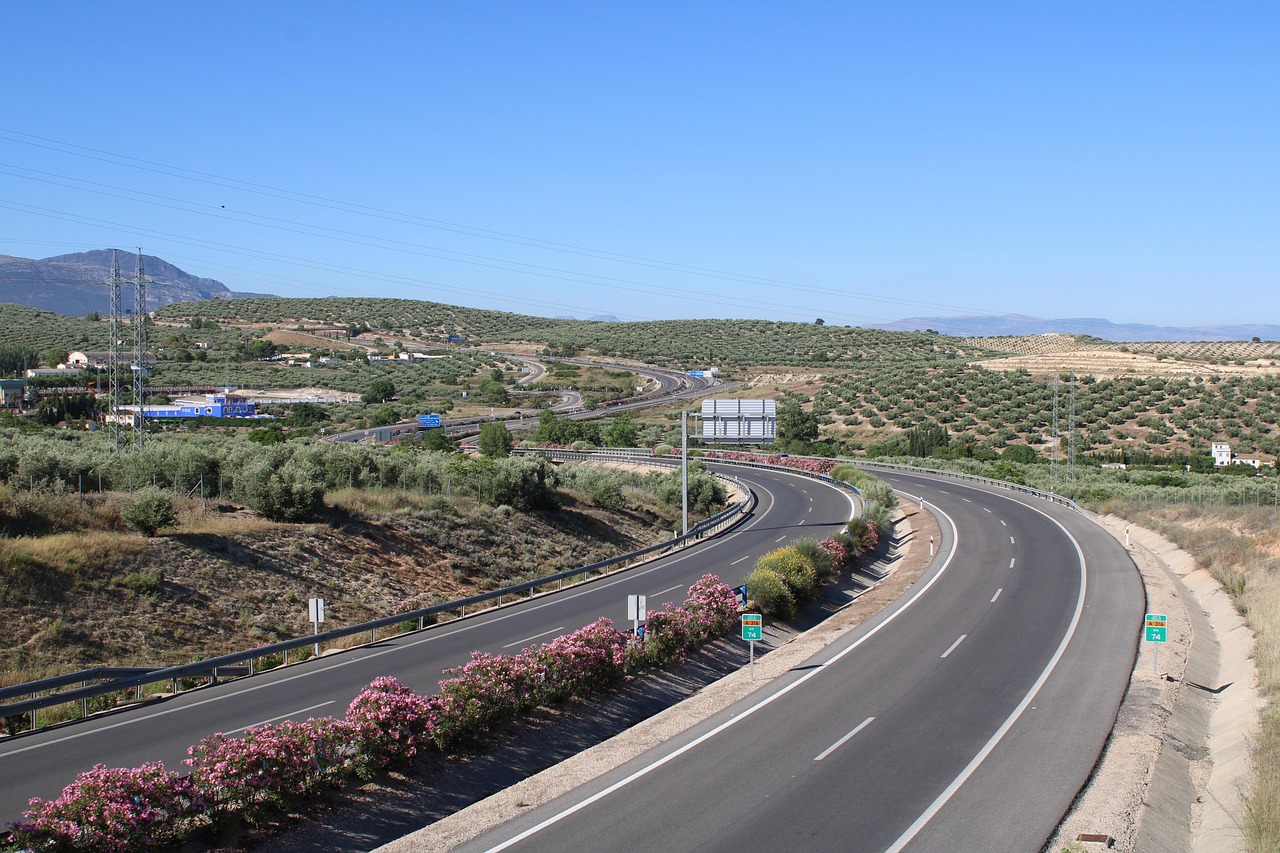
Knowing the State Road Network is essential for anyone traveling around Spain. Six radial motorways, identified by the letter “A” followed by a number (from 1 to 6), radiate from Madrid like the spokes of a wheel, connecting the capital with the far reaches of the peninsula and its coasts.
The nomenclature is intuitive: the A-1 heads north, the A-2 northeast, the A-3 east, the A-4 south, the A-5 southwest, and the A-6 northwest. Together, this network spans several thousand kilometers, consisting of high-capacity motorways that form the backbone of road transport in the country.
The quality of these roads is, as a rule, excellent. They are dual carriageways, with two or three lanes per direction, separated by central reservations and equipped with the most modern safety measures. Their pavement is made of concrete or high-performance asphalt, ensuring a stable and low-noise ride. These infrastructures are managed and maintained directly by the Government of Spain through the Ministry of Transport, Mobility and Urban Agenda, ensuring uniform standards across the entire network.
One of the most common questions is about tolls. While historically some of these routes had toll sections, currently the vast majority of these sections are free. There are notable exceptions, such as the AP-6 (the toll variant of the A-6 at the Guadarrama Pass), but travel on the radial motorways with the “A-” nomenclature is free of direct tolls.
The regulated maximum speed is 120 km/h, a limit that must be scrupulously respected, as surveillance is constant via fixed and mobile cameras operated by the Guardia Civil Traffic Unit, the body responsible for traffic safety on these arteries.
For the professional driver, these roads are their primary tool. The signage, on blue and green panels, is clear and uniform, indicating services, rest areas (many of them with full services for trucks), and exits.
Route planning is simple thanks to this radial design: from any point, it is enough to head towards Madrid to, from the M-40 or M-50 (the capital’s ring roads), connect with the radial road that leads to the final destination, avoiding in most cases entering the urban center.
For the tourist discovering Spain by road, these routes offer a journey through an astonishingly diverse geography. The A-4, the Southern Motorway, descends from the plains of La Mancha to the lush landscapes of Andalusia. The A-7, although not a pure radial, acts as a toll motorway parallel to the Mediterranean coast, complementing the A-3. The A-1 winds its way towards the green landscapes of the Basque Country, and the A-6 challenges the mountains of the Cantabrian Range towards Galicia. Every kilometer tells a different story of the Spanish landscape.
In conclusion, whether for business or pleasure, mastering the Spanish radial road system is the key to efficient and safe mobility. Its design, maintenance, and signage make it one of the best networks in Europe. For the driver, the recommendation is simple: plan the route, respect the rules, and enjoy the journey through an infrastructure that has been crucial for the connection and development of every corner of Spain.
Have any thoughts?
Share your reaction or leave a quick response — we’d love to hear what you think!
-
 0
0
-
 0
0
-
 0
0
-
 0
0
-
 0
0
