
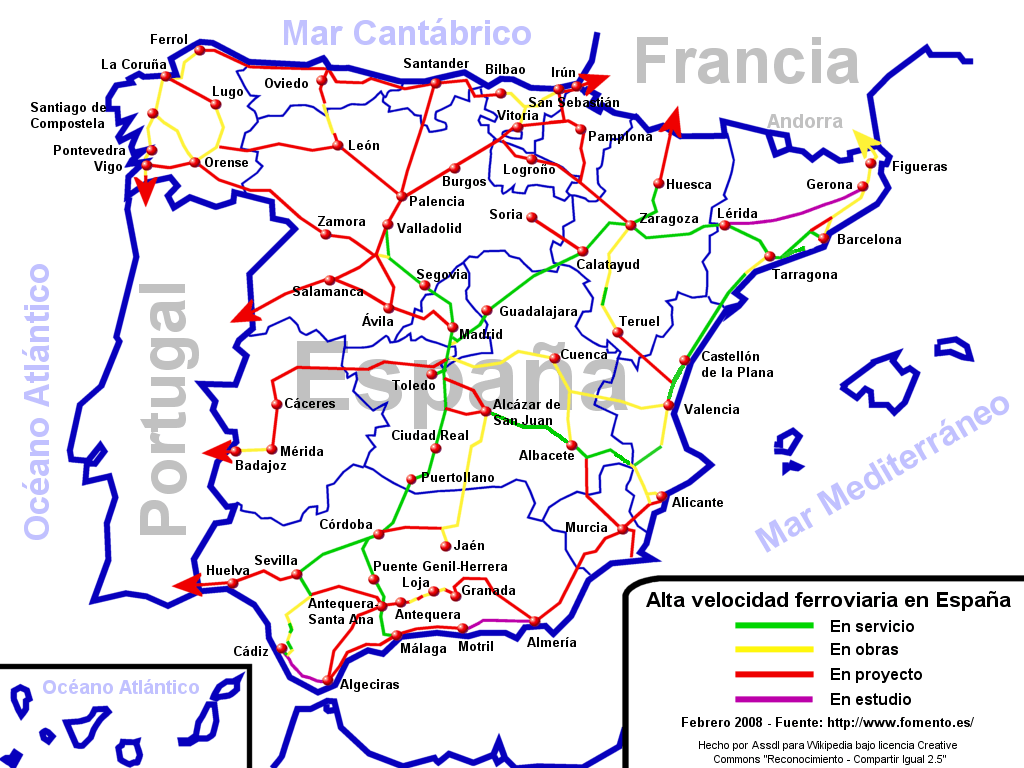
The Spanish road network, with its 165,705 total kilometres, constitutes one of the most extensive and vital infrastructures in Europe. As of the end of 2024, this network is structured into three clearly defined levels: the State Road Network (Red de Carreteras del Estado – RCE), with 26,525 km managed by the Ministry of Transport, which handles most of the traffic; the regional networks, with 71,251 km; and the provincial networks (diputacionales), with 67,980 km. This hierarchical structure guarantees an efficient distribution of competencies and resources, with the RCE being the main skeleton supporting over half of the total traffic and almost all heavy goods transport.
The origin of this system dates back to the 18th century with the first road plans, but its true modern transformation began in the second half of the 20th century. The turning point was the approval of the 1962 General Road Plan, which laid the groundwork for the massive construction of highways and motorways. However, the fundamental design is even older: the radial concept, with Madrid as the epicentre of all main roads, was devised in the 18th century by King Felipe V and materialized with the General Road Map of 1775. This historic design still shapes the appearance of the current state network.
Spain’s main roads are named and distributed following this radial scheme. From the Puerta del Sol in Madrid, the six RCE highways and motorways that form the cardinal axes depart: the A-1 (North, towards Burgos, the Basque Country and France), the A-2 (Northeast, towards Zaragoza, Barcelona and Catalonia), the A-3 (East, towards Valencia and the Valencian Community), the A-4 (South, towards Córdoba, Seville and Andalusia), the A-5 (Southwest, towards Badajoz and Portugal) and the A-6 (Northwest, towards A Coruña and Galicia). To these, important transverse axes are added, such as the AP-7 (Mediterranean Motorway) or the A-49 (link with Portugal via Huelva), which complement and densify the network.
This design is not just a historical legacy, but a fundamental economic tool. As infrastructure experts from the College of Civil Engineers point out, “the high-capacity radial network was, in its day, a successful project of territorial cohesion that allowed the integration of regional markets with the capital.” This distribution has been crucial for developing trade and communication within the peninsula, facilitating the flow of goods and people from the centre to the main peripheral economic and logistical hubs.
Beyond the state roads, the secondary network managed by the autonomous communities (71,251 km) weaves a capillary mesh that structures the inland territory and connects provincial capitals with their areas of influence. Meanwhile, the 67,980 km of provincial roads ensure accessibility to the smallest municipalities, fulfilling a social function and fighting depopulation. Together, they form an integrated system that, despite its management complexity, has proven to be robust.
A follow-up conversation will be needed to analyse in depth an equally crucial aspect: the quality of the roadways. The evolution of pavement, safety systems, and the maintenance of this extensive network are an indispensable line item that determines not only transport efficiency but also the safety of the millions of users who daily depend on this backbone for their economic and personal activities.
Have any thoughts?
Share your reaction or leave a quick response — we’d love to hear what you think!
-
 0
0
-
 0
0
-
 0
0
-
 0
0
-
 0
0
