
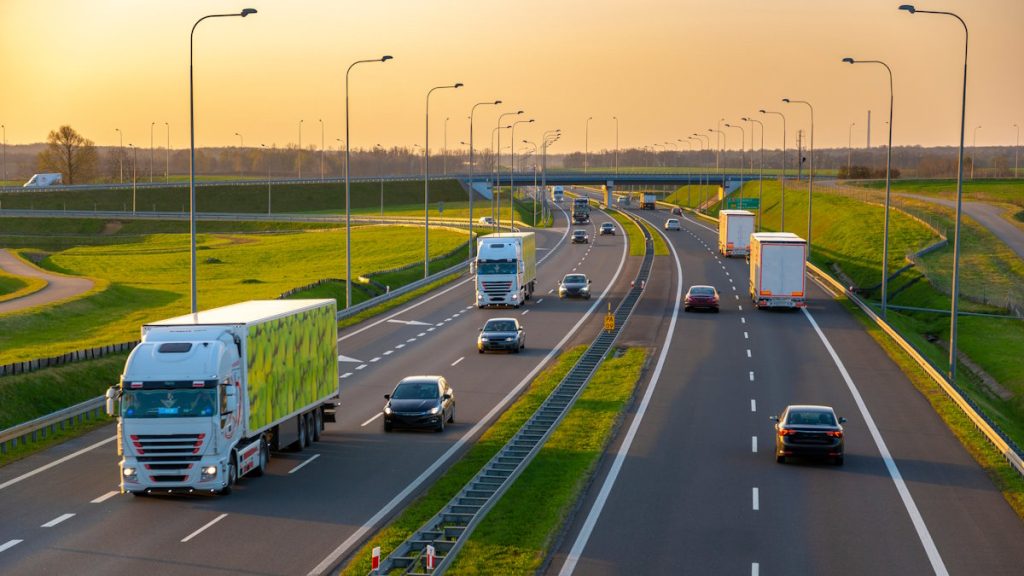
Poland has established itself as an indispensable logistics power on the European map. Its central location, acting as a bridge between the countries of the European Union and the East, is its greatest asset.
This geostrategic position has turned the country into a natural highway for trade, with roads, railways, and multimodal corridors channeling a constant flow of goods. The ever-expanding motorway network and the modernization of the railways, funded with European money, have shortened transit times and increased capacity, attracting massive investments from global logistics giants.
The landscape on the outskirts of cities like Warsaw, Łódź, Poznań, or Wrocław is being shaped by an unprecedented phenomenon: the warehouse “boom.”
Immense logistics parks, some of the most modern in Europe, are emerging to meet the demand of e-commerce and the need for resilient supply chains. These are not simple storage sheds; they are sophisticated distribution centers that prioritize sustainability, with green certifications, solar panels, and advanced energy management systems, responding to a new environmental awareness in the industry.
Inside these warehouses, a quiet revolution is underway. Poland is a testing and adoption ground for the latest automation technologies. Autonomous mobile robots (AMR/AGV) for order picking, software-driven mobile shelving, robotic arms for palletizing, and drones for inventory are transforming operations. This implementation seeks not only efficiency and error reduction but also to alleviate the shortage of labor in a tight job market, creating safer and more technical work environments.
Beyond the warehouse walls, digitalization is the main protagonist. Polish companies are integrating state-of-the-art Warehouse Management Systems (WMS) and Transportation Management Systems (TMS) that offer unprecedented real-time visibility.
Blockchain technology is beginning to be explored to guarantee the traceability and security of goods, while Big Data analyzes consumption patterns to optimize routes and stock levels. This digital layer turns data into the most valuable asset, enabling predictive, and not just reactive, logistics.
Although road transport remains dominant, Poland is strongly promoting rail freight, especially for international traffic. Intermodality – the efficient combination of train, truck, and ship – is a key piece in its strategy to decongest roads and reduce the carbon footprint. The modernization of interchange hubs and investment in intermodal terminals are making rail a faster and more competitive option for long distances, reinforcing its role as an East-West corridor.
The path is not without challenges. Congestion on some road axes and the need for further digitalization in border procedures are pending issues. However, Poland looks to the future with ambition. The focus is now on consolidating an intelligent and green logistics sector: fleets of electric vehicles, alternative fuels, and the full integration of Artificial Intelligence in supply chain management.
In short, Poland is no longer just a transit center; it is a first-class logistics hub that is writing, with technology and innovation, its role in the future of European trade.
Have any thoughts?
Share your reaction or leave a quick response — we’d love to hear what you think!
-
 0
0
-
 0
0
-
 0
0
-
 0
0
-
 0
0
