
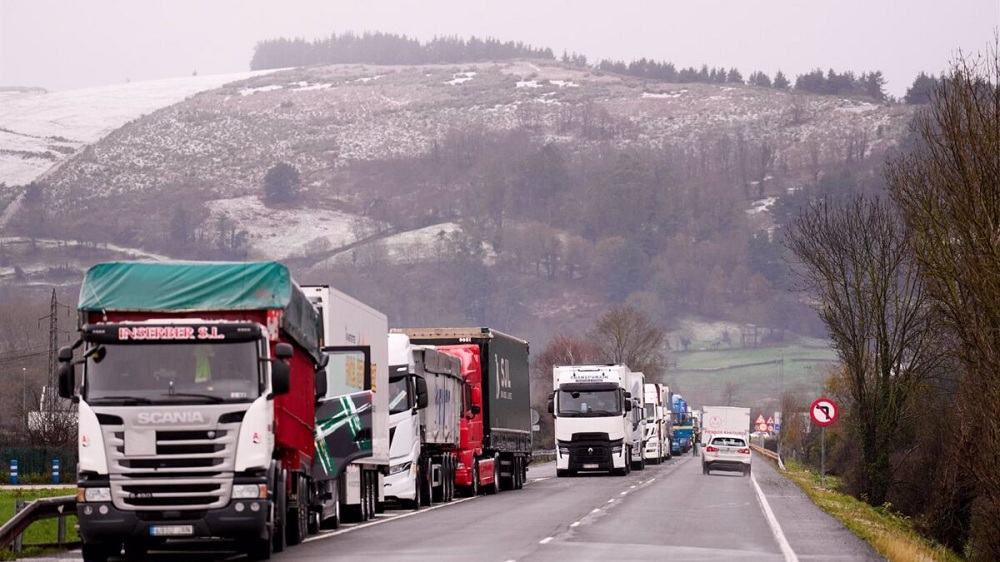
In the heart of winter, the situation of professional drivers in Spain highlights a worrying lack of dignified infrastructure for rest.
As low temperatures and storms like “Joseph” lash the peninsula, hauliers are faced with a network of parking lots that does not meet basic human needs.
Although the Ministry of Transport has enabled 37 emergency areas for winter viability with capacity for more than 11,670 heavy vehicles, these spaces lack the minimum essential services such as toilets, showers or heating, becoming mere “cold parking lots” where drivers are trapped for hours without being able to attend to their physiological needs or rest in decent conditions.
The problem, widely denounced by specialized publications such as Autónomos en Ruta and the CETM employers’ association, is aggravated by the fact that these emergency parking lots were originally conceived only to remove trucks from circulation in the event of snowfalls, not as overnight places. However, the reality is that administrative traffic restrictions, added to the storms, force drivers to remain at these points for whole days in the middle of winter, exposed to the cold and damp.
This situation contrasts radically with European quality standards (SSTPA certification), which require conditioned rest areas, gender-separated services and an internet connection, conditions that are conspicuously absent in practically all of these Spanish spaces.
In parallel, the traditional rest area network in Spain is undergoing a process of progressive deterioration. The closure of roadside restaurants, the degradation of public areas historically used for parking, and growing restrictions in urban environments have drastically reduced the options available to hauliers. This shortage, insistently denounced by the CETM, not only affects the driver’s quality of life, but also increases fatigue at the wheel, stress and exposure to cargo theft, creating an explosive cocktail for road safety on the freezing roads of the north of the peninsula.
The Government, aware of the challenge, has recently met with autonomous communities to promote a plan that complies with European regulations, which require a safe parking area every 150 kilometers on the basic network by 2040. However, haulier organizations criticize that, for now, the process is advancing without their direct participation, which they consider a mistake, as they are the ones who best know the real needs on the ground. While bureaucracy advances, drivers continue to face a winter for which current infrastructure is unprepared, highlighting an urgent need for modernization and humanization of rest areas.
Have any thoughts?
Share your reaction or leave a quick response — we’d love to hear what you think!
-
 0
0
-
 0
0
-
 0
0
-
 0
0
-
 0
0
