
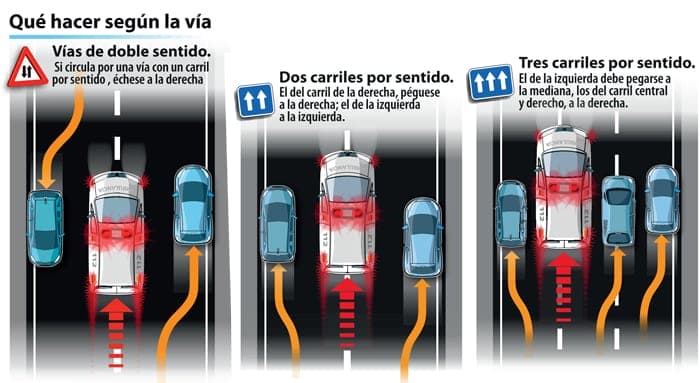
The emergency corridor, also known as the “corridor effect” or “emergency lane,” is a road safety procedure that saves lives by allowing the rapid passage of ambulances, firefighters, and police on congested roads. Its origin, regulation, and effectiveness are well documented in several European countries, with Germany being the pioneer in its modern implementation during the 1970s.
This practice, which initially emerged as an empirical response from drivers upon hearing sirens, has been formalized in the traffic laws of numerous nations, transforming into a civic duty with a quantifiable impact on the survival of accident victims.
The origin of this measure is in Central Europe, specifically in Germany and Austria, where the behavior of drivers who intuitively moved aside to create a central passage began to be observed and then regulated.
The need to speed up the response time of emergency services during the “Golden Hour” (the first 60 minutes after an accident, crucial for survival) prompted authorities to study and standardize this behavior.
The underlying philosophy is simple but vital: on a highway with traffic jams, vehicles in the left lane move to their left and vehicles in the other lanes move to their right, opening up a free space between the left lane and the one next to it for the exclusive passage of priority vehicles.
The legal implementation of the emergency corridor varies by country, generally being established by national traffic authorities or through specific laws. For example, in Poland, the Council of Ministers introduced this obligation into its Road Traffic Law as part of its National Road Safety Program. In Spain, the Directorate General of Traffic (DGT) has announced that it will make it mandatory in the upcoming reform of the General Traffic Regulations, scheduled for 2026, detailing in its article 32 the obligation for drivers to “move to the sides” on dual carriageways and highways when driving at walking pace or stopped. Organizations like the RACE have also played a crucial role in promoting this measure, based on studies that demonstrate its effectiveness.
The effectiveness of emergency corridors is amply demonstrated, being the main reason for their widespread adoption in a dozen European countries such as Germany, Austria, Switzerland, the Czech Republic, and Slovenia. Their success is measured in time and, more importantly, in lives saved. Studies indicate that reducing the arrival time of emergency services has a direct impact on survival. It is estimated that an ambulance arriving just four minutes earlier at the scene of an accident can increase the chances of survival for a seriously injured victim by up to 40%, as it allows action to be taken within the crucial “Golden Hour.”
An example of its positive outcome is the interactive campaign launched by the Polish government to educate drivers on how to correctly create this space, thereby facilitating the work of rescue services and helping to reduce road mortality.
The measure not only speeds up the arrival of help but also facilitates the evacuation of the injured and the restoration of traffic flow, minimizing obstacles for emergency professionals who would otherwise lose valuable seconds maneuvering between immobilized vehicles.
Finally, technological evolution promises to further reinforce the effectiveness of these corridors. The DGT in Spain plans to implement, starting this year 2026, an early warning system through its DGT 3.0 platform. Since emergency vehicles are geolocated, their management centers will be able to share this information in real-time so that drivers approaching a traffic jam receive an alert in their vehicles or on their devices. This “connectivity” will allow motorists to prepare in advance to form the corridor, even before hearing the sirens, thus optimizing a maneuver that, as international experience shows, has already proven to be a resounding success in improving road safety.
Have any thoughts?
Share your reaction or leave a quick response — we’d love to hear what you think!
-
 0
0
-
 0
0
-
 0
0
-
 0
0
-
 0
0
