
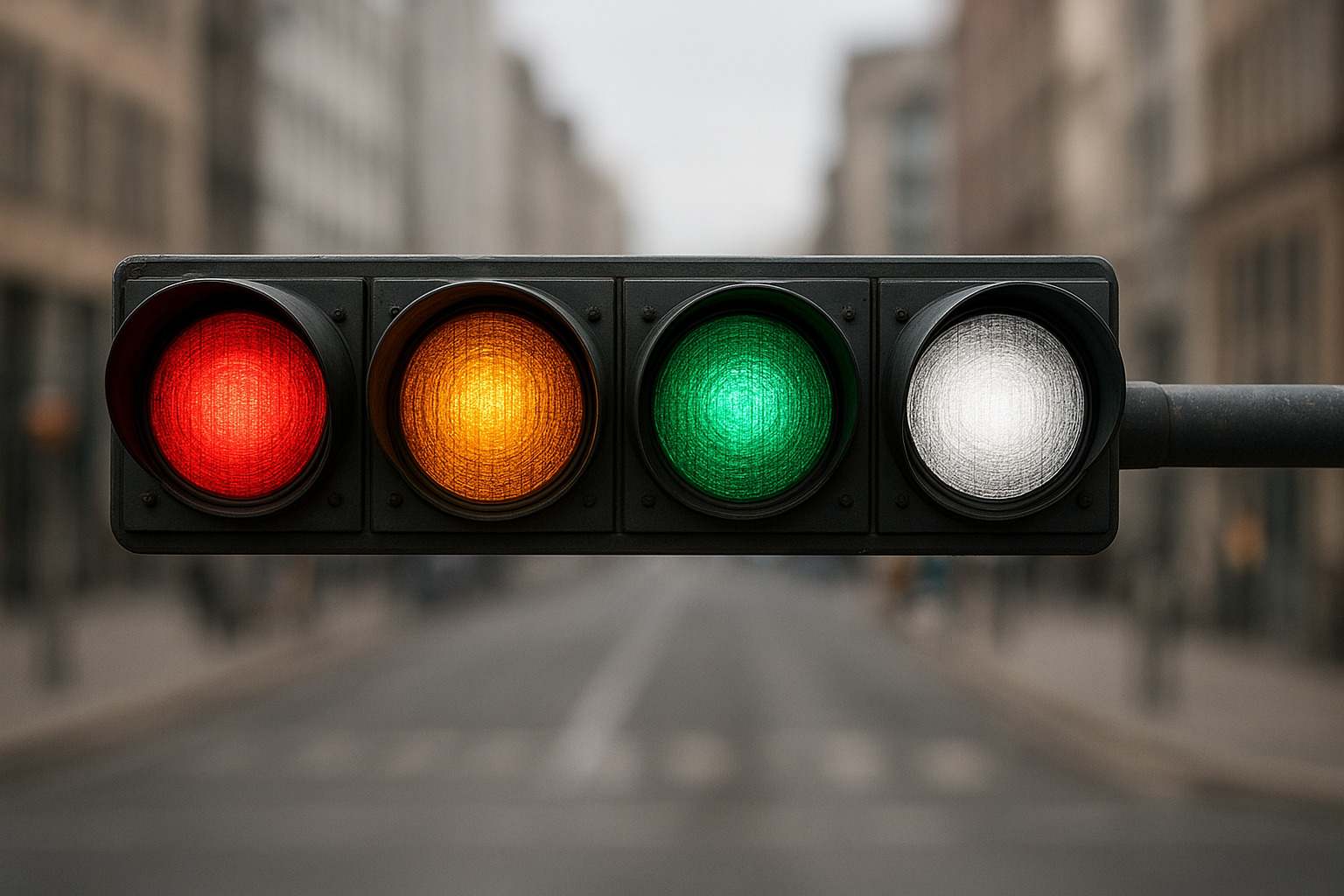
The traffic light, that silent guardian that orders the chaos of urban intersections, has a more explosive and fascinating history than most imagine. Its origin dates back to London in 1868, when railway engineer John Peake Knight installed the first device near the Palace of Westminster. That pioneer, however, was far from being the electrical apparatus we know today. It was a manual system of rotating arms that, for its night-time operation, used red and green gas lamps. The experience lasted barely a month: on January 2, 1869, the device exploded, seriously injuring the policeman operating it, which temporarily forced the idea to be abandoned.
It was not until the rise of the automobile, particularly with the mass production of the Ford Model T in the United States, that the need to regulate traffic became imperative. In 1912, police officer Lester Wire installed a prototype in Salt Lake City with red and green electric lights, although it was still manual. The great qualitative leap came in 1920, by the hand of another policeman, William Potts in Detroit, who added the yellow or amber light to warn of the imminent change of light, thus creating the three-color pattern. However, the one who took popular credit and the patent in 1923 was Garrett Morgan, an African American inventor who, after witnessing a serious accident, designed and patented a three-position system that included a “caution” signal, an invention that today saves countless lives at every crossing in the world.
The information provided by its lights constitutes a universal and vital language for road coexistence. The non-flashing red light is the most imperative order: it strictly prohibits passage, forcing vehicles to stop before the safety line. The green light, for its part, authorizes priority movement, although without exempting the driver from maintaining caution. The yellow or amber light, in its fixed form, is a crucial warning that announces the change to red, indicating that vehicles must stop unless they are so close to the intersection that they cannot do so safely. There are also variants, such as the flashing yellow light, which requires extreme caution and yielding the right of way, or the flashing red light, used at level crossings for a temporary prohibition. For pedestrians, the figures of a stationary pedestrian (red) or a walking one (green) serve the same function, protecting their passage.
Complying with what these lights “agree upon” is not a mere suggestion, but the fundamental pillar on which everyone’s safety rests. Obeying the signals significantly reduces the risk of collisions, which tend to be concentrated at intersections. By assigning clear and predictable turns, traffic lights transform a potential conflict point into an orderly space where vehicles, pedestrians, and cyclists converge. Their importance transcends mere fluidity; by avoiding unnecessary stops and starts, they help reduce fuel consumption and pollutant emissions, and they are a vital tool for giving priority to emergency services in their work.
However, the evolution of the traffic light has not stopped. In various parts of the world, with an eye on Europe, new lights and devices are being added with very specific objectives. On the one hand, researchers from North Carolina State University propose the incorporation of a fourth white light. This would not be directed at human drivers, but at autonomous vehicles, which could communicate with the traffic light to coordinate their movements, optimize traffic flow, and reduce congestion by up to 94% in high-density scenarios. On the other hand, and more tangibly, several European cities such as those in the Netherlands, Belgium, and Germany, as well as Spanish towns like Elche or Sant Cugat, have installed LED strips on the pavement at the edge of sidewalks. These lights, synchronized with the conventional traffic light, seek to attract the attention of pedestrians who cross the streets with their eyes fixed on their mobile phones, offering a second chance to perceive the signal.
The applicability of these innovations to the rest of the urban cities, particularly in Europe, is not only probable but is already an incipient reality. The LED ground strips are a low-cost, easy-to-implement solution that is spreading rapidly as a response to a modern and widespread behavioral problem: mobile phone distraction. As for the fourth white light for autonomous vehicles, although its mass adoption depends on a greater penetration of this technology and the harmonization of regulations, the old continent is already moving in that direction. Cities in Germany, France, and Spain are testing smart traffic lights with sensors that adapt to real-time flow, reducing jams and emissions. These systems “talk” to vehicles and lay the foundations for the future integration of a specific signal for autonomous driving. Thus, the traffic light, which was born with gas and exploded, is heading towards becoming a wireless communication node, demonstrating that its capacity to adapt to the times is as necessary as the invention of the yellow light was a century ago.
Have any thoughts?
Share your reaction or leave a quick response — we’d love to hear what you think!
-
 0
0
-
 0
0
-
 0
0
-
 0
0
-
 0
0
